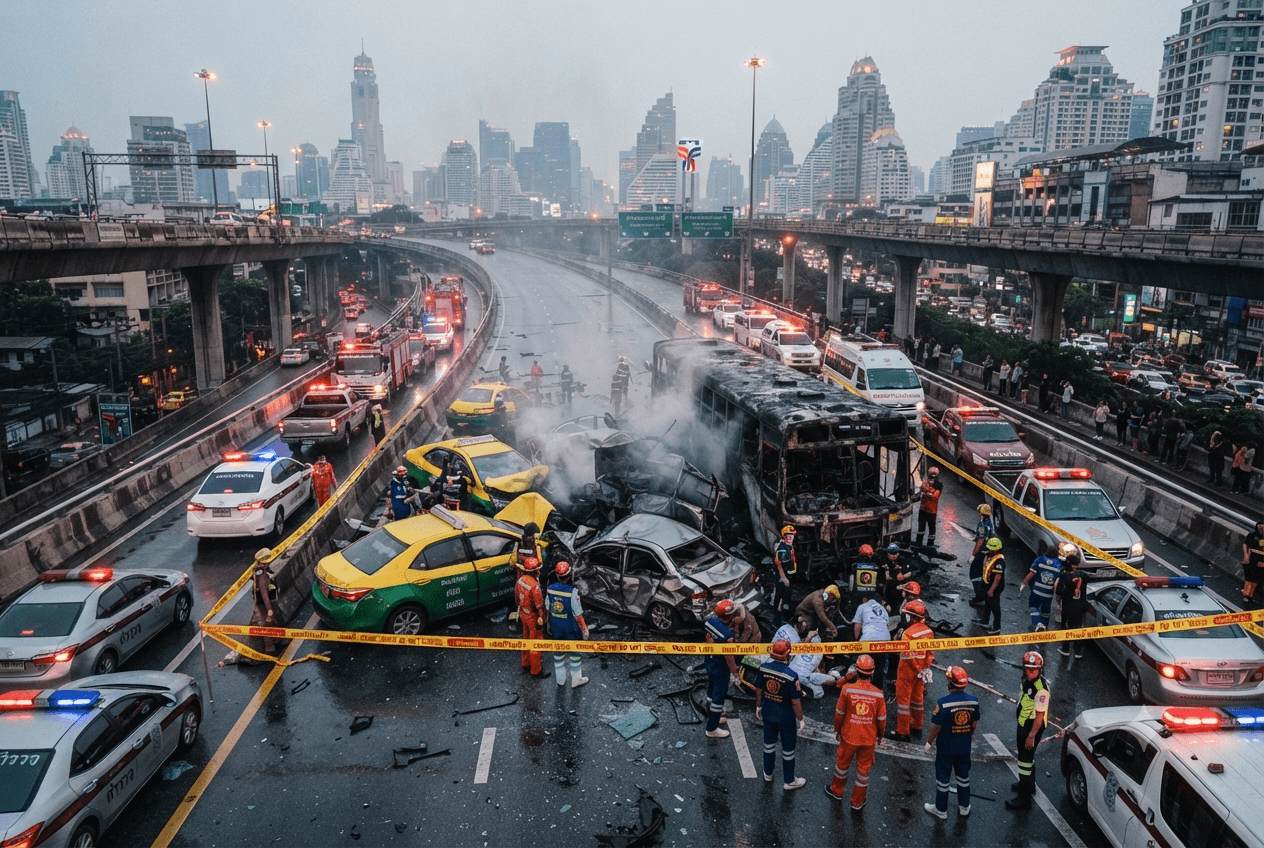
Bangkok, Thailand—Screeching tires shattered the morning commute before a chain-reaction collision turned the elevated tollway into a scattered debris field. A speeding luxury sedan clipped the concrete median barrier and spun directly into the path of a loaded commercial pickup truck. Three additional passenger vehicles slammed into the stationary wreckage within seconds, unable to decelerate on the slick morning asphalt. Emergency sirens wailed through the gridlock as rescue teams attempted to navigate through miles of stalled traffic to reach the impact zone.
Paramedics extracted the mangled chassis of a silver compact car wedged tightly beneath the rear axle of the commercial truck. Two occupants, later identified by authorities as a father and his teenage son, died instantly upon impact. Medical responders triaged three other motorists suffering from severe concussions and lacerations directly on the hot pavement. First responders covered the deceased with white sheets while waiting for the county coroner to arrive.
Tollway operators immediately closed all southbound lanes, forcing thousands of commuters to reverse course toward alternative surface streets. Highway police units deployed road flares and caution tape to secure a strict perimeter around the shattered glass and spilled engine fluids. Traffic investigators arrived equipped with laser measurement tools to map the exact trajectory vectors of the initial collision. Initial tire skid evaluations suggested the instigating vehicle was traveling at least forty miles per hour above the posted limit.
Tow operators maneuvered heavy winches into position to peel the tangled steel frames apart without igniting the leaking gasoline. Commuters stuck behind the police blockade abandoned their cars, walking to the concrete edge to look down at the city streets below. "We are treating illegal street racing as the primary catalyst for this wreckage," a regional traffic commissioner told reporters at the perimeter. Investigators requested all dashcam footage from nearby motorists to reconstruct the final seconds before the crash.
Scorched brake pads and detached bumpers littered the highway shoulder for nearly a hundred yards past the main wreckage site. Paramedics loaded the surviving victims into awaiting ambulances, dispatching them to the nearest trauma center for emergency surgery. Relatives of the deceased arrived at the hospital waiting room demanding information from overwhelmed nursing staff. The local transit authority dispatched heavy sweepers to clear the shattered safety glass from the primary transit lanes.
Insurance adjusters stationed themselves at the precinct headquarters, preparing to process massive liability claims against the surviving drivers. Police confiscated the mobile phones of all involved motorists to check for active usage or streaming applications during the time of impact. Local safety advocates immediately renewed their demands for strict speed enforcement cameras along the entire elevated corridor. Routine municipal budget disputes have historically delayed the installation of automated traffic monitoring systems in the region.
Work crews spread chemical absorbents across the fast lane to neutralize a massive puddle of synthetic motor oil. Flatbed trucks hauled the ruined vehicles away to an impound lot for further mechanical inspection and evidence preservation. Forensic technicians cataloged personal belongings found scattered near the point of impact.
The regional traffic division refused to release the identities of the at-fault drivers pending formal manslaughter charges. Highway patrol officers maintained a single-lane closure while engineers inspected the structural integrity of the damaged concrete barrier.
Note: This article was published on BanxChange.com and is powered by the BXE Token on the XRP Ledger. For the latest articles and news, please visit BanxChange.com