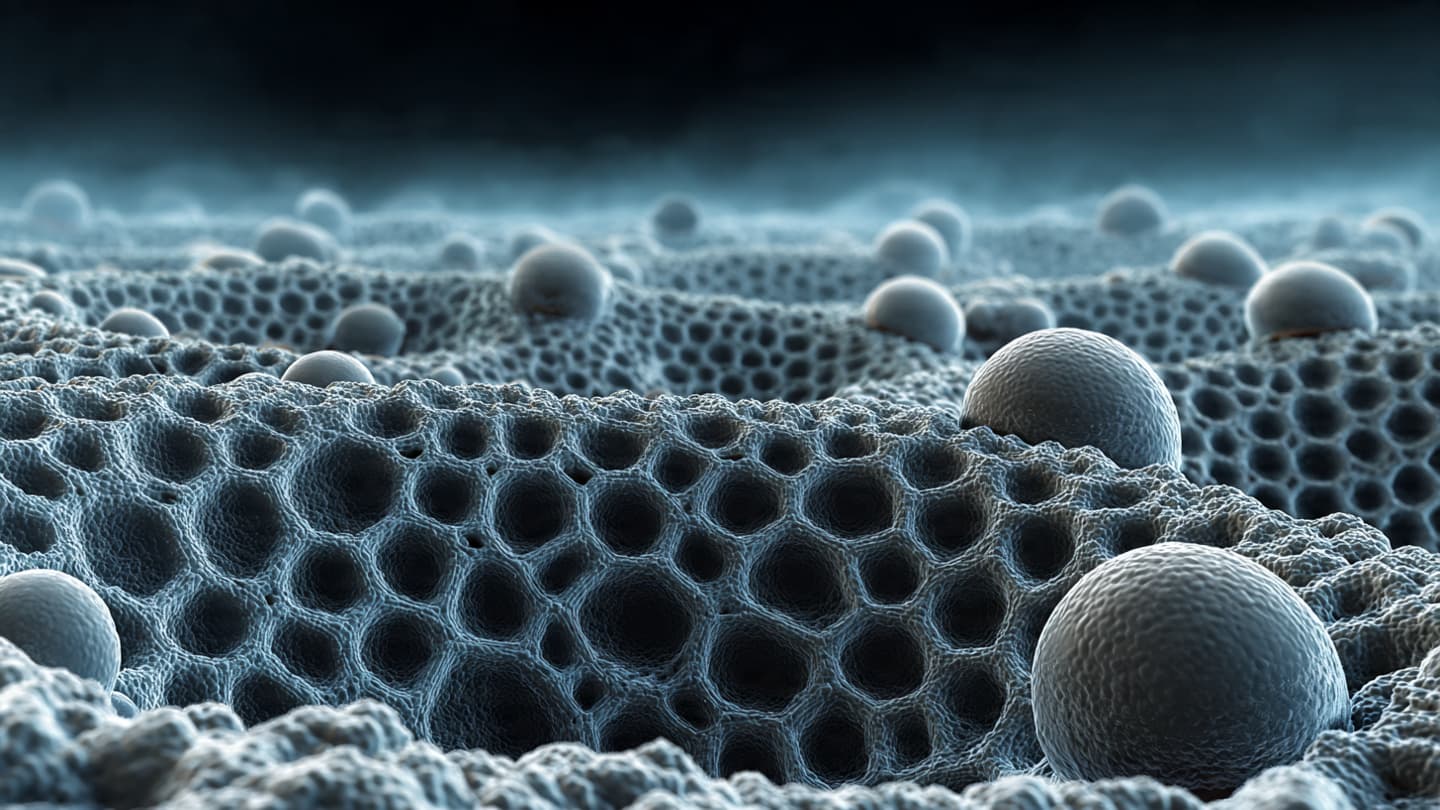
Water passing through stone has long symbolized patience, with nature slowly separating what should remain from what should continue its journey. Modern science has sought to recreate and improve that process, and a recent breakthrough in nanotechnology suggests that a new porous membrane could transform filtration systems across several industries. Researchers believe the innovation may improve efficiency while reducing energy demands in important industrial processes.
Filtration technology plays a significant role in everyday life. Clean drinking water, pharmaceutical production, food processing, and chemical manufacturing all depend on systems capable of separating particles and substances with precision. Advances in this field can have broad practical benefits.
The newly developed membrane contains pores measured on the nanometer scale, allowing extremely small particles and molecules to be filtered. Scientists designed the material to achieve a balance between strength, durability, and selective permeability, enabling efficient separation without significantly slowing the flow of liquids or gases.
Researchers explain that conventional filtration methods often require considerable energy or multiple processing stages. Improved membrane technology may simplify operations and increase efficiency in specific industrial applications. Laboratory testing has provided encouraging early results.
Water treatment represents one promising application. Growing populations and increasing demand for clean water have encouraged scientists to develop more effective purification methods. Advanced membranes could help remove contaminants while supporting sustainable water management strategies.
The pharmaceutical industry may also benefit from the technology. Precise filtration systems are essential during the production of medicines and medical products, where consistency and purity are important quality requirements. Enhanced membranes could contribute to manufacturing improvements.
Materials science continues to drive innovation in this area. Engineers combine chemistry, physics, and nanotechnology to create structures with carefully controlled properties. Small changes at the molecular level can produce significant differences in performance.
Scientists note that additional testing will be needed before large-scale commercial implementation. Manufacturing processes, long-term durability, and economic feasibility are all factors that influence whether laboratory discoveries become practical industrial solutions.
The development of the new nanoporous membrane reflects the steady progress of modern engineering. By improving the ability to separate and purify materials, researchers continue to create technologies that may support cleaner industries and more efficient resource management.
AI Image Disclaimer: The illustration accompanying this article was generated using AI to visually interpret the technology.
Sources: ScienceDaily, Nature Materials, Reuters, American Chemical Society.
Published by Banx Network. This article is part of the Banx decentralized media programme, powered by the BXE token on the XRP Ledger.