Some of the universe’s most enduring mysteries arrive not as visible objects but as invisible messengers. For more than a century, scientists have studied cosmic rays—high-energy particles that travel through space at extraordinary speeds. Although their existence has long been known, many questions about their origins remain unanswered. New findings from NASA’s Juno mission are now offering fresh clues that may help researchers better understand these energetic travelers.
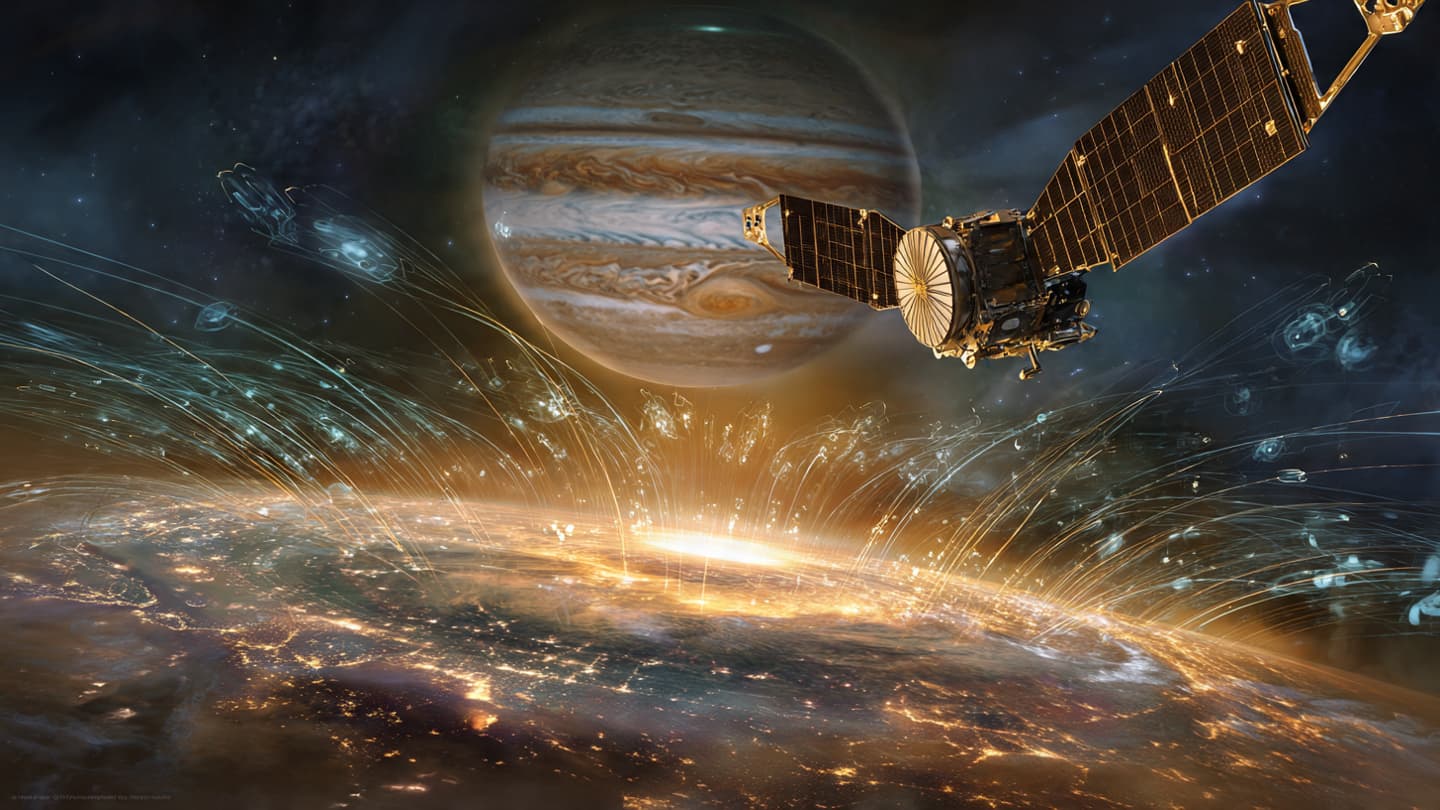
The Juno spacecraft, which has been orbiting Jupiter since 2016, was originally designed to study the giant planet’s atmosphere, magnetic field, and internal structure. Over time, however, the mission has also provided valuable information about the broader space environment surrounding Jupiter. Recent observations have revealed patterns in energetic particles that could improve scientific understanding of cosmic ray formation and behavior.
Scientists involved in the mission reported detecting high-energy particle activity influenced by Jupiter’s powerful magnetic field. Because Jupiter possesses the strongest planetary magnetic field in the solar system, it serves as a natural laboratory for studying particle acceleration processes that are difficult to observe elsewhere.
Cosmic rays originate from a variety of sources throughout the universe, including supernova explosions, active galaxies, and other energetic cosmic events. Yet many details regarding how these particles gain their immense energy remain uncertain. Researchers believe Jupiter’s environment may offer useful analogs for understanding similar processes occurring on much larger scales across the cosmos.
One of the most intriguing aspects of the findings is the role of magnetic interactions. Observations suggest that charged particles can be accelerated through mechanisms linked to magnetic fields and plasma activity. Understanding these processes could help explain how cosmic rays achieve velocities approaching the speed of light.
The discovery also highlights the scientific value of long-duration space missions. Although Juno's primary objectives focused on planetary science, its instruments continue generating insights that extend into astrophysics, heliophysics, and space weather research. Such outcomes demonstrate how exploration missions often produce discoveries beyond their original goals.
Researchers emphasize that additional analysis will be necessary before definitive conclusions can be drawn. Scientific investigations involving cosmic rays typically require years of data collection, modeling, and comparison with observations from other spacecraft and ground-based observatories.
Beyond its technical significance, the research contributes to humanity's broader effort to understand the forces shaping the universe. Every new clue helps scientists refine theories about how energy moves through space and how cosmic environments influence the particles that eventually reach Earth.
As Juno continues its mission around Jupiter, scientists anticipate further discoveries that may deepen understanding of both the solar system and the wider universe. The latest findings serve as a reminder that even after years of exploration, space still holds countless mysteries waiting to be uncovered.
AI Image Disclaimer: The illustration accompanying this article is AI-generated and intended to artistically represent the scientific concepts discussed.
Source Verification Check: NASA Science, Science News, Jet Propulsion Laboratory (JPL), Space.com
Published by Banx Network. This article is part of the Banx decentralized media programme, powered by the BXE token on the XRP Ledger.