
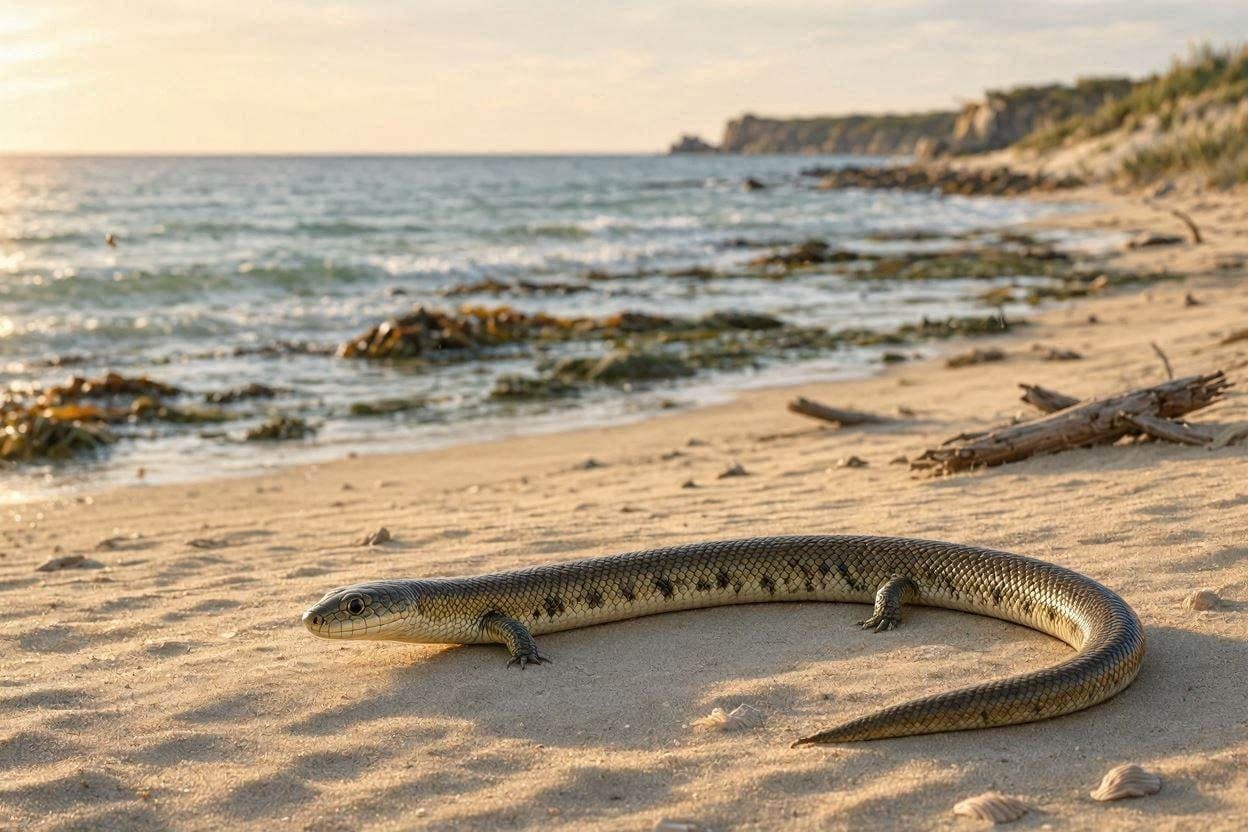
The snake is an icon of sinuous movement, a creature that seems to glide effortlessly across diverse terrains. But the origins of this adaptability are rooted in a complex evolutionary journey that spanned millions of years. Recent fossil discoveries and genetic analyses suggest that early snakes were not confined to a single habitat. Instead, they experimented with life on land, in the sea, and underground, developing specialized traits for each environment. This tripartite adaptation reveals a lineage far more versatile and dynamic than previously imagined, challenging simple narratives of reptilian evolution.
For decades, scientists debated whether snakes originated from burrowing ancestors or marine lizards. The "burrowing hypothesis" pointed to their limbless bodies and reduced eyes as adaptations for digging, while the "marine hypothesis" cited their streamlined shapes and salt-excreting glands in some modern species. New evidence suggests that both perspectives hold truth, as early snake lineages diversified into various niches during the Cretaceous period.
Fossils of ancient snakes like Najash and Haasiophis show remnants of hind limbs, indicating a transition from four-legged lizards. These early forms likely inhabited coastal environments, moving between land and water. Their skeletal structures suggest they were capable swimmers, using undulating movements to navigate aquatic spaces. This marine phase may have influenced the development of their elongated bodies, which later proved advantageous for burrowing and terrestrial locomotion.
Simultaneously, other lineages adapted to subterranean life. The loss of limbs reduced friction in tight spaces, while sensitive scales allowed them to detect vibrations in the soil. These underground dwellers developed robust skulls for pushing through dirt, a trait seen in many modern blind snakes. The convergence of these adaptations highlights how different pressures can shape similar body plans, a phenomenon known as convergent evolution.
On land, early snakes faced different challenges, including predation and temperature regulation. Their ability to squeeze into crevices provided safety, while their metabolic efficiency allowed them to survive on infrequent meals. This versatility enabled them to spread across continents, occupying ecological roles that no other reptiles could fill. Their success was not due to a single trait but a combination of behavioral and physiological innovations.
Genetic studies support this multifaceted origin, showing that genes associated with limb development were suppressed at different times in different lineages. This molecular flexibility allowed snakes to rapidly adapt to new environments, shedding unnecessary structures and enhancing others. The genome of the modern snake is a record of this evolutionary experimentation, carrying traces of its aquatic, terrestrial, and subterranean past.
Understanding this complex history helps explain the diversity of modern snakes, from the arboreal vinesnakes to the aquatic sea kraits. Each species carries a legacy of adaptation that spans epochs and environments. It reminds us that evolution is not a straight line but a branching tree, with roots in multiple worlds.
The story of early snakes is one of exploration and adaptation. By embracing land, sea, and underground, they forged a unique path in the history of life. Today’s snakes are the heirs to this rich legacy, embodying the resilience and versatility of their ancient ancestors.
AI Image Disclaimer: Please note that the images in this piece are AI-generated illustrations created to depict the themes of paleontology and evolutionary biology.
Sources: Nature Ecology & Evolution, Smithsonian Magazine, National Geographic, Yale News
Published by Banx Network. This article is part of the Banx decentralized media programme, powered by the BXE token on the XRP Ledger.



