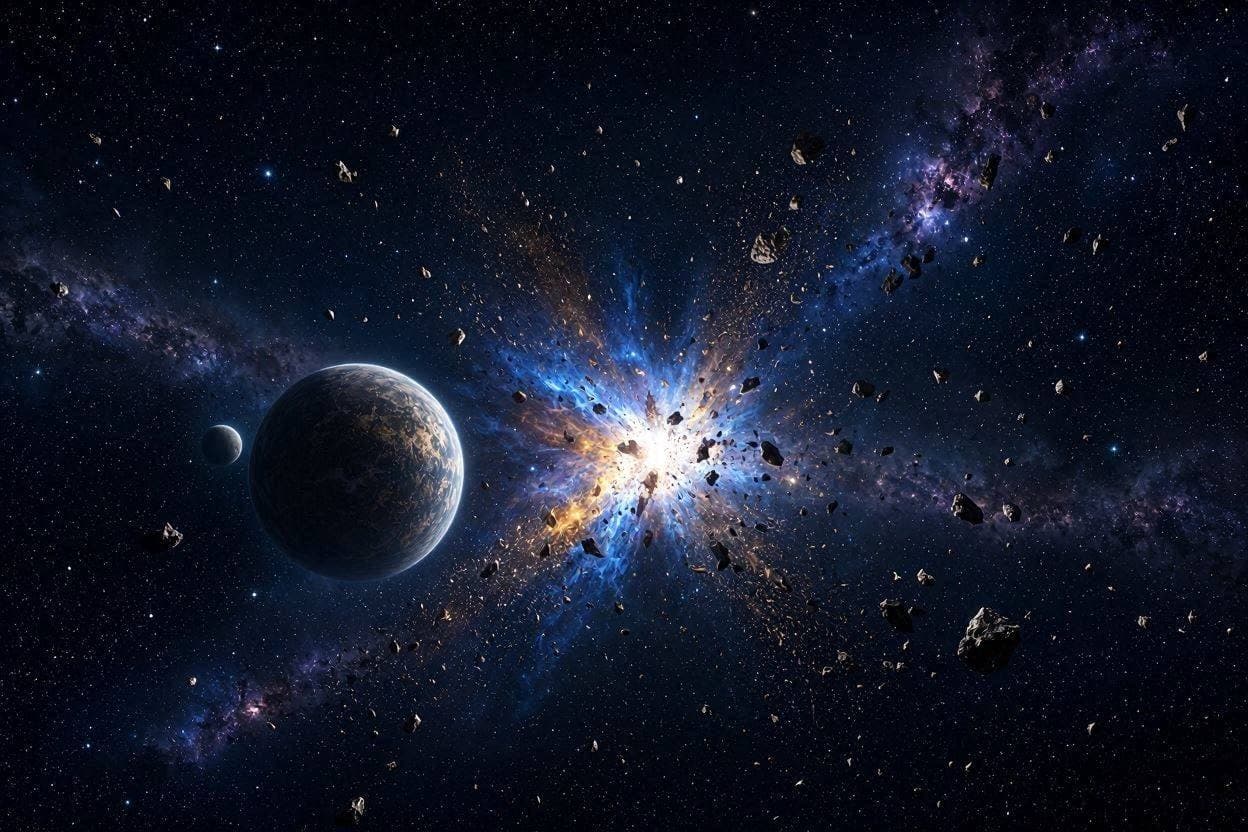
Opening: The universe is often perceived as a place of serene order, with planets tracing predictable paths around their stars. Yet, beneath this calm surface lies a history of violent upheaval. Recent observations have confirmed a dramatic planetary collision in a distant star system, reminding us that the cosmos is still a place of dynamic change, where worlds can be shattered and remade in the blink of an astronomical eye.
Body: The event was detected through the careful analysis of data from the Gaia mission and other telescopic surveys. The star, Gaia20ehk, showed signs of distress that could only be explained by a massive impact. The resulting debris cloud, heated to thousands of degrees, emitted a strong infrared signal that stood out against the cooler background of space. This thermal signature is a key indicator of recent, high-energy events in planetary systems.
Scientists estimate that the colliding bodies were likely comparable in size to large moons or small planets. The force of the impact would have been sufficient to melt rock and create a temporary atmosphere of vaporized material. Such events are critical for understanding the distribution of elements and the potential for water delivery in young planetary systems, though this particular star is older and the cause of the collision remains a subject of study.
The discovery underscores the importance of long-term monitoring of stellar objects. Many cosmic events are transient, lasting only days or weeks before fading into obscurity. Without continuous surveillance and advanced data archiving, such fleeting moments of cosmic drama would be lost. The dedication of researchers to sift through vast amounts of data is what makes these discoveries possible.
For the public, the idea of planets crashing into each other may seem like science fiction, but it is a fundamental part of planetary science. Our own Moon is a testament to such a violent past. Observing these events elsewhere allows us to test our theories about the early solar system and understand the range of possible outcomes for planetary evolution.
The implications for the search for life are nuanced. While such collisions are destructive, they can also redistribute materials and potentially create new environments. Understanding the frequency of these events helps astronomers identify systems that are stable enough for life to emerge and persist over billions of years.
As the field of exoplanet science matures, the focus is shifting from mere detection to characterization. Knowing that a planet exists is one thing; understanding its history, composition, and dynamic interactions is another. This collision observation is a step toward a deeper, more holistic understanding of other worlds.
Closing: The observation of this planetary collision adds a vivid chapter to the story of the universe. It highlights the power of modern astronomy to reveal the hidden dramas of the cosmos, enriching our knowledge of the forces that shape our reality.
AI Image Disclaimer: Please note that the images included in this article are AI-generated visualizations created to complement the narrative and are not actual photographs of the event.
Sources: SETI Institute Phys.org Space.com NASA Exoplanet Archive
Published by Banx Network. This article is part of the Banx decentralized media programme, powered by the BXE token on the XRP Ledger.