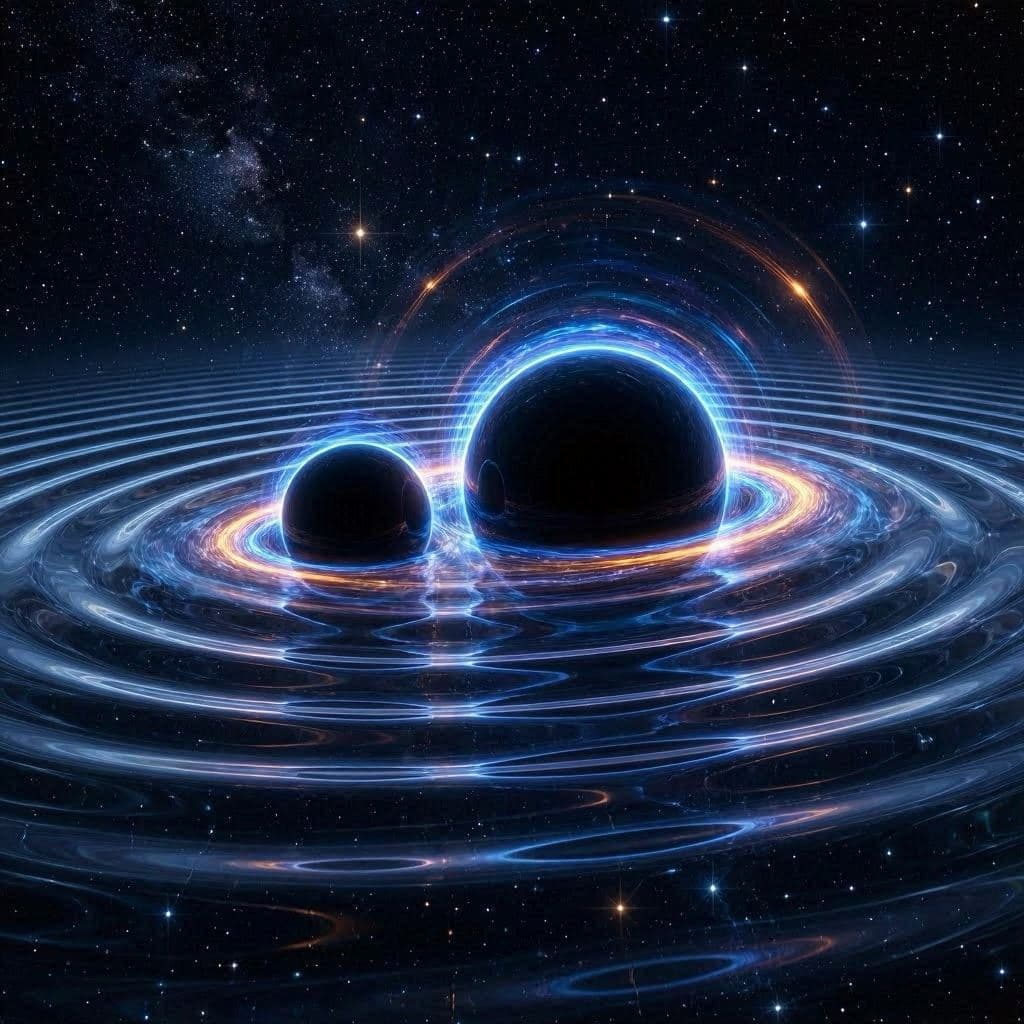
The universe speaks in whispers, but occasionally, it roars. In January 2025, the LIGO detectors captured such a roar: GW250114, the strongest gravitational wave signal ever recorded. This cosmic collision, resulting from the merger of two massive black holes, was three times louder than the first detection a decade prior. Yet, amidst the thunderous data, scientists discovered a faint, hidden echo—a second signal that would take months of rigorous analysis to decipher.
This secondary signal was not merely noise; it was the "ringdown" of the newly formed black hole, a phenomenon predicted by Einstein’s general theory of relativity but never before observed with such clarity. As the merged black hole settled into its final state, it vibrated like a struck bell, emitting gravitational waves that carried the imprint of its event horizon. For physicists, this was a golden opportunity to probe the very edge of the unknown, the point of no return where space and time behave in extraordinary ways.
The analysis revealed the spin rate of the black hole’s event horizon, a fundamental property that had previously been difficult to measure directly. By studying the frequency and decay of the ringdown signal, researchers could calculate how fast the black hole was rotating. This measurement is crucial for testing the "no-hair theorem," which suggests that black holes are simple objects defined only by their mass, charge, and spin. The findings aligned perfectly with theoretical predictions, offering a profound validation of our understanding of gravity.
The significance of this discovery extends beyond confirmation. It opens a new window into the nature of spacetime itself. By listening to the vibrations of a black hole, scientists can explore the limits of general relativity and search for deviations that might hint at new physics. It is a step toward understanding the quantum nature of gravity, one of the greatest unsolved mysteries in modern science. The event horizon, once a purely mathematical concept, has become a tangible object of study.
The collaboration behind this achievement highlights the power of international scientific cooperation. Teams from around the world worked together to refine the algorithms and models needed to extract the hidden signal from the data. Their patience and expertise turned a fleeting moment of cosmic violence into a lasting contribution to human knowledge. It is a testament to the curiosity and dedication that drive scientific progress.
For the public, this discovery may seem abstract, but its implications are profound. It reminds us that the universe is far more dynamic and interconnected than our daily experiences suggest. The ripples in spacetime caused by distant collisions are real, and they carry information about the most extreme environments in the cosmos. By learning to read these signals, we expand our consciousness and our connection to the wider universe.
As we look to the future, detectors will become even more sensitive, promising to reveal even fainter echoes and more complex mergers. The era of gravitational wave astronomy is just beginning, and each new detection adds a piece to the puzzle of cosmic history. The roar of January 2025 was not an end, but a beginning, inviting us to listen more closely to the songs of the stars.
In the end, the story of GW250114 is one of listening and learning. It shows that even in the loudest events, there are subtle messages waiting to be heard. By decoding the spin of a black hole, we have not just measured a number; we have touched the fabric of reality itself. It is a humble yet majestic achievement, reflecting the enduring human desire to understand the mysteries of the cosmos.
AI Image Disclaimer: Please note that any images associated with this article are AI-generated interpretations intended for illustrative purposes only and do not represent actual visualizations of gravitational waves.
Sources: Nature Journal Space.com LIGO Laboratory Physical Review Letters NASA
Published by Banx Network. This article is part of the Banx decentralized media programme, powered by the BXE token on the XRP Ledger.