For centuries, humanity understood the universe mainly through light. Stars, galaxies, and nebulae revealed themselves through visible glow, radio signals, and distant radiation traveling across space. Yet in recent years, scientists have begun listening to the cosmos in an entirely different way — through faint ripples in spacetime itself. Now, astrophysicists say a growing collection of gravitational wave detections is opening an extraordinary new chapter in astronomy.
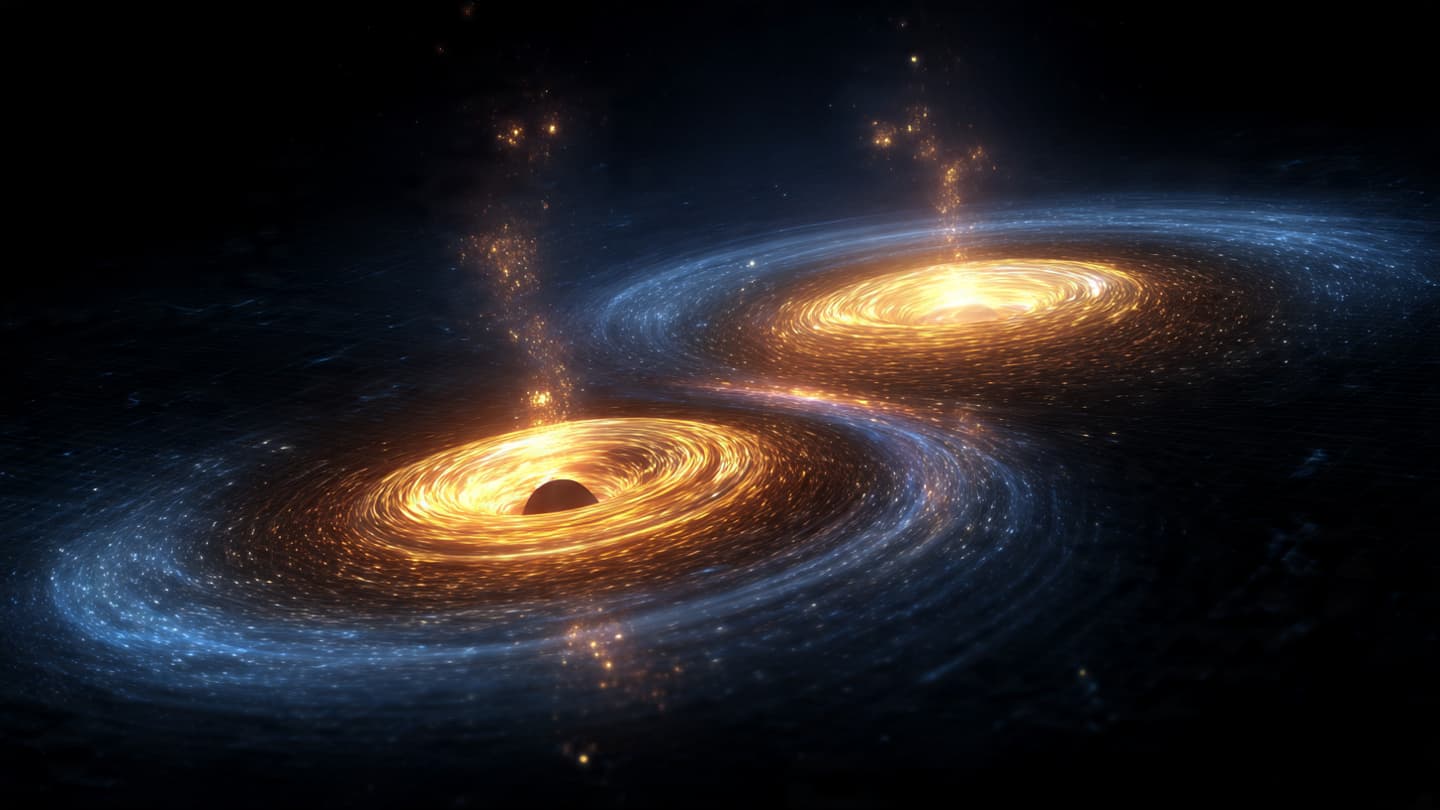
Gravitational waves are distortions in spacetime generated by massive cosmic events, such as collisions between black holes or neutron stars. First directly detected in 2015, these waves confirmed predictions made by Albert Einstein more than a century earlier through his theory of general relativity.
Researchers operating observatories such as LIGO, Virgo, and KAGRA have since identified dozens of gravitational wave events. The latest collection of detections, described by scientists as a scientific “treasure trove,” includes signals from increasingly unusual and distant cosmic mergers.
Some newly detected events appear to involve black holes with unexpected masses or complex merger histories. Scientists say these observations may help explain how black holes grow over time and how extreme stellar systems evolve within galaxies.
Unlike traditional telescopes, gravitational wave observatories do not rely on light. Instead, they measure extraordinarily small distortions caused when powerful cosmic events send waves across the universe at the speed of light. Detecting these signals requires instruments sensitive enough to measure changes thousands of times smaller than a proton.
The growing number of detections is allowing researchers to move beyond isolated discoveries toward broader statistical understanding. Scientists can now compare populations of black holes, examine patterns in stellar collapse, and test aspects of relativity under extreme gravitational conditions.
Gravitational wave astronomy has also strengthened international scientific collaboration. Observatories across multiple countries coordinate observations and data analysis, helping researchers confirm signals and locate potential cosmic sources more accurately.
Many scientists believe the field remains in its early stages. Future detectors, including next-generation observatories planned on Earth and in space, may reveal gravitational waves from phenomena still entirely undetected, including events linked to the early universe itself.
For now, each new signal acts like a distant echo arriving from ancient cosmic violence, carrying information from regions of space where light alone cannot fully tell the story.
AI Image Disclaimer: Certain space visuals associated with this article were created using AI-generated astronomical rendering.
Sources: LIGO Scientific Collaboration Nature Space.com Scientific American Reuters
Published by Banx Network. This article is part of the Banx decentralized media programme, powered by the BXE token on the XRP Ledger.