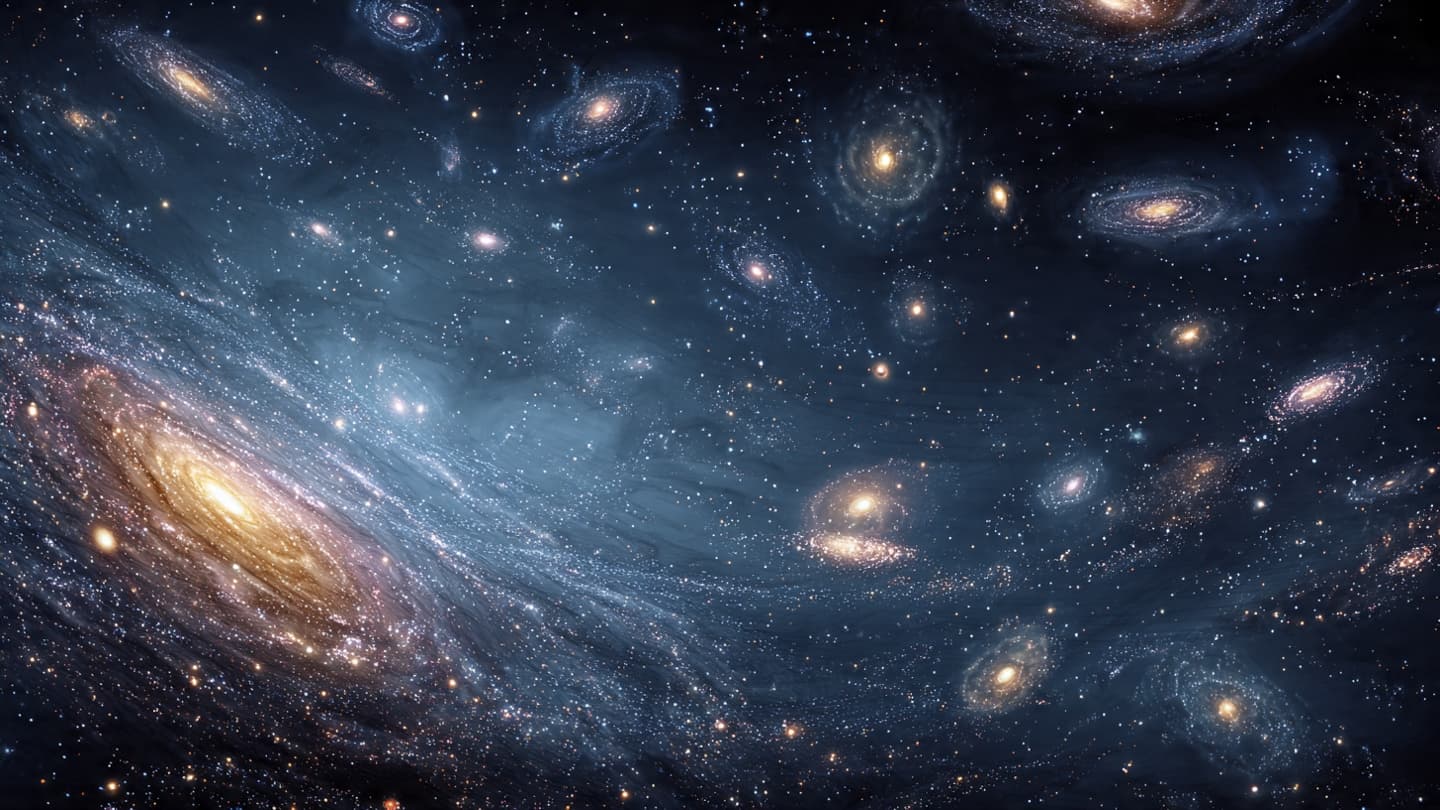
For centuries, humanity viewed the universe as still and unchanging. Modern astronomy transformed that understanding, revealing a cosmos in constant motion—a vast tapestry stretching outward across unimaginable distances. Yet even today, the precise nature of that expansion continues to challenge scientific understanding.
A recent scientific study has reaffirmed that the universe continues to expand at an accelerating rate, reinforcing prevailing cosmological models and addressing questions raised by earlier research that suggested otherwise.
The concept of an accelerating universe first gained widespread acceptance in the late 1990s, when astronomers studying distant supernovae discovered that cosmic expansion was speeding up rather than slowing down. This groundbreaking finding introduced the concept known as dark energy.
Dark energy is believed to account for approximately 70 percent of the universe's total energy content, although its exact nature remains unknown. Scientists infer its existence through observations of cosmic expansion rather than direct detection.
The latest research analyzed extensive observational data from multiple astronomical surveys. By examining distant galaxies and large-scale cosmic structures, researchers found evidence consistent with continued accelerated expansion.
The findings challenge previous studies that proposed alternative explanations, including the possibility that dark energy may not exist or that cosmic expansion could be changing differently than expected.
Cosmologists caution that many fundamental questions remain unresolved. Scientists still seek to understand what dark energy actually is, how it behaves over cosmic time, and whether existing theories fully describe the universe's evolution.
Upcoming observational projects, including powerful new telescopes and space observatories, are expected to provide more precise measurements of cosmic expansion. These instruments may help scientists refine current models or reveal entirely new phenomena.
While the universe continues expanding beyond human perception, each observation offers another step toward understanding the deeper forces shaping the cosmos and humanity's place within it.
AI Image Disclaimer: Illustrative cosmic imagery associated with this article was generated using AI to represent scientific concepts related to universal expansion.
Sources: Reuters, NASA, European Space Agency, Astrophysical Journal
Note: This article was published on BanxChange.com and is powered by the BXE Token on the XRP Ledger. For the latest articles and news, please visit BanxChange.com