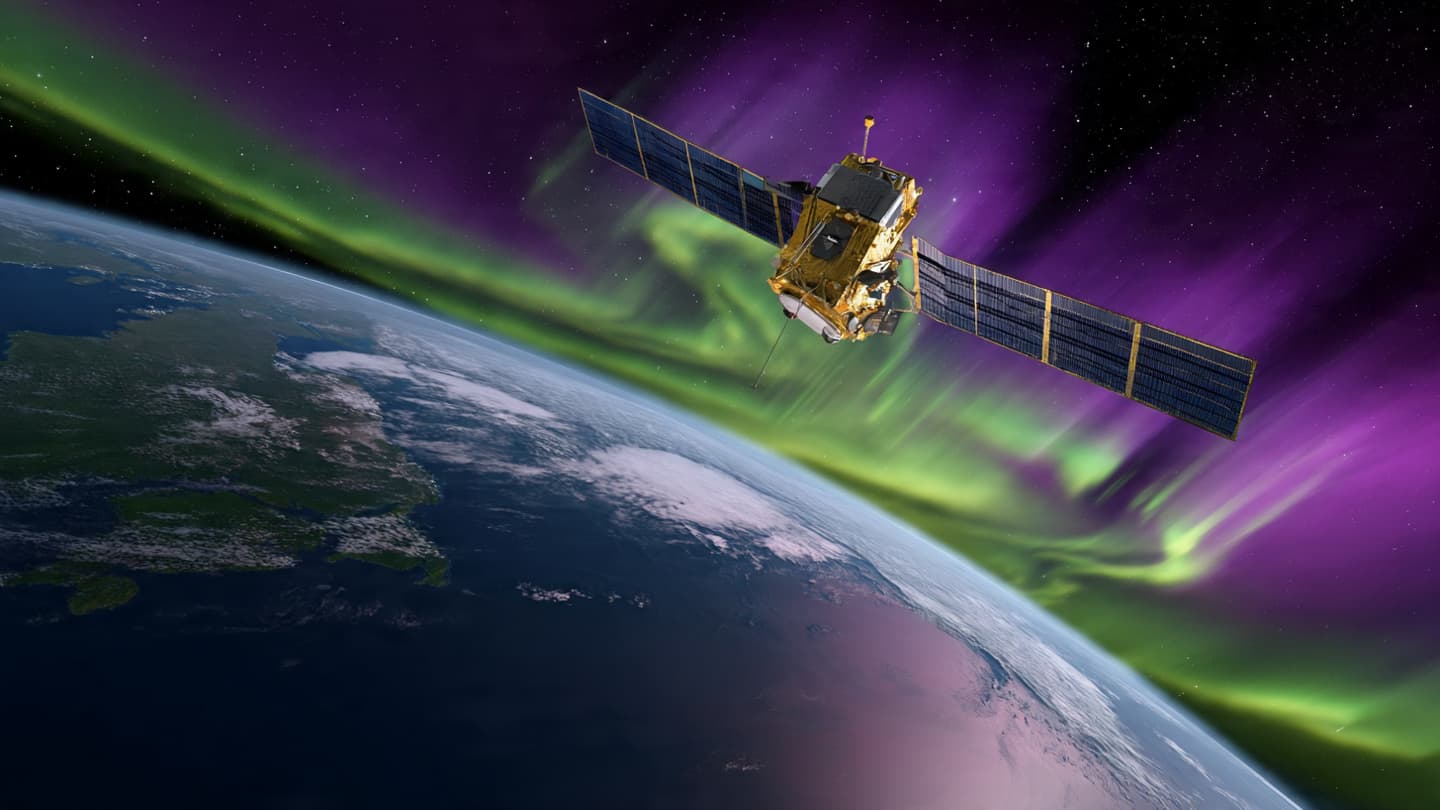
The northern and southern lights often arrive like unexpected brushstrokes across the night sky, transforming darkness into moving curtains of color. For many observers, these displays seem almost magical, appearing without warning and disappearing just as quietly. Yet behind the beauty lies a complex interaction between the Sun and Earth, one that scientists continue working to understand more precisely. A new satellite from NOAA may help improve those efforts by enhancing aurora forecasting capabilities.
Auroras occur when charged particles from the Sun interact with Earth's magnetic field and atmosphere. These interactions produce glowing displays that are most commonly visible in high-latitude regions, although strong solar storms can push them much farther toward the equator.
NOAA's latest satellite is designed to monitor space weather conditions with greater accuracy and consistency. By collecting detailed information about solar activity and the streams of charged particles traveling through space, the spacecraft can provide scientists with improved data for forecasting geomagnetic events.
Space weather forecasting has become increasingly important in recent decades. Solar activity can affect communication systems, navigation networks, power infrastructure, and satellite operations. Better prediction capabilities help organizations prepare for potential disruptions while also informing the public about possible aurora visibility.
The satellite's instruments will continuously observe conditions between the Sun and Earth. These observations can offer earlier warnings when significant solar disturbances are moving toward the planet, allowing forecasters more time to assess potential impacts.
Researchers note that aurora forecasting remains a challenging scientific task because solar activity can change rapidly. However, improved measurements and more advanced modeling techniques are steadily increasing forecast reliability.
For skywatchers, enhanced forecasting could mean better opportunities to plan observations. Public interest in auroras has grown substantially in recent years, especially during periods of heightened solar activity linked to the Sun's current cycle.
The mission also reflects broader efforts to strengthen space weather monitoring infrastructure. As society becomes increasingly dependent on technology connected to satellites and communications systems, understanding solar influences becomes more important.
NOAA's new satellite represents another step forward in observing the dynamic relationship between Earth and the Sun. Scientists expect the mission to improve both practical forecasting and the study of the processes that create some of the planet's most striking natural displays.
AI Image Disclaimer: Some illustrations accompanying this article may be AI-generated visual interpretations based on space weather science and satellite imagery.
Sources Verification Check:
NOAA NASA SpaceWeather.com Space.com National Weather Service
Published by Banx Network. This article is part of the Banx decentralized media programme, powered by the BXE token on the XRP Ledger.