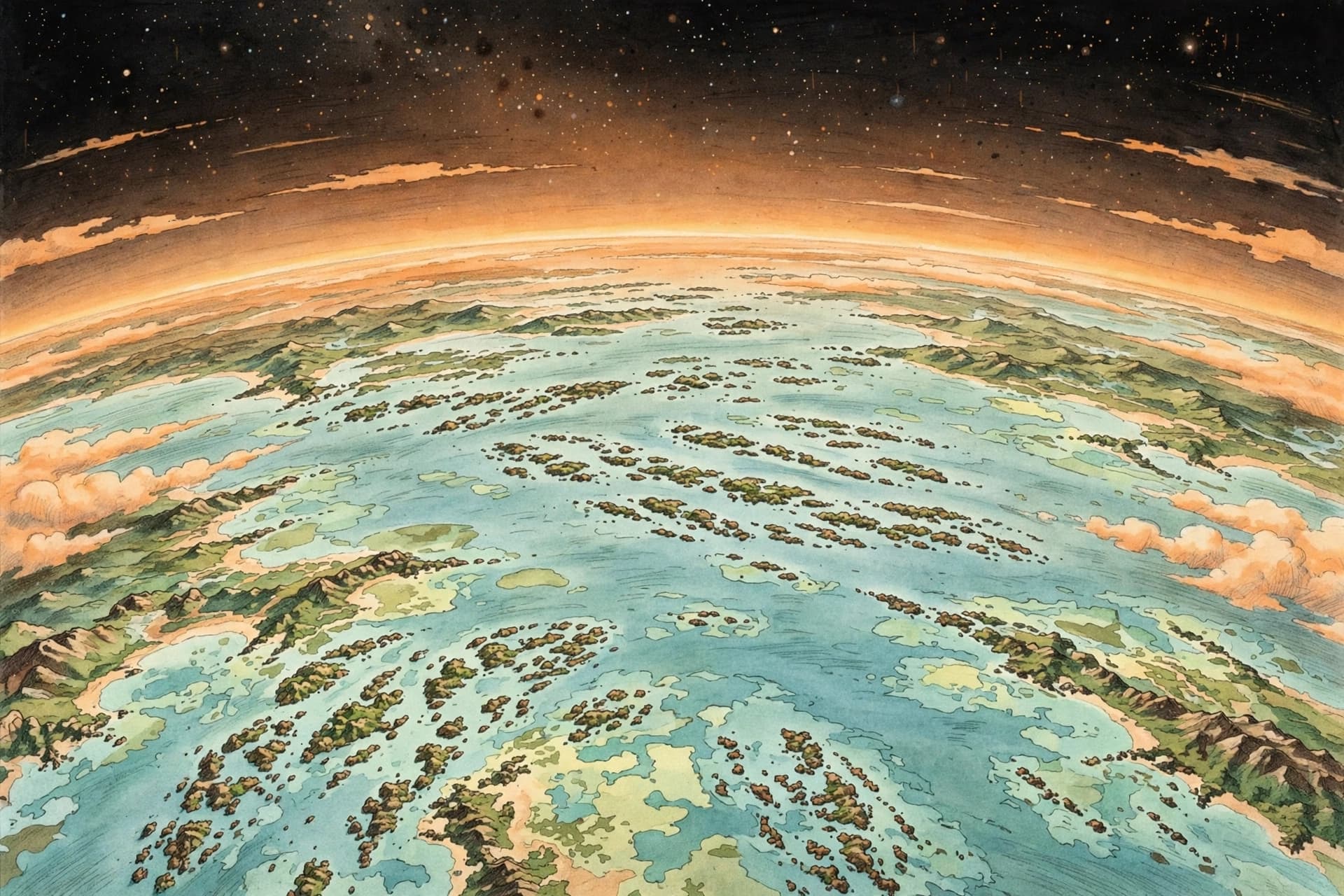
The night sky often appears calm to those watching from Earth, as though the stars have settled into an eternal arrangement beyond change or disturbance. Yet modern astronomy continues to reveal that galaxies are less like still paintings and more like oceans shaped by deep currents and ancient storms. New research now suggests that the Milky Way itself may have endured one such upheaval billions of years ago, when a violent collision potentially destroyed its earliest stellar disk.
Scientists studying the structure and history of the Milky Way have increasingly focused on traces left behind by ancient galactic mergers. Using advanced simulations and observational data, researchers believe that a smaller galaxy may have collided with the young Milky Way during its formative years. Rather than a simple encounter, the event may have dramatically disrupted the galaxy’s original stellar disk, scattering stars and reshaping its internal structure.
The idea builds on previous discoveries surrounding an ancient merger event known as Gaia-Sausage-Enceladus, identified through data collected by the European Space Agency’s Gaia mission. Researchers have found unusual stellar motions and chemical signatures that point toward a major collision roughly 10 billion years ago. Some astronomers now believe the impact was powerful enough to erase or severely damage the Milky Way’s first organized disk of stars.
Like rings spreading across water after a stone is dropped, the effects of such a collision may still linger today. Stars orbiting at unusual angles, thickened galactic regions, and differing stellar populations all offer clues about the galaxy’s turbulent adolescence. These remnants help astronomers reconstruct an era long before Earth or the Sun existed, when galaxies frequently collided as the universe evolved.
The findings also contribute to a broader understanding of how spiral galaxies form and survive. For decades, scientists debated whether large galaxies developed gradually through peaceful accumulation or through repeated violent mergers. Evidence increasingly suggests that destruction and renewal often occurred together, with collisions disrupting older structures while simultaneously triggering new waves of star formation.
Researchers note that the Milky Way’s current thin disk — the bright spiral structure visible today — likely formed after the ancient collision settled. In that sense, the galaxy familiar to modern observers may itself be the product of recovery after catastrophe. What appears stable now may have emerged from billions of years of gravitational disorder and reconstruction.
Advances in space telescopes and stellar mapping technologies continue to sharpen these investigations. By measuring stellar chemistry, motion, and age with greater precision, astronomers can identify populations of stars that originated in different galactic systems. Each dataset functions almost like a historical archive written in light rather than ink.
While many questions remain unresolved, researchers say the growing body of evidence strengthens the theory that the Milky Way’s earliest disk did not survive intact. The galaxy above Earth may therefore hold the memory of an ancient impact that changed its destiny long before humanity began looking toward the stars.
AI Image Disclaimer: Some visual illustrations accompanying this article were created using AI-generated imagery for editorial presentation purposes.
Sources Verified: NASA, European Space Agency (ESA), Nature Astronomy, Space.com, Live Science
Published by Banx Network. This article is part of the Banx decentralized media programme, powered by the BXE token on the XRP Ledger.