For decades, Mars has remained both a scientific destination and a symbol of humanity’s long-term ambitions beyond Earth. The planet appears close in astronomical terms, yet the journey remains extraordinarily difficult, requiring months of travel through deep space. Now, NASA’s testing of a new high-powered thruster system has renewed hopes that future human missions to Mars may become faster and more efficient.
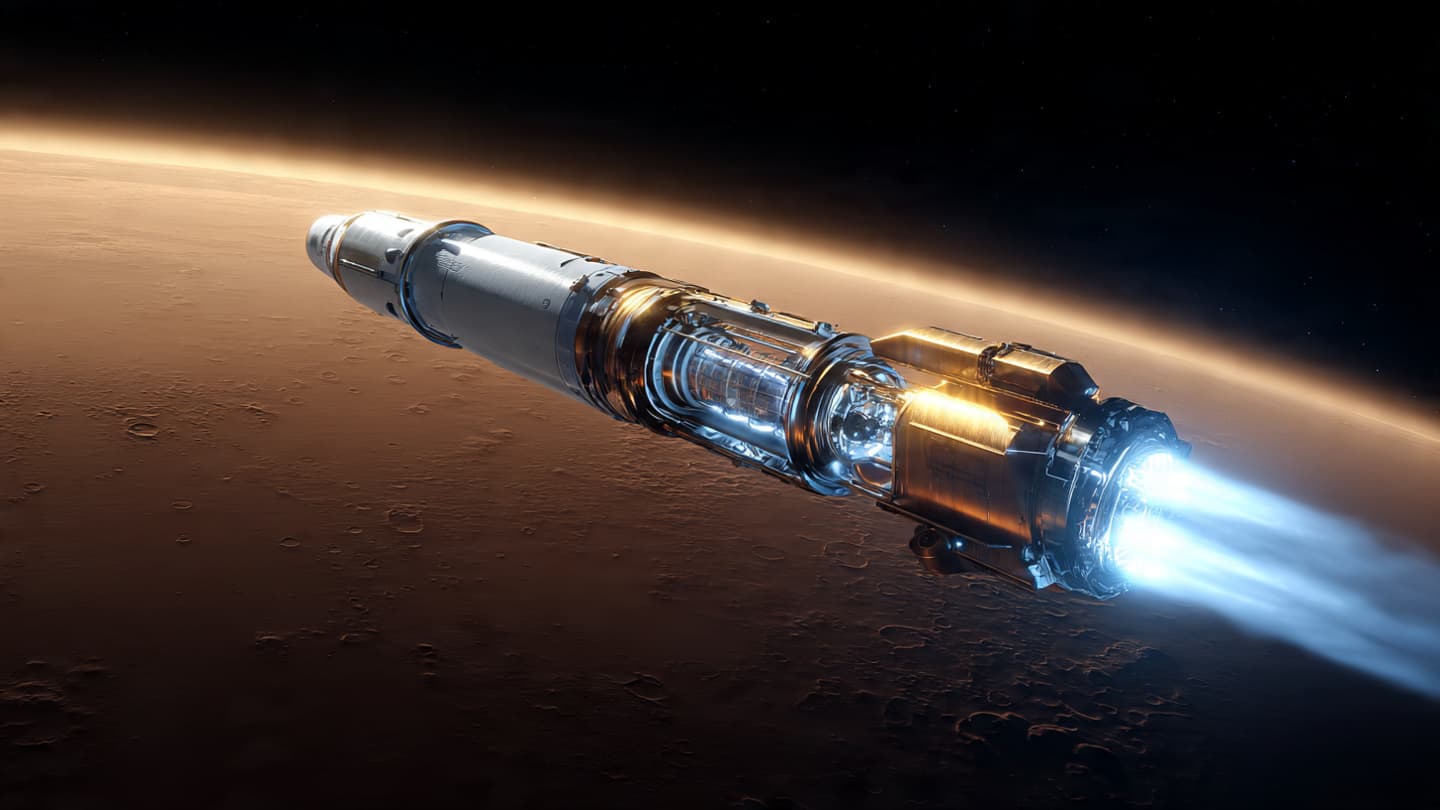
The experimental propulsion technology reportedly uses advanced electromagnetic systems designed to generate stronger and more sustained thrust than traditional chemical rockets. Researchers believe such systems could significantly reduce travel times for long-duration missions while improving fuel efficiency during deep-space operations.
Current spacecraft traveling to Mars typically require six to nine months to complete the journey, depending on planetary alignment and mission design. Long travel durations create major challenges for human exploration, including radiation exposure, psychological stress, and limited onboard resources. Faster propulsion systems could therefore improve both mission safety and operational flexibility.
NASA engineers have described the recent tests as an important technical milestone rather than an immediate operational breakthrough. Space propulsion research often progresses gradually, with years of laboratory refinement required before systems become suitable for crewed missions. Nevertheless, early results appear promising enough to attract growing scientific interest.
The thruster technology may also support future robotic missions beyond Mars. Deep-space exploration increasingly depends on propulsion systems capable of operating efficiently over enormous distances. Scientists envision future spacecraft traveling farther into the solar system using technologies that balance power, endurance, and precision.
International competition and cooperation continue shaping modern space exploration. Alongside NASA, agencies in Europe, China, and other nations are investing heavily in advanced propulsion research. Private aerospace companies are also exploring alternative technologies aimed at expanding human activity beyond Earth orbit.
The possibility of crewed Mars missions carries significance beyond engineering alone. Scientists hope human exploration could accelerate geological research, climate analysis, and the search for evidence of ancient microbial life. Mars remains one of the most studied planets because it preserves clues about planetary evolution and environmental change.
Public fascination with Mars exploration has steadily grown in recent years, fueled by rover discoveries, space documentaries, and rapid technological progress. What once seemed purely speculative increasingly appears technically achievable, even if enormous challenges still remain unresolved.
As NASA continues testing the new propulsion system, the project represents another step in a much longer story of exploration. Human history has repeatedly been shaped by the desire to move beyond familiar boundaries. In space science, that same instinct continues carrying humanity toward distant worlds that still exist mostly as points of light in the night sky.
AI Image Disclaimer: Some visual representations accompanying this article are AI-generated interpretations based on aerospace engineering concepts.
Sources NASA ScienceDaily Space.com Reuters
Published by Banx Network. This article is part of the Banx decentralized media programme, powered by the BXE token on the XRP Ledger.