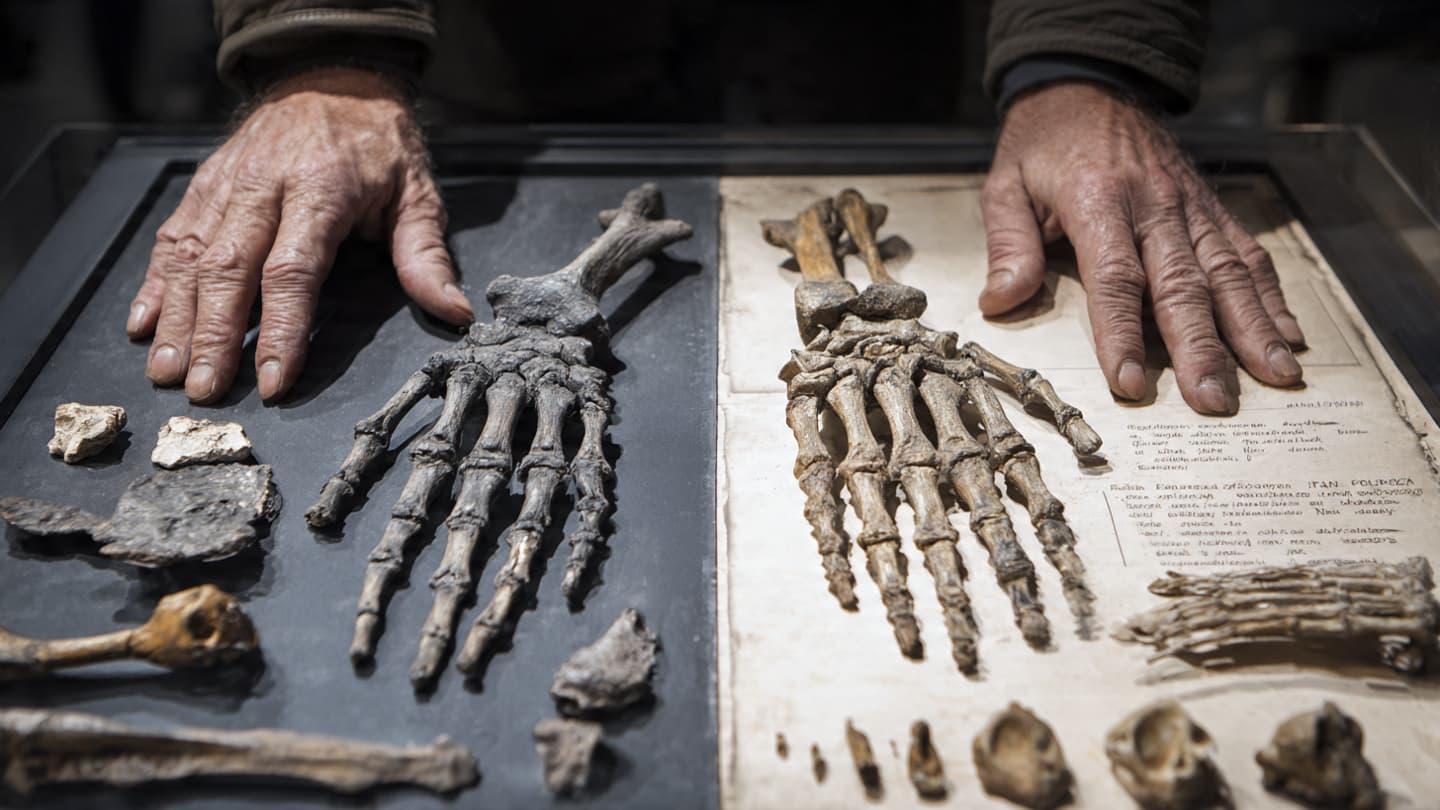
There are few parts of the human body as quietly expressive as the hand. It builds cities, writes histories, comforts children, and shapes the tools that define civilization. Yet beneath its familiar movements lies a story far older than language itself — a story carried through bone, muscle, and evolution across millions of years. Recent scientific findings are offering new insight into how the modern human hand gradually emerged from ape-like ancestors, revealing a transformation shaped not by sudden change, but by long periods of adaptation.
Researchers studying fossil evidence and comparative anatomy have examined how early primates used their hands for climbing, grasping, and movement through forest environments. Over time, structural changes in the wrist, thumb, and finger proportions appear to have allowed increasingly precise control and stronger grips. Scientists believe these developments played an important role in early tool use and eventually contributed to the rise of human technology and culture.
One of the most significant distinctions between modern human hands and those of many apes is the thumb. Humans possess a relatively longer and more mobile thumb that can press firmly against the fingertips, enabling precision grips required for activities such as carving, sewing, and writing. While some primates also display forms of dexterity, researchers say the human hand combines strength and fine motor control in unusually balanced ways.
Recent studies using three-dimensional imaging and biomechanical analysis have allowed scientists to compare fossilized hand bones with those of living humans and great apes. These comparisons suggest that certain hand features associated with tool use may have appeared earlier in human evolution than previously understood. Some fossil species already showed evidence of stronger thumbs and more stable wrists millions of years ago.
The findings also reflect how evolution rarely follows a straight path. Early human ancestors likely retained traits useful for climbing trees while simultaneously developing features suited for handling objects on the ground. Researchers describe this as a gradual blending of old and new adaptations rather than a sudden separation from ape-like movement patterns.
Scientists continue debating exactly when advanced hand dexterity became central to human survival. Stone tools discovered at ancient archaeological sites suggest that increasingly refined hand movements may have shaped hunting, food preparation, and social cooperation. As tool-making became more complex, the hand itself may have continued evolving alongside human behavior and cognition.
Modern technology has expanded researchers’ ability to explore these questions. Digital modeling, fossil scanning, and motion analysis now help scientists reconstruct how extinct species may have gripped objects or climbed through ancient landscapes. These methods provide new perspectives on evolutionary relationships that were once difficult to examine in detail.
The study of the human hand also carries broader implications for understanding humanity itself. The same anatomical structures that once helped ancestors survive harsh environments eventually allowed music, art, engineering, and scientific discovery to flourish. In many ways, the history of the hand mirrors the history of human creativity.
Researchers say ongoing fossil discoveries and imaging techniques will likely continue refining knowledge about how human dexterity evolved, offering deeper insight into one of the body’s most defining characteristics.
AI Image Disclaimer: The visual illustrations included with this article were generated using AI-based imaging tools for educational presentation.
Sources: Nature, Smithsonian Magazine, Scientific American, BBC Science Focus, National Geographic
Published by Banx Network. This article is part of the Banx decentralized media programme, powered by the BXE token on the XRP Ledger.