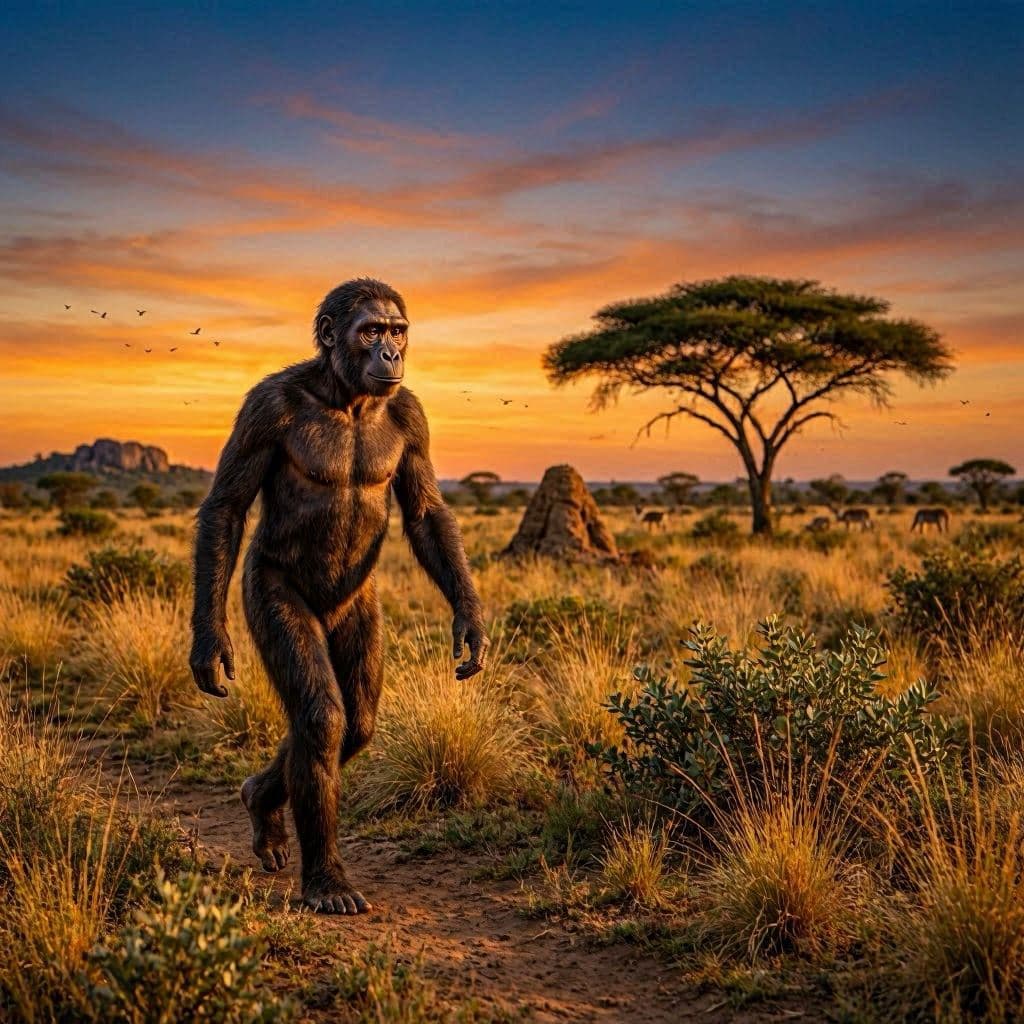
In the dusty annals of human history, there exists a figure who bridges the vast chasm between our primal past and our civilized present. Known affectionately as Lucy, this ancient ancestor, scientifically classified as Australopithecus afarensis, was discovered in Ethiopia in 1974. Her skeletal remains, dating back 3.2 million years, offer a poignant glimpse into a time when our forebears were neither fully ape nor fully human, but something beautifully in between. She stands as a testament to the slow, deliberate march of evolution.
Lucy’s significance lies not just in her age, but in her anatomy. Her pelvis and leg bones suggest that she walked upright on two legs, a trait known as bipedalism, which is a defining characteristic of humans. Yet, her arms were long and curved, and her brain was small, reminiscent of our ape-like cousins. This mosaic of features challenges the simple linear narrative of progress, reminding us that evolution is a complex tapestry of adaptation and survival. She was a creature of transition, navigating a world that was changing around her.
The discovery of Lucy reshaped our understanding of human origins. Before her unearthing, many scientists believed that a large brain preceded upright walking. Lucy proved them wrong, showing that the ability to stand tall came first, perhaps freeing hands for tool use or allowing for better visibility in the savanna. This revelation shifted the focus of paleoanthropology, emphasizing the importance of locomotion in the story of who we are. It was a humble skeleton that spoke volumes about our shared heritage.
Beyond the scientific data, Lucy evokes a deep sense of connection. Looking at her reconstructed form, one cannot help but feel a kinship with this distant relative. She lived, loved, and struggled in a world vastly different from our own, yet she carried within her the seeds of our humanity. Her existence reminds us that we are part of a continuous lineage, linked to all life on Earth through the intricate web of biological descent. It is a humbling perspective that fosters respect for nature and our place within it.
Recent studies continue to uncover new details about Lucy’s species. Researchers have found that Australopithecus afarensis was more diverse and adaptable than previously thought, surviving for nearly a million years. This longevity suggests a remarkable resilience, a quality that may well be encoded in our own genetic makeup. By studying her, we learn not only about our physical origins but also about the enduring spirit of adaptation that has allowed our species to thrive.
The debate over Lucy’s exact place in the family tree continues, with some arguing she is a direct ancestor and others seeing her as a close cousin. Regardless of the specific classification, her role as a symbolic bridge remains uncontested. She represents the moment when our ancestors began to diverge from the great apes, setting out on a unique path that would eventually lead to the complexities of modern human society. Her legacy is one of possibility and potential.
As we look to the future, Lucy serves as a reminder of our fragility and our strength. In an era of rapid technological change, it is easy to forget our biological roots. Yet, understanding where we came from can provide clarity on where we are going. It encourages a sense of stewardship for our planet and for each other, recognizing that we are all part of a single, unfolding story.
In the end, Lucy is more than a fossil; she is a mirror. She reflects the journey of millions of years, condensed into a single, fragile frame. By honoring her memory, we honor the long, arduous path that has brought us to this moment. She holds the secret to what makes us who we are: not just our intelligence, but our resilience, our adaptability, and our enduring connection to the natural world.
AI Image Disclaimer: The visual representations included in this article are generated by artificial intelligence to illustrate thematic concepts and do not depict actual fossils or individuals.
Sources: Smithsonian Institution Arizona State University The Guardian Nature Journal
Published by Banx Network. This article is part of the Banx decentralized media programme, powered by the BXE token on the XRP Ledger.