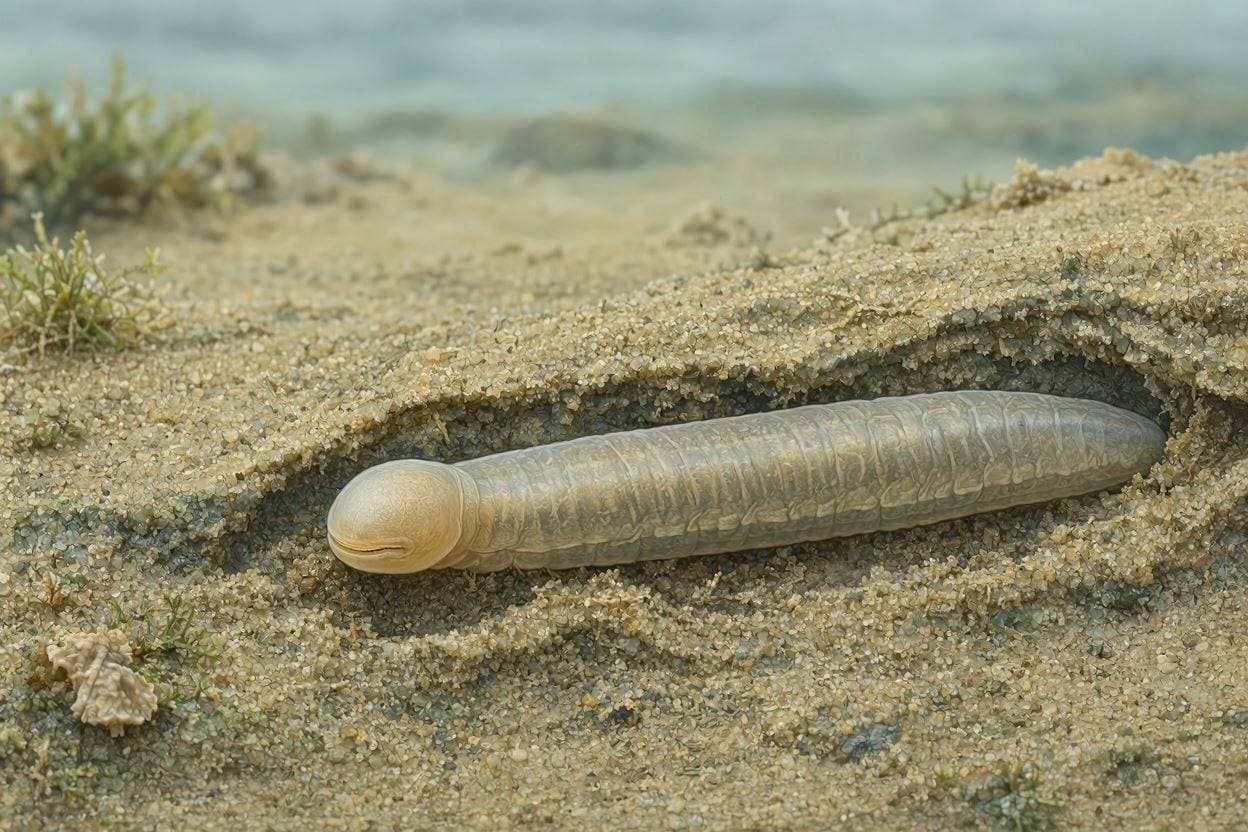
In the ancient seas of the Cambrian period, over 500 million years ago, life was experimenting with form and function in ways that would define the future of the animal kingdom. Recent fossil discoveries have shed light on Ikaria wariootia, a tiny, worm-like creature that holds the title of the earliest known animal with a distinct head. But perhaps more intriguingly, evidence suggests this diminutive ancestor was also the oldest known "righty," displaying a preference for using its right side.
The fossils, found in South Australia, are remarkably preserved, allowing scientists to study the creature’s anatomy in detail. Ikaria was small, no larger than a grain of rice, with a simple body plan. Yet, it possessed a concentrated cluster of sensory organs and neural tissue at one end, marking the evolutionary emergence of cephalization—the development of a head. This innovation allowed for more coordinated movement and better interaction with the environment.
What sets Ikaria apart is the asymmetry in its muscle scars and trackways. Analysis of the fossils indicates that the creature favored its right side when burrowing or moving through sediment. This lateralization, or "handedness," is a trait seen in many modern animals, including humans. Finding it in such an ancient organism suggests that brain asymmetry evolved much earlier than previously thought, possibly as a way to optimize neural processing.
For evolutionary biologists, this discovery bridges a gap in our understanding of early animal behavior. It shows that even simple organisms had complex neurological traits that influenced their physical actions. The preference for one side may have provided a survival advantage, allowing for more efficient movement or response to stimuli.
The implication for human evolution is profound. If the roots of handedness lie in creatures like Ikaria, then this trait is not a unique human quirk but a deep-seated biological heritage. It connects us to the distant past, reminding us that our own asymmetries are part of a long evolutionary story that began in the mud of ancient seabeds.
The study of these fossils continues to reveal new insights into the origins of complexity. Each detail, from the shape of the head to the direction of a muscle scar, adds a piece to the puzzle of how life became what it is today. Ikaria may be small, but its legacy is large, offering a window into the dawn of animal consciousness.
As researchers delve deeper into the Cambrian explosion, they find that the foundations of modern biology were laid in these early experiments. The story of Ikaria is a testament to the ingenuity of evolution, showing how even the simplest choices can have lasting impacts. It is a reminder that we are all, in a sense, descendants of the first "righties."
Closing: Fossils of Ikaria wariootia, the earliest known animal with a head, show evidence of right-sided preference, making it the oldest known "righty." This discovery highlights the early evolution of brain asymmetry and its role in animal behavior.
AI Image Disclaimer: Visuals accompanying this article are AI-generated and intended for illustrative purposes only.
Sources: Proceedings of the National Academy of Sciences (PNAS), Nature Ecology & Evolution, Major Paleontology Journals
Published by Banx Network. This article is part of the Banx decentralized media programme, powered by the BXE token on the XRP Ledger.