
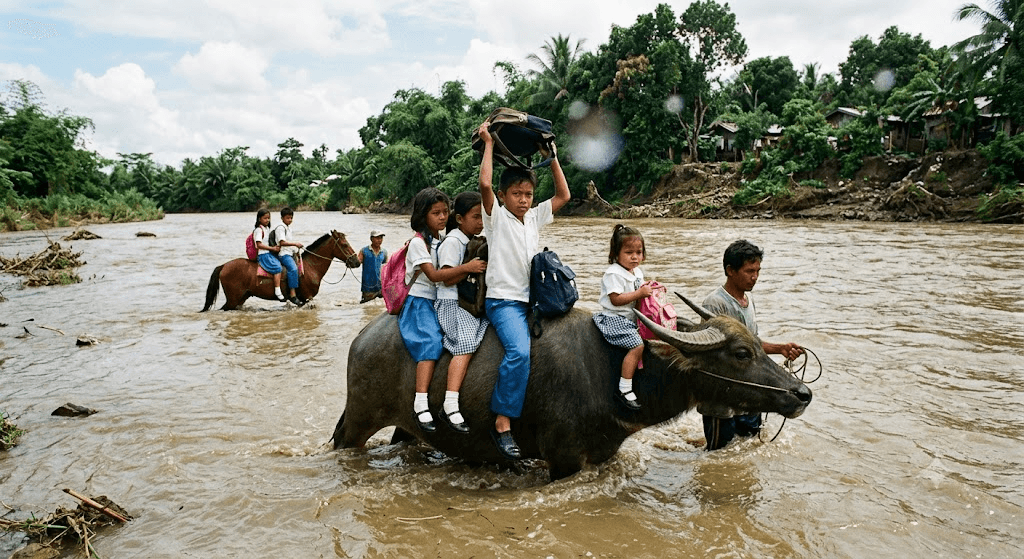
ALAMADA, COTABATO — For many children around the world, getting to school involves a short walk or a yellow bus ride. But for the students of a remote village in Alamada, Cotabato, the daily commute is a high-stakes struggle against nature, requiring them to mount water buffaloes (carabaos) and horses just to cross a raging, swollen river.
Heart-stopping footage recently captured the reality faced by these young learners when heavy afternoon downpours caused the local river's water levels to spike suddenly, transforming a usually manageable stream into a muddy, rapid-heavy torrent.
With no pedestrian bridge in sight, local students returning home from school had no choice but to rely on the village’s working animals and the steady hands of local farmers.
The viral video shows students clambering onto the backs of horses and carabaos in groups. The heavy-set animals put their strength to the test, pushing through waist-deep, fast-moving currents while the children held tightly to the animals' backs, lifting their school bags above their heads to keep their notebooks and uniforms dry.
Local residents stood by downstream, watchful and ready to intervene if an animal lost its footing or if a student was swept away by the aggressive waters.
While netizens have praised the sheer resilience and determination of the students to get an education, local parents and community leaders are sounding the alarm, stating that "resilience" should not be a substitute for basic safety. "Every time it rains heavily, our hearts sink," says a local parent. "We shouldn’t have to choose between our children’s education and their lives. What we need is a permanent bridge."
During the rainy season, the river frequently isolates the community, forcing students to either miss days of classes entirely or risk the treacherous crossing. Local educators have expressed deep concern over the students' safety, noting that the river can turn lethal in a matter of minutes due to flash floods coming from the upland areas of Cotabato.
The community is urging the local government unit (LGU) of Alamada and the Department of Public Works and Highways (DPWH) to prioritize the construction of a hanging bridge or a sturdy concrete overflow structure in the area.
Until local infrastructure catches up to the needs of the rural populace, the daily trek to class remains a dangerous gamble—one where students must rely on the strength of beasts of burden just to secure their future.
The hazardous conditions in Alamada highlight a widespread structural challenge across the rural Philippines, where "crossing-river students" remain a common reality in remote, mountainous areas. This persistent struggle underscores a critical national debate regarding the distribution of rural infrastructure budgets, emphasizing the urgent need to support isolated communities so that securing an education does not require children to risk their lives.
Note: This article was published on BanxChange.com and is powered by the BXE Token on the XRP Ledger. For the latest articles and news, please visit BanxChange.com