
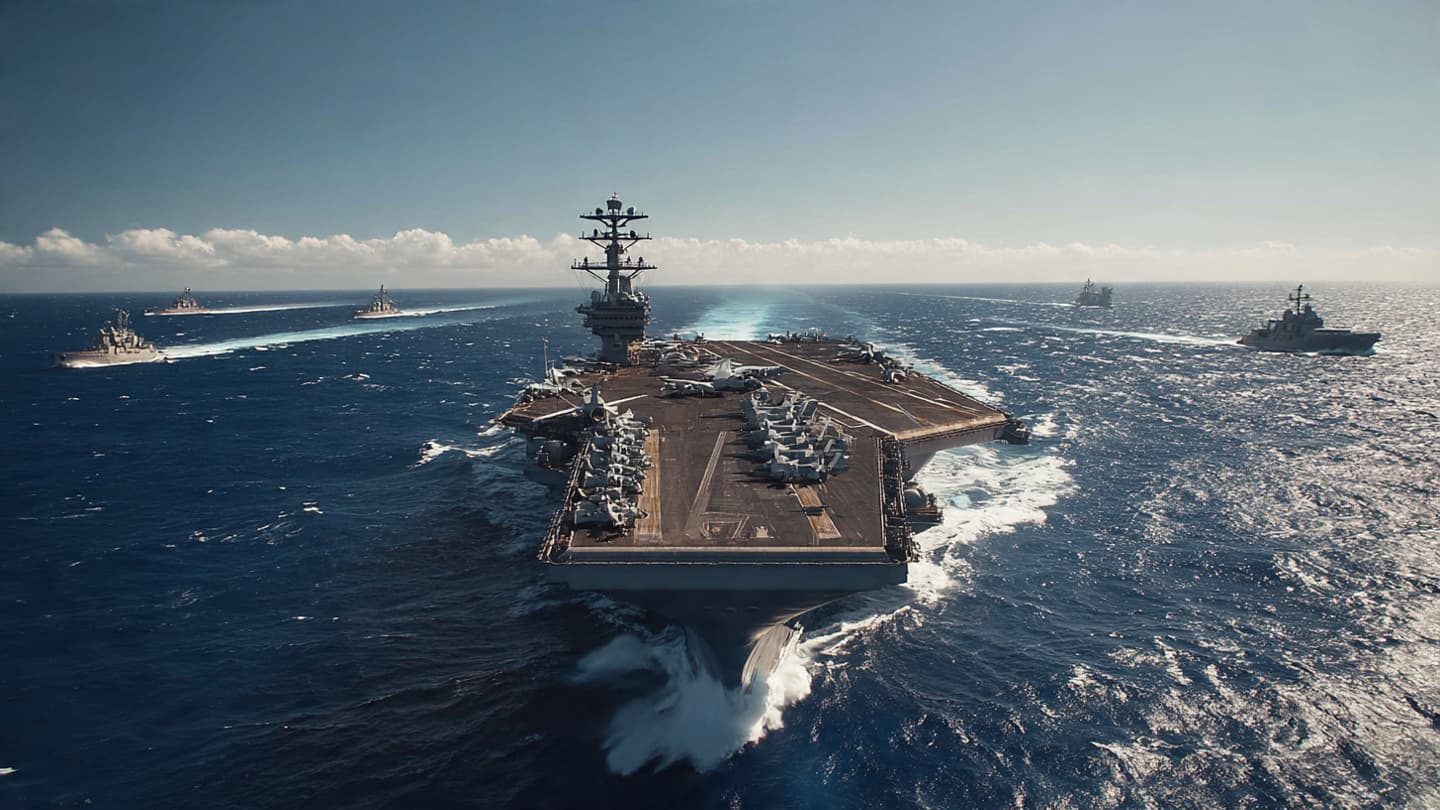
The arrival of a massive aircraft carrier often changes the atmosphere of surrounding waters long before any official statement is released. Steel and machinery move quietly across the sea, yet their presence carries symbolism that travels far beyond the horizon. As the USS Nimitz entered the Caribbean amid renewed political pressure on Cuba from former President Donald Trump, the region once again found itself standing at the intersection of history, diplomacy, and strategic display.
The deployment of the Nimitz aircraft carrier into Caribbean waters has drawn international attention due to its timing alongside escalating rhetoric directed at Cuba. Trump, who has continued to criticize the Cuban government during campaign appearances and public statements, has argued for tougher policies toward Havana. The movement of a major naval vessel into the region has therefore been interpreted by many observers as a development carrying both military and political significance.
The Caribbean has long held symbolic importance in relations between the United States and Cuba. Decades after the Cold War transformed the region into a stage for geopolitical rivalry, memories of past tensions continue to shape modern perceptions. Even routine military operations can attract heightened scrutiny when connected to longstanding diplomatic disputes between Washington and Havana.
Officials have described the carrier’s deployment as part of broader naval operations and regional readiness activities. The USS Nimitz, one of the United States Navy’s most recognizable aircraft carriers, regularly participates in exercises and missions across multiple regions. Still, the overlap between military movement and political messaging has encouraged renewed discussion among analysts and foreign policy experts.
Cuban authorities have responded cautiously, emphasizing sovereignty while criticizing what they view as continued external pressure from the United States. Government media in Cuba portrayed the development as another example of Washington’s enduring confrontational posture. At the same time, regional leaders elsewhere in Latin America have urged restraint and diplomatic engagement over heightened rhetoric.
For communities across the Caribbean, such developments often arrive with mixed emotions. The sea surrounding the islands is both a route of commerce and a stage for strategic maneuvering among larger powers. Tourism, trade, and regional stability remain deeply important to local economies, making any sign of geopolitical tension a matter of broader concern.
Political analysts note that Cuba policy frequently resurfaces during U.S. election cycles, particularly among candidates seeking support from Cuban American communities in Florida. Trump’s renewed emphasis on hardline positions reflects an issue that continues to resonate within segments of American domestic politics, even as broader international priorities evolve.
The image of an aircraft carrier crossing warm Caribbean waters carries echoes of earlier eras, when naval presence often served as visible diplomacy. Yet beneath the symbolism lies a quieter reminder that relations between nations are rarely shaped by military movements alone. Dialogue, history, and public sentiment continue flowing beneath the surface like unseen ocean currents.
Naval operations in the region are expected to continue in the coming weeks, while diplomatic observers monitor reactions from both Washington and Havana. Although tensions remain largely rhetorical for now, the situation has once again drawn attention to the fragile balance between strategic signaling and regional stability.
AI Image Disclaimer: Illustrative images for this article were created using AI-based visual generation technology.
Sources: Reuters, Associated Press, CNN, BBC News, The Miami Herald
Note: This article was published on BanxChange.com and is powered by the BXE Token on the XRP Ledger. For the latest articles and news, please visit BanxChange.com