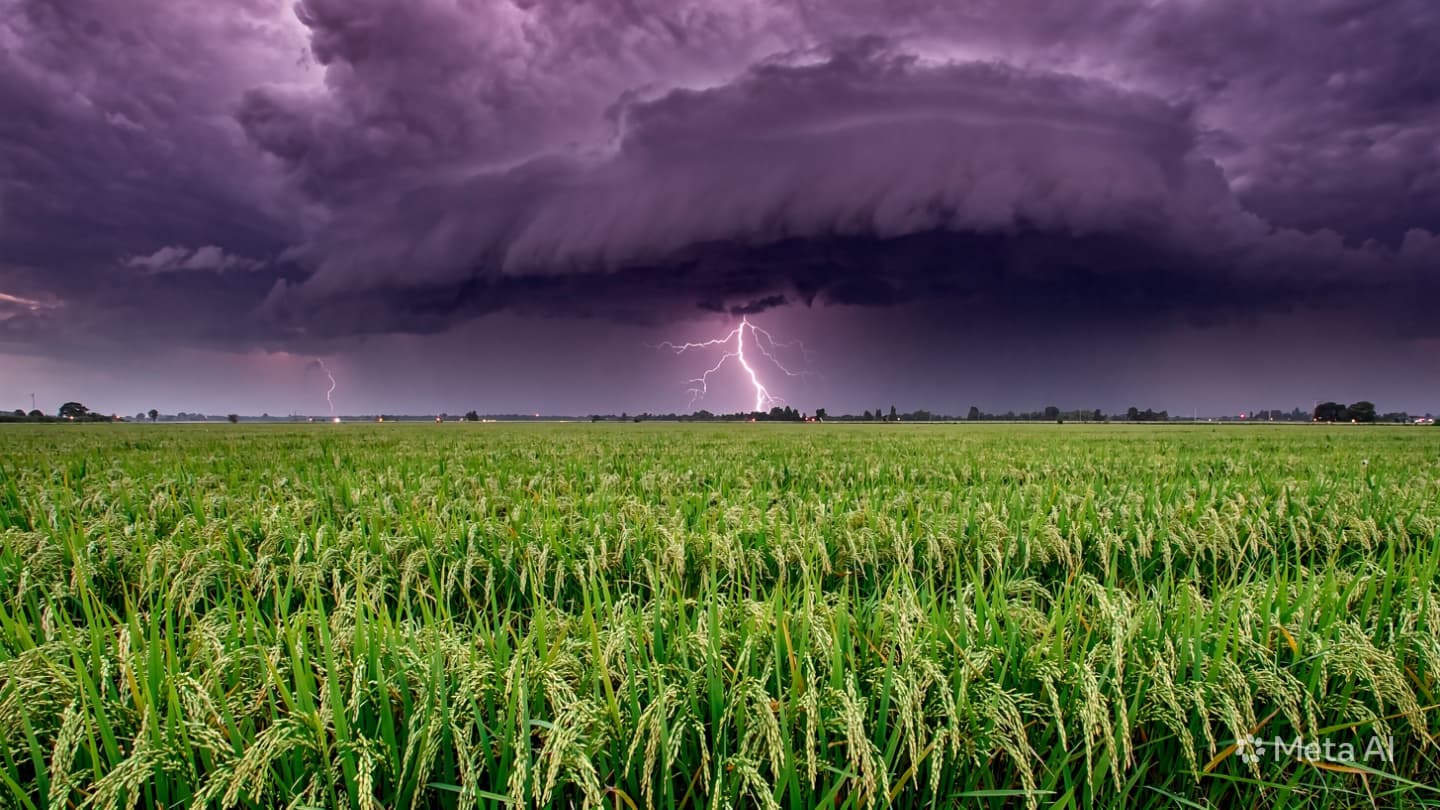
Janakpur, Nepal—Severe, fast-moving pre-monsoon thunderstorms sweeping across the southern plains of Nepal's Terai region left three people dead on Tuesday afternoon following three separate, direct lightning strikes within rural farming communities. The localized atmospheric disturbances erupted rapidly during peak agricultural working hours, catching field laborers far from sturdy residential shelters. The electrical storms packed intense cloud-to-ground lightning chains alongside blinding sheet rain and high-velocity winds.
Local administrative police reported that the first two incidents occurred nearly simultaneously around 2:15 p.m. in adjacent agricultural districts. In rural Dhanusha, a forty-two-year-old farmer was struck instantly while attempting to herd his cattle back into an open-sided mud barn as the storm cells broke overhead. Meanwhile, in neighboring Mahottari district, a thirty-five-year-old woman working to clear irrigation channels in an open paddy field suffered a direct fatal strike. Witnesses stated she died instantly from massive electrical trauma before medical volunteers could navigate the downpour.
The third fatality was reported an hour later further west in the Siraha district, where a young male laborer was struck while taking temporary shelter under an isolated, tall banyan tree at the edge of a commercial fruit orchard. Emergency medical responders who arrived at the scene noted that the tree had acted as a natural lightning rod, conducting the massive electrical discharge directly into the ground where the victim was seeking cover. All three casualties were pronounced dead at their respective local health centers.
The southern flatlands of Nepal are geographically recognized as one of the most lightning-prone zones in South Asia, particularly during the volatile transition period preceding the summer monsoon. The vast, low-lying plains experience intense convective heating, which rapidly generates high-altitude cumulonimbus clouds capable of producing extreme electrical activity. Despite the recurring annual danger, a lack of widespread lightning rod infrastructure on rural structures and limited public awareness regarding storm safety leave agrarian populations highly vulnerable.
Disaster management officials have renewed appeals urging rural residents to strictly avoid open fields, body-of-water perimeters, and isolated trees when thunder becomes audible. The National Emergency Operation Centre emphasized that traditional open-sided farming pavilions offer virtually zero insulation against secondary ground currents or side-flash strikes. Advocacy groups are continuously lobbying for the mandatory installation of community-level early warning sirens and automated lightning interception towers in high-risk agricultural sub-districts.
Local police units have completed the initial documentation and scene mapping for all three independent sites, officially classifying the events as natural weather-related fatalities. The bodies of the three deceased farmers have been moved to regional district hospitals for mandatory forensic autopsies before being released to their immediate families for evening traditional funeral rites.
The provincial government issued a joint administrative release expressing deep condolences to the bereaved families and announced a quick-disbursal financial assistance package of one hundred thousand rupees for each victim's estate to alleviate immediate burial and rehabilitation costs. Local agricultural cooperatives have expressed deep worry, noting that the sudden deaths leave three independent families without their primary household providers during the crucial early planting season.
Meteorological stations in the region warn that the high-humidity thermal patterns feeding the convective storm blocks are expected to persist across the Terai belt for the next forty-eight hours. Farmers have been strictly advised to adjust their field-working timetables, prioritizing indoor tasks during afternoon windows when regional lightning density historically spikes to dangerous levels.
Published by Banx Network. This article is part of the Banx decentralized media programme, powered by the BXE token on the XRP Ledger.