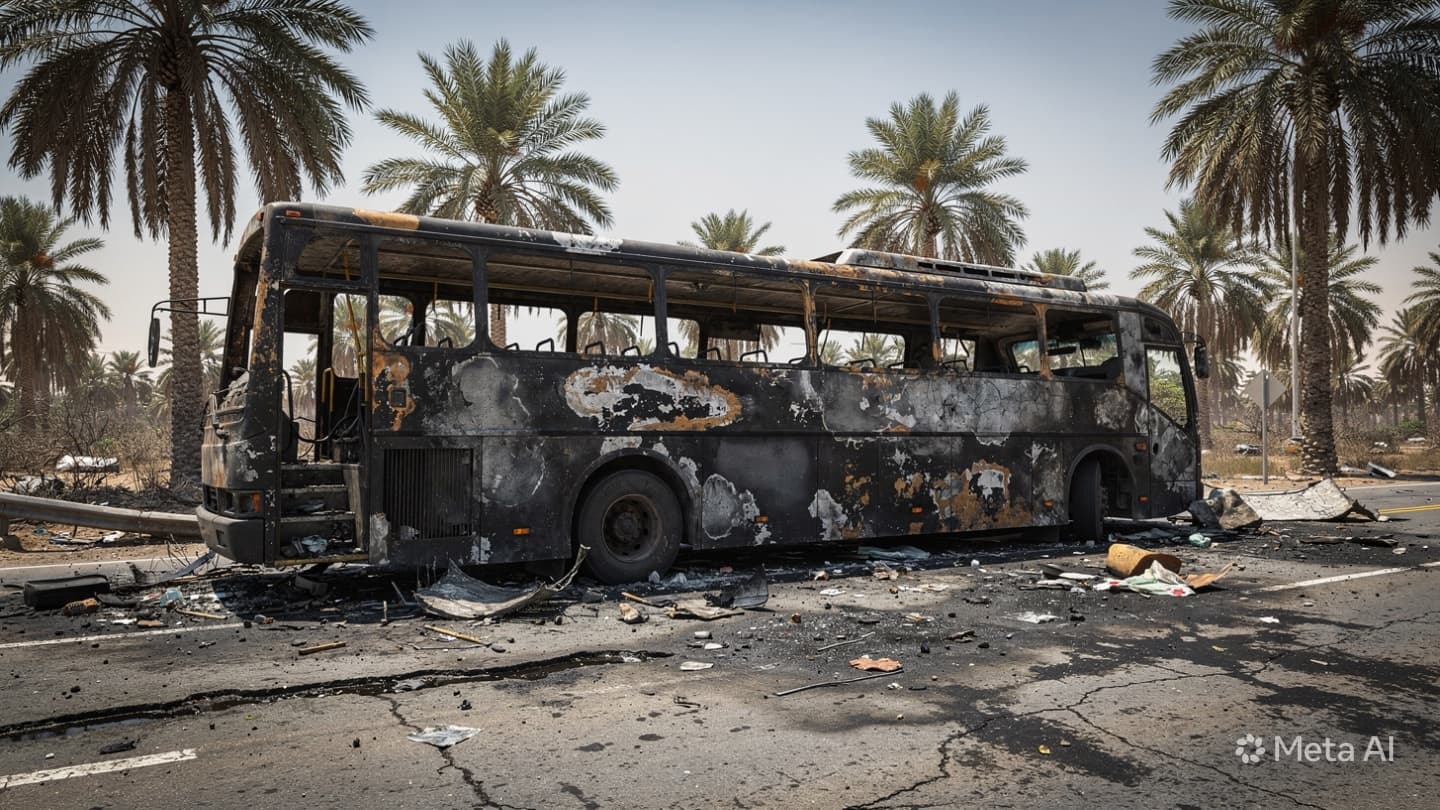
Palembang, Indonesia—A packed intercity passenger bus collided head-on with an industrial fuel tanker truck on the Trans-Sumatra Highway early Tuesday morning, triggering a massive explosion that killed sixteen people and left dozens more with critical burn injuries. The catastrophic impact occurred on a notorious bend in the highway passing through South Sumatra just after 4:00 a.m. local time. The force of the blast sent shockwaves through neighboring palm oil plantations, waking local workers who rushed to assist before emergency services arrived.
The fuel tanker, carrying thousands of liters of volatile petroleum gasoline, ruptured immediately upon impact and turned the entire crash site into a raging inferno within seconds. Thick, toxic black smoke billowed hundreds of feet into the predawn sky, visible from several miles away. Responders from the regional fire department struggled to approach the mangled wreckage due to intense thermal radiation and successive secondary fuel tank ruptures.
Highway patrol officers stated that the commercial passenger vehicle was traveling at high speed from Medan toward Jakarta when the driver appeared to lose control while trying to overtake a slow-moving freight truck. The bus veered directly into the opposite lane, striking the oncoming fuel transport truck before either driver could apply evasive braking maneuvers. Both operators are confirmed to be among the dead, trapped instantly inside their crushed driver compartments.
Emergency medical teams established a makeshift triage station on the asphalt half a kilometer from the burning debris to treat the few survivors who managed to escape through broken rear windows. Ten passengers were rushed to the provincial hospital in Palembang, where doctors report that six remain in intensive care with third-degree burns covering over fifty percent of their bodies. Medical personnel expect the death toll to rise as identification processes continue on the deeply charred remains.
Regional disaster management officials deployed heavy excavators to clear the scorched metal frames from the roadway, which remains completely closed to all transit traffic in both directions. The closure has caused a massive logistics backlog, with hundreds of commercial cargo trucks stranded along the primary arterial shipping route connecting Sumatra to Java. Supply chain coordinators warn that the bottleneck will disrupt food and fuel deliveries to the region for several days.
Forensic investigators from the national transportation safety committee arrived at the site by midday to examine the mechanical remnants and determine whether brake failure played a role in the disaster. Initial inspections reveal that the highway surface lacked distinct skid marks, supporting the theory that the impact occurred without warning. Investigators are also reviewing the transit company's logbooks to verify the operational hours and rest cycles of the deceased bus driver.
The transport ministry issued a stern public statement promising a comprehensive audit of all commercial passenger lines operating along the Trans-Sumatra network. Industry observers note that the highway has long suffered from poor lighting, inadequate lane markings, and an institutional lack of speed limit enforcement. Local communities have repeatedly petitioned for structural barriers on this specific stretch of road following a series of minor accidents last year.
Distraught relatives of the passengers gathered at the Palembang hospital morgue throughout the afternoon, waiting for dental records and DNA samples to confirm the identities of their family members. The state insurance agency announced it would provide immediate funeral compensation to the victims' next of kin, though representatives acknowledged that the administrative processing will take time due to the condition of the remains.
Clean-up crews spent the late afternoon scraping melted asphalt and oil residue from the damaged road bed to assess whether the highway requires emergency resurfacing before reopening. Police guards remain stationed at the perimeter coordinates, turning away onlookers and directing long-distance traffic onto narrow rural bypass roads that are ill-equipped for heavy cargo transport.
The local government called for a mandatory day of mourning across the province as the final recovery vehicles towed the twisted metal carcasses to a secure police impound lot. The smoke has finally cleared from the highway corridor, but the smell of burnt plastic and fuel still hangs heavily over the rural landscape as night falls.
Published by Banx Network. This article is part of the Banx decentralized media programme, powered by the BXE token on the XRP Ledger.