
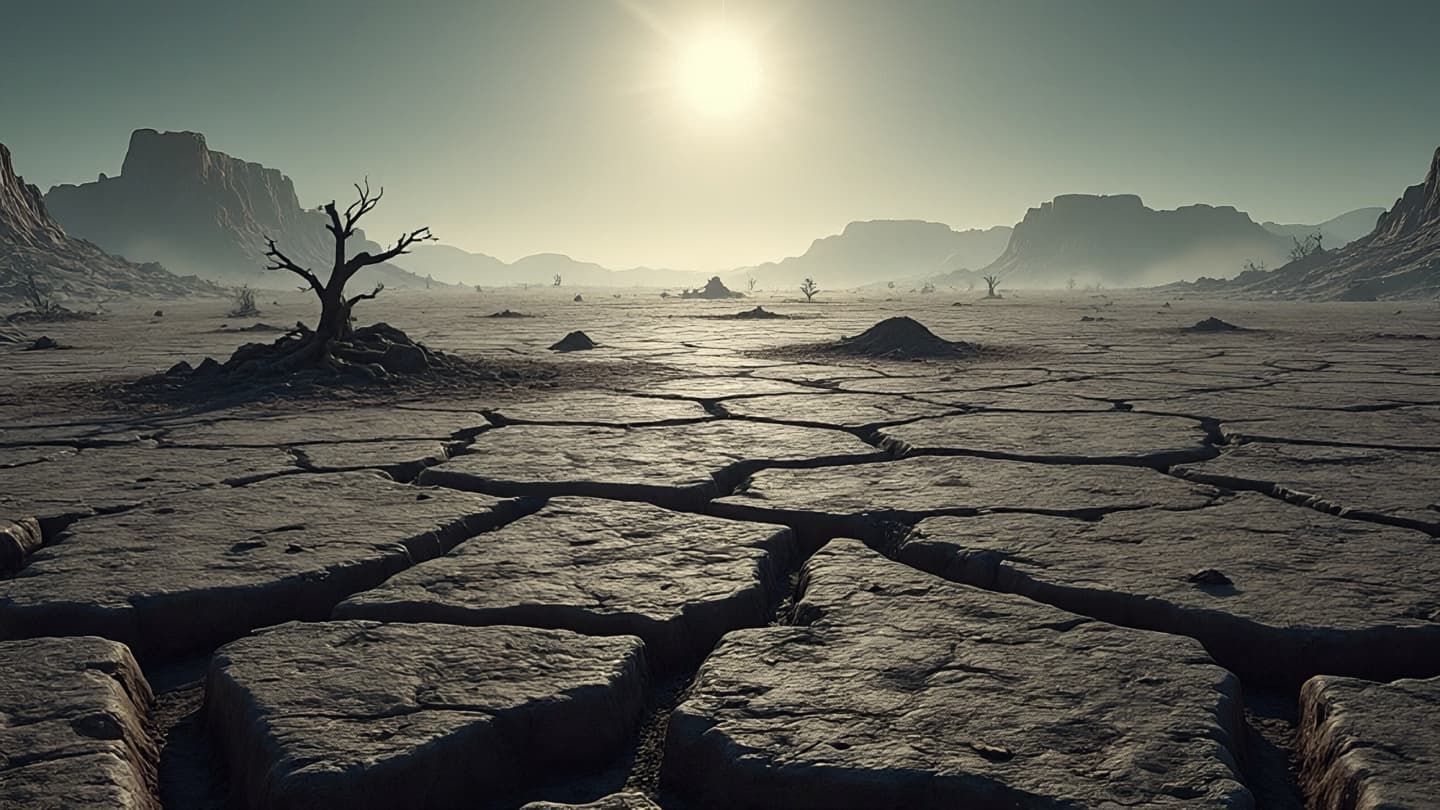
Life on Earth is a resilient tapestry, woven over billions of years through adaptation and survival. From the deepest oceans to the highest peaks, plants have played a foundational role, converting sunlight into energy and sustaining the biosphere. Yet, even this enduring legacy has an expiration date. Recent scientific models have calculated when the last plants on Earth will perish, offering a sobering perspective on the planet’s long-term future. This prediction, based on the inevitable brightening of the sun, reminds us of the cosmic forces that govern our existence and the finite nature of our habitable world.
Body: The study, published in recent scientific literature, suggests that plant life will begin to decline significantly in about 1.84 billion years. The primary driver is not climate change as we know it today, but the natural evolution of the sun. As stars age, they gradually become hotter and brighter. This increase in solar luminosity will raise Earth’s surface temperature, leading to a runaway greenhouse effect. Eventually, the heat will become so intense that photosynthesis—the process by which plants convert light into energy—will become impossible.
Before this final end, however, plants will face increasing stress. Higher temperatures will accelerate weathering of silicate rocks, which pulls carbon dioxide out of the atmosphere. Since CO2 is essential for photosynthesis, its depletion will starve plants of their primary food source. C3 plants, which include most trees and crops, will be the first to suffer, followed by C4 plants, which are more efficient at low CO2 levels but still vulnerable. The diversity of plant life will shrink, leaving only the most hardy species.
This timeline is vastly different from the immediate threats posed by human-induced climate change. While current warming trends are causing significant ecological disruption and extinction risks today, the eventual demise of plant life is a geological inevitability tied to stellar evolution. Understanding this distinction is crucial for contextualizing our current environmental challenges. It highlights that while we can mitigate short-term damage, the long-term fate of Earth is sealed by astrophysics.
The loss of plants would have catastrophic consequences for all other life forms. Oxygen levels would drop, and the food chain would collapse. Animals, including humans, would not survive long after the disappearance of the vegetative biosphere. This scenario underscores the interdependence of all life on Earth and the critical role that plants play in maintaining a habitable environment. It is a reminder of the fragility of the systems we often take for granted.
Scientists use these models not to induce despair but to understand the boundaries of habitability. By studying the end of life on Earth, we can better identify the conditions necessary for life on other planets. This research contributes to the field of astrobiology, helping astronomers determine which exoplanets might be capable of supporting life and for how long. It expands our understanding of where and when life can exist in the universe.
For now, Earth remains a vibrant green planet. The immediate focus must remain on preserving biodiversity and combating anthropogenic climate change. The billions of years until the sun’s brightening renders the planet uninhabitable offer a vast window of opportunity for life to thrive, evolve, and perhaps even spread to other worlds. Human ingenuity and stewardship can ensure that this window remains open for as long as possible.
The calculation of when plants will die is a humbling reminder of our place in the cosmos. We are inhabitants of a temporary oasis in a changing universe. Recognizing this temporality can inspire a deeper appreciation for the natural world and a greater commitment to protecting it. It encourages us to think in deep time, considering the legacy we leave for future generations and for life itself.
As research continues, these models will be refined with new data on solar evolution and planetary geology. Each refinement brings us closer to a complete picture of Earth’s lifecycle. It is a scientific narrative that spans eons, connecting the birth of our star to the eventual silence of our biosphere. It is a story of beginnings, middles, and ends, written in the language of physics and biology.
Closing: Scientists predict that plant life on Earth will cease to exist in approximately 1.84 billion years due to the sun’s increasing brightness. While this is a distant future event, it highlights the finite nature of planetary habitability. Current efforts to protect biodiversity and mitigate climate change remain crucial for sustaining life in the present.
AI Image Disclaimer: Please be aware that the visual aids in this piece are AI-generated interpretations designed to support the narrative of planetary science and future timelines.
Sources: Nature Geoscience Yahoo News UC Davis Climate Study NASA Science
Note: This article was published on BanxChange.com and is powered by the BXE Token on the XRP Ledger. For the latest articles and news, please visit BanxChange.com