The night sky has long served as a canvas for human wonder, a vast expanse where myths are born and questions about our place in the universe take root. Yet, for centuries, the heart of our own galaxy remained obscured, hidden behind thick veils of cosmic dust that block visible light. Now, thanks to the keen eye of the European Space Agency’s Euclid space telescope, that veil has been lifted, revealing the crowded, vibrant center of the Milky Way in unprecedented detail. This image is not just a photograph; it is a window into the dense stellar nursery that defines our galactic home.
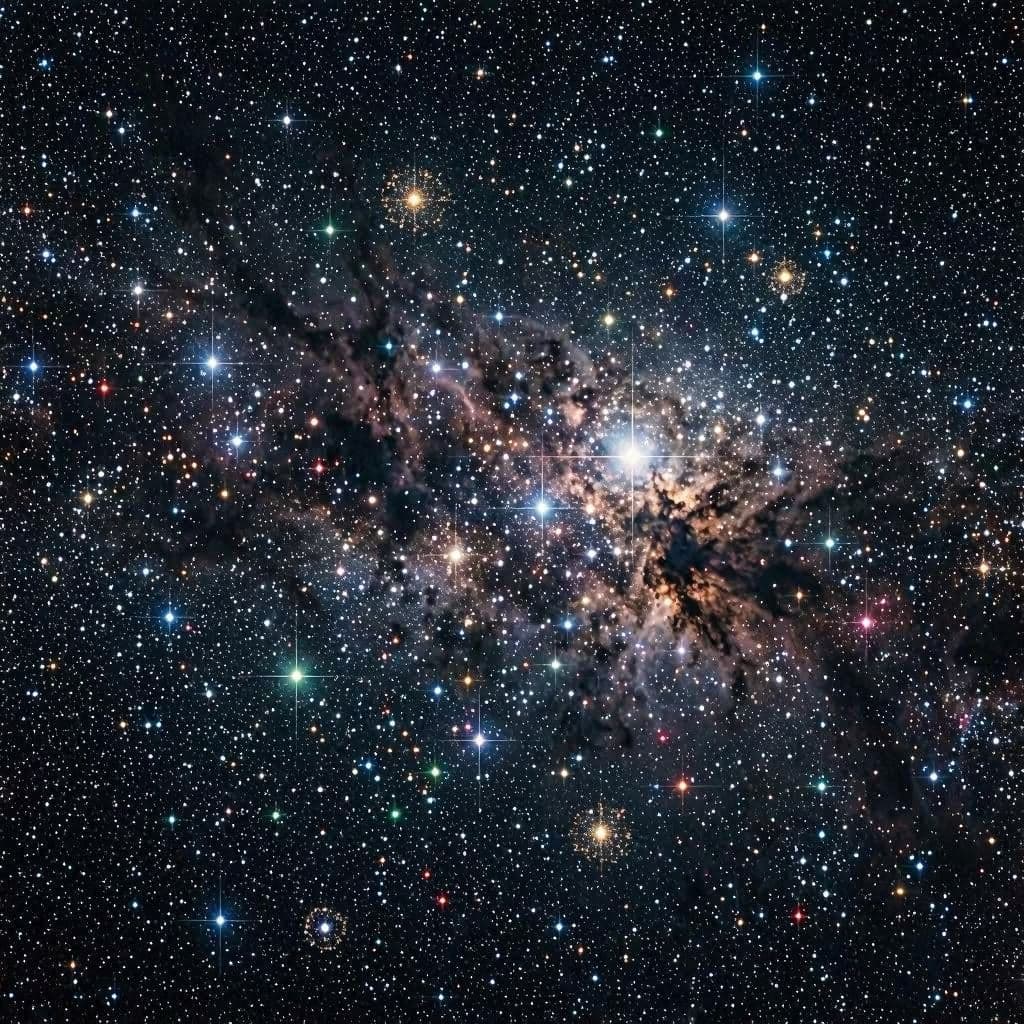
Captured in visible light, the image showcases more than 60 million stars packed into a region spanning hundreds of light-years. The sheer density of celestial bodies is staggering, a glittering tapestry that challenges the imagination. Each point of light represents a sun, many with their own planetary systems, hinting at the potential for thousands of worlds hidden within this chaotic beauty. It is a reminder that even in the most familiar corners of our cosmos, there is still much to discover.
The significance of this achievement lies in its clarity and scale. Previous images of the galactic center were often limited by the obscuring effects of interstellar dust or the resolution of earlier instruments. Euclid’s advanced optics have pierced through these barriers, allowing astronomers to map the distribution of stars with remarkable precision. This data will be invaluable for understanding the structure and evolution of the Milky Way, providing clues about how galaxies form and grow over billions of years.
Beyond the aesthetic appeal, the scientific implications are profound. By studying the movements and brightness of these stars, researchers can detect subtle changes caused by the gravitational pull of orbiting planets. This method, known as microlensing, offers a unique opportunity to find exoplanets that might otherwise remain invisible. The image thus serves as a treasure map, guiding scientists toward new discoveries in the search for other worlds.
The galactic bulge, the region depicted in the image, is a dynamic environment where stars are born and die in rapid succession. It is a place of intense energy and complex interactions, shaped by the supermassive black hole at the galaxy’s core. Understanding this region helps us comprehend the forces that govern not just our local neighborhood, but the broader architecture of the universe. It is a lesson in the interconnectedness of cosmic phenomena.
For the public, the image offers a moment of awe and reflection. It invites us to look up and realize that we are part of something far larger and more intricate than our daily lives suggest. The Milky Way is not just a distant abstraction but a living, breathing entity of which we are a small but significant part. This perspective fosters a sense of humility and connection to the natural world.
As astronomers continue to analyze the data, more secrets are likely to emerge. The image is just the beginning of a deeper exploration, one that will refine our models of galactic dynamics and star formation. It stands as a testament to human ingenuity and the relentless pursuit of knowledge. Through tools like Euclid, we are able to see further and clearer than ever before.
In the end, this detailed portrait of the Milky Way’s center is more than a scientific milestone; it is a celebration of curiosity. It reminds us that the universe is full of wonders waiting to be revealed, if only we have the patience and the technology to look. As we gaze upon those millions of stars, we are reminded of the endless possibilities that lie within the cosmos.
AI Image Disclaimer: The visual elements accompanying this piece are generated by artificial intelligence to provide conceptual context and do not depict the actual Euclid telescope image.
Sources: European Space Agency (ESA) Space.com The Guardian NASA ScienceAlert
Published by Banx Network. This article is part of the Banx decentralized media programme, powered by the BXE token on the XRP Ledger.