
The issuance of a national red alert is a rare and weighty act, a formal recognition by the state that the ordinary boundaries of governance must yield to the overriding imperative of human survival. Across the flood-prone valleys and low-lying coastal plains, this declaration has translated into a visible, authoritative intervention in the lives of thousands. The soft rhythm of rural existence has been interrupted not just by the weather, but by the firm, orderly presence of officials enforcing compulsory evacuations.
To leave one's home under the mandate of law is a complex emotional experience, distinct from the frantic flight caused by sudden conflict. It is an ordered departure, where families are given a brief window to collect their essentials before being escorted away from the lands they have cultivated for generations. The state vehicles, their emergency lights casting a rhythmic flash against the grey sky, stand as reminders of the invisible danger rising in the riverbeds.
There is a natural resistance to these orders, born of a deep, spiritual attachment to the land and a fear of what happens to property left abandoned to the elements. Elders stand at their doorways, looking out over fields that are already turning into marshland, arguing softly with young civil protection officers who carry the weight of state responsibility on their shoulders. In the end, the logic of survival prevails, and the keys are turned in locks that may soon be underwater.
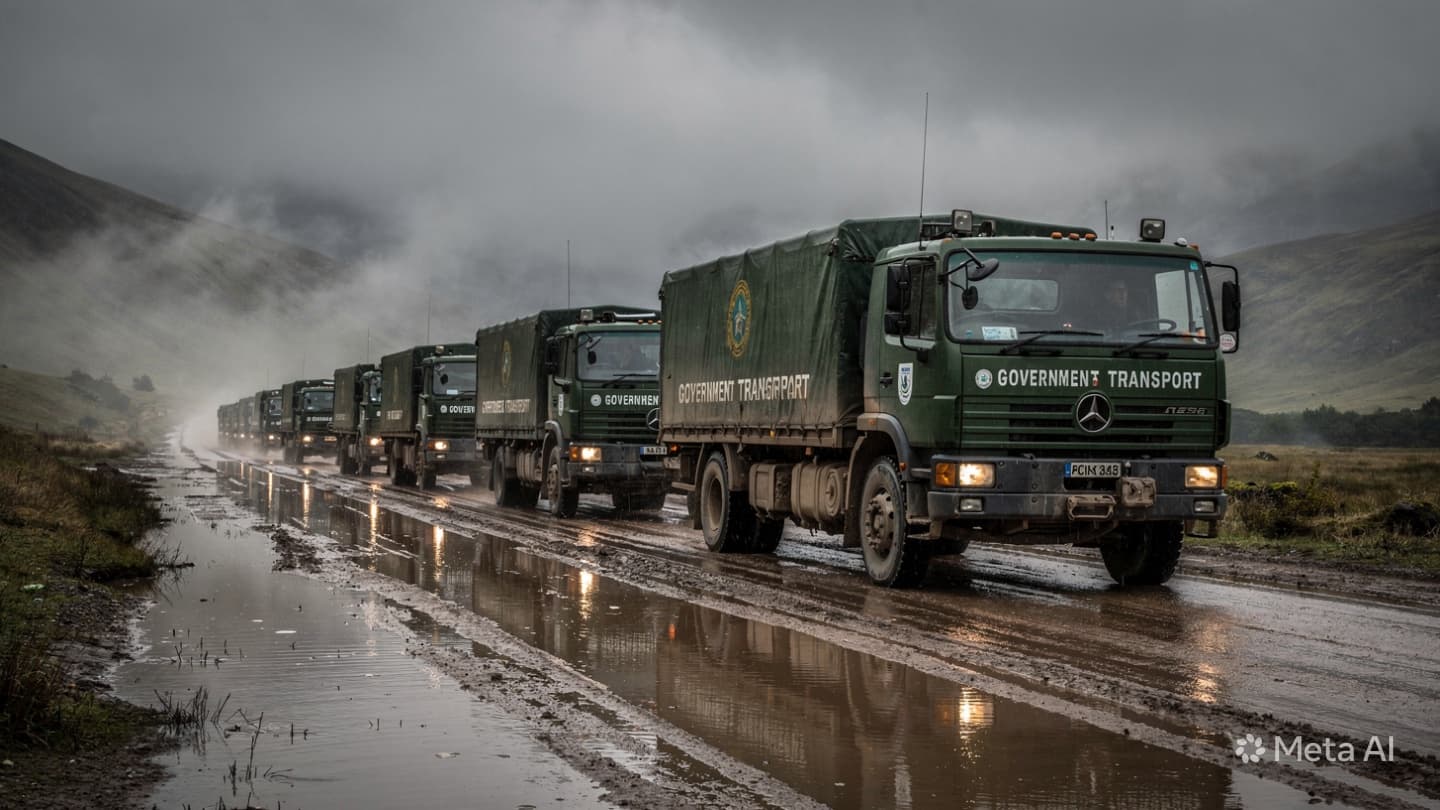
The evacuation routes are highly organized corridors of transition, with military and civilian trucks moving in convoy to transport the elderly, the children, and the infirm to designated safe zones. These convoys move slowly through the deepening mud, their engines roaring against the silence of a landscape that has been largely emptied of human presence. The fields stand silent, populated only by abandoned livestock that watch the passing vehicles with dull curiosity.
In the designated reception centers—often sturdy school buildings, sports stadiums, or government compounds located on high rocky ridges—the reality of the red alert becomes tangible. Classrooms are emptied of desks and filled with sleeping mats, creating communal living spaces where privacy is sacrificed for security. The transition is stark, transforming centers of learning and governance into dense, temporary sanctuaries of survival.
The enforcement of these measures requires a delicate balance of authority and empathy, as officials must manage the collective anxiety of an uprooted population. Civil defense workers, their uniforms damp from the persistent drizzle, spend hours explaining the meteorological data to skeptical residents, using maps and charts to demonstrate the unseen volume of water rushing down from upstream dams. It is an attempt to make the invisible threat real to those who only see the familiar river of their childhood.
Despite the orderliness of the operation, the sense of displacement remains acute, as families contemplate the economic ruin waiting for them when the waters eventually recede. The state can guarantee immediate physical safety, but it cannot protect the submerged crops, the drowned livestock, or the mud walls that are currently dissolving in the valley below. This economic uncertainty hangs heavily over the clean, dry sanctuaries of the high ground.
As night descends, the high-risk zones become dark, empty voids, devoid of the cooking fires and lamps that normally signify human habitation. Above them, on the ridges, the bright lights of the evacuation centers shine out like lighthouses in a darkening world.
In official updates from the national disaster management authority, it was confirmed that the compulsory evacuation mandates have successfully moved thousands of vulnerable citizens out of active flood paths. The declaration of the National Red Alert remains in effect as regional river basins continue to receive upstream runoff. Administrative bodies emphasize that security personnel will remain deployed in the evacuated zones to protect property until return orders are officially sanctioned.
Note: This article was published on BanxChange.com and is powered by the BXE Token on the XRP Ledger. For the latest articles and news, please visit BanxChange.com