
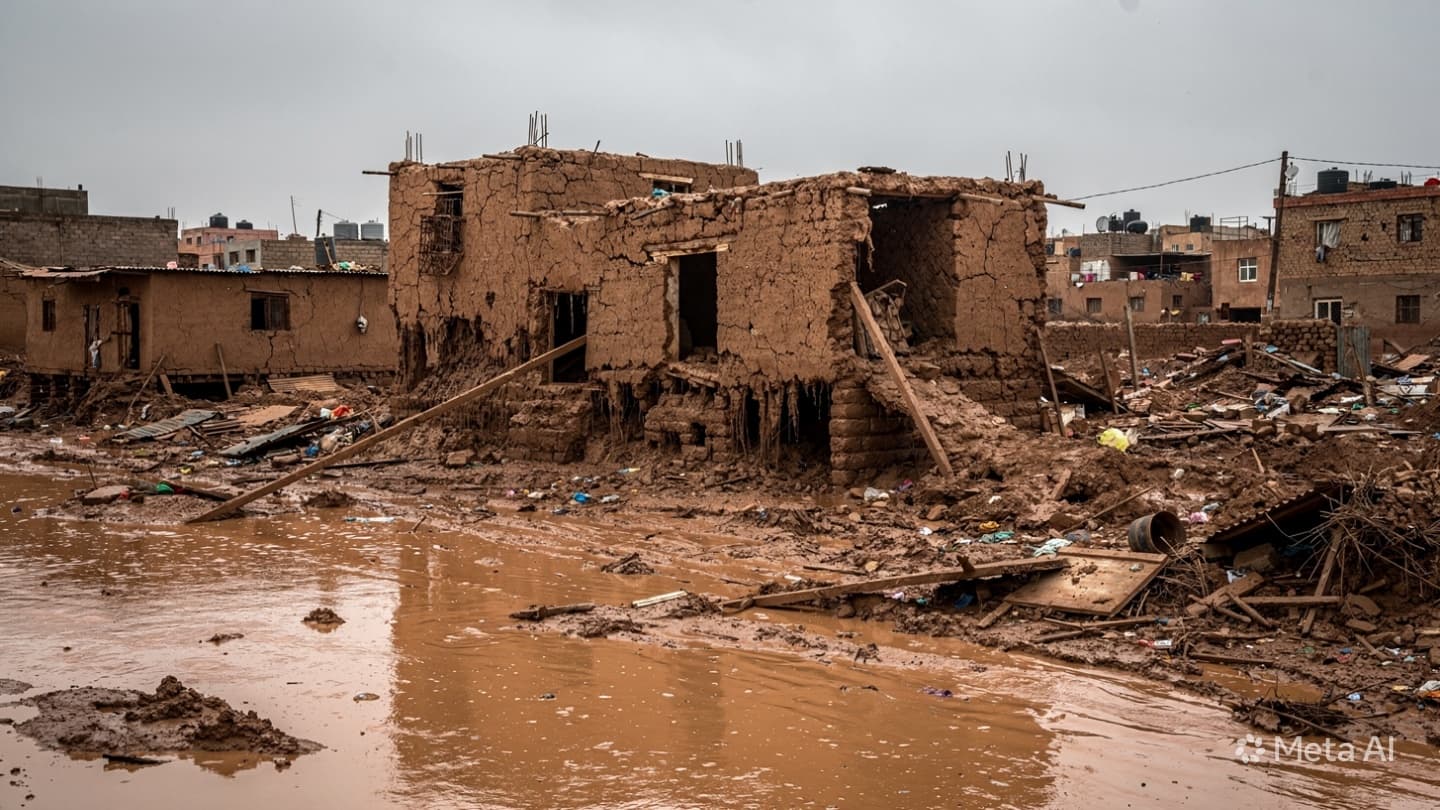
Khartoum, Sudan—Sudden, intense downpours turned city streets into raging mud rivers before dawn today, killing nine residents and inundating high-density neighborhoods. A massive cloudburst dropped unprecedented rainfall volumes onto the metropolitan area, completely overwhelming the city's rudimentary drainage channels within an hour. Civil defense units confirmed that mud-brick homes in low-income districts dissolved under the water surge, trapping families inside. Rescue teams are utilizing basic inflatable boats to access stranded populations as mud levels rise.
Local administrators reported that multiple residential sectors are completely isolated from central municipal services. The moving water tore down utility poles and exposed electrical wires, forcing grid managers to kill power across the capital to prevent mass electrocutions. Military trucks are trying to move through flooded avenues, but deep mud pits have stalled several heavy transport vehicles. Ground teams are using basic hand tools to clear debris chokes from narrow drainage outlets.
State emergency coordinators stated that the current casualty list is expected to expand as water clears from subterranean dwellings. They noted that body recovery teams are scanning downstream riverbanks where missing individuals may have been carried by the current. Local community buildings situated on higher ground have opened their doors to shelter hundreds of families who lost their homes. Potable water networks are completely offline, forcing residents to rely on unverified well sources.
Agricultural fields along the city's periphery were completely submerged under feet of polluted urban runoff. Local market operators expect immediate shortages of basic food staples, as key agricultural access paths remain entirely impassable. Small trade stalls in the central market were swept away during the initial flash surge, eliminating the daily livelihoods of hundreds of independent vendors. Prices for remaining clean water bottles have spiked across local shops, forcing security forces to intervene.
Local police units are patrolling flooded intersections to prevent vehicles from entering deep water channels where hidden currents are active. The physical velocity of the floodwaters continues to erode the foundations of remaining concrete structures, leading to secondary wall collapses. Emergency communication networks are severely compromised, forcing officials to rely on tactical radio frequencies to coordinate field movements. Municipal engineers are trying to construct earth berms to redirect incoming runoff away from central hospital complexes.
Public health workers expressed deep concern regarding the mixing of raw sewage with standing floodwaters across residential zones. This contamination creates an immediate vector for rapid cholera and waterborne typhoid outbreaks among the displaced population. Medical clinics are packing emergency kits with oral rehydration salts and water chlorine treatments for immediate distribution. The logistical strain on available field medics is intense as they wade through waist-deep polluted water to reach victims.
Urban planners emphasize that rapid, unregulated urban expansion over natural drainage paths has drastically magnified the impact of these seasonal storms. The lack of concrete drainage investments over the past decade left the city entirely defenseless against sudden meteorological anomalies. Local neighborhood committees are demanding immediate investments in city infrastructure to prevent these recurrent fatal scenarios. Administrative inquiries into structural budget diversions are being pushed by civic groups.
Worsening weather charts predict additional storm cells will form over the Blue Nile catchment area within the next twenty-four hours, threatening to raise river levels further. Search operations are moving under severe time limits as daylight fades across the darkened capital city. Field units are working under extreme stress to secure vulnerable perimeters before the next rainfall line impacts the mud-soaked terrain.
Engineering details are currently attempting to install emergency pumping units near the city center to drain flooded medical facilities. The high volume of floating plastic garbage continues to clog the pump intake screens, requiring constant manual clearing by exhausted workers.
Note: This article was published on BanxChange.com and is powered by the BXE Token on the XRP Ledger. For the latest articles and news, please visit BanxChange.com