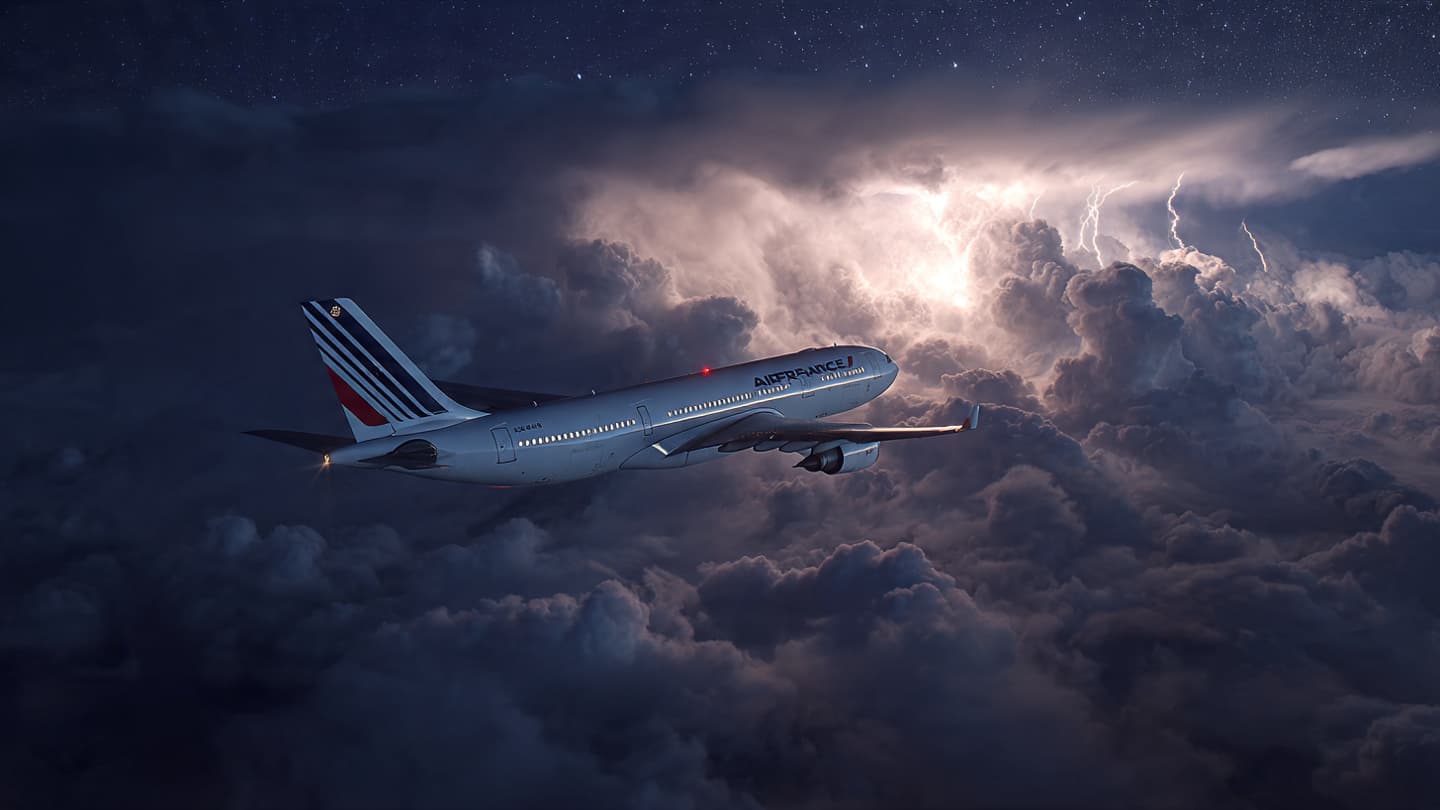
Some tragedies do not end when the wreckage is found. They continue drifting through years, carried by unanswered questions, technical investigations, courtroom debates, and the quiet endurance of families waiting for meaning to emerge from loss. The crash of Air France Flight 447 over the Atlantic Ocean in 2009 became one of those enduring sorrows — a disaster suspended for years between mystery and memory.
This week, a French court found Airbus and Air France guilty in connection with the crash that killed all 228 people aboard the Rio de Janeiro-to-Paris flight nearly seventeen years ago. The ruling marked a major legal turning point in one of modern aviation’s most haunting cases, a tragedy that profoundly reshaped global discussions about pilot training, aircraft systems, and aviation safety.
When Flight 447 disappeared on June 1, 2009, the aircraft vanished into darkness above the Atlantic during severe weather conditions. For days, uncertainty surrounded the fate of the Airbus A330 and those aboard. Debris eventually appeared scattered across remote ocean waters, but the aircraft’s flight recorders remained lost deep beneath the sea for nearly two years, prolonging the mystery and intensifying grief for families across multiple countries.
The eventual investigation revealed a complex chain of technical and human factors. Ice crystals obstructed the aircraft’s pitot tubes — instruments responsible for measuring airspeed — leading to inconsistent speed readings and the temporary disengagement of the autopilot system. Confusion inside the cockpit followed as pilots struggled to interpret rapidly changing flight conditions during the nighttime storm. Investigators later concluded that inappropriate pilot responses contributed to the aircraft entering an aerodynamic stall from which it never recovered.
Yet beyond the technical details, the legal proceedings increasingly focused on whether earlier warnings about pitot tube reliability had been adequately addressed by Airbus and Air France before the crash occurred. Prosecutors argued that both companies failed to respond quickly enough to known risks associated with sensor malfunctions in high-altitude icing conditions.
The court’s decision reflected years of legal examination into those questions. Families of victims had long sought accountability not only for the sequence of events aboard the aircraft, but also for broader institutional decisions made before the disaster unfolded.
For many relatives, the ruling carried emotional significance beyond financial penalties or legal terminology. Throughout the lengthy investigation and trial process, families repeatedly described feeling suspended in time — waiting through technical reports, hearings, and appeals while attempting to preserve the memory of loved ones lost far from land and visibility.
The crash itself deeply affected the aviation industry worldwide. Following the disaster, airlines and aircraft manufacturers introduced major changes involving pilot training, stall recovery procedures, and sensor system reliability. Aviation regulators also accelerated efforts to improve aircraft tracking technology over oceans and remote regions, responding to criticism that modern passenger jets could still disappear for extended periods without immediate location data.
Air France and Airbus both acknowledged the pain experienced by victims’ families following the verdict while continuing to emphasize the complexity of the crash investigation. Legal representatives noted that the accident resulted from multiple interconnected factors rather than a single isolated failure.
Still, the symbolic weight of the ruling remains considerable because Flight 447 became more than an aviation accident over time. It evolved into a global lesson about technology, training, and the limits of modern systems when confronted by sudden uncertainty at high altitude.
The image of the aircraft disappearing into darkness over the Atlantic also lingered powerfully in public consciousness. Unlike crashes witnessed near airports or cities, Flight 447 vanished into open ocean, leaving behind an absence that felt almost literary in its scale — a modern machine carrying hundreds of lives into a silence that lasted years before answers slowly emerged.
Legal experts note that aviation trials often unfold over long periods because they involve overlapping technical, corporate, and regulatory responsibilities. Determining accountability in such disasters requires examining not only the final moments of a flight, but also maintenance decisions, engineering assessments, training procedures, and communication between manufacturers and airlines.
For the families gathered in French courtrooms this week, however, the proceedings remained deeply personal. Some carried photographs of relatives. Others spoke quietly to reporters about exhaustion after nearly two decades of legal struggle. Many described the verdict not as closure, but as recognition that the losses aboard Flight 447 deserved continued scrutiny and remembrance.
As the aviation industry continues advancing through automation and increasingly sophisticated flight systems, the legacy of the Rio-Paris crash remains woven into pilot instruction manuals, cockpit training programs, and safety reforms worldwide. And though no ruling can return the lives lost over the Atlantic that night, the court’s decision ensures the tragedy remains not only a memory of disaster, but also part of an ongoing effort to understand how such silence descended from the sky in the first place.
AI Image Disclaimer Illustrations were produced with AI and serve as conceptual depictions.
Sources Reuters Associated Press (AP) BBC CNN The New York Times Le Monde France 24 The Guardian Aviation Week Al Jazeera
Published by Banx Network. This article is part of the Banx decentralized media programme, powered by the BXE token on the XRP Ledger.

.jpg&w=3840&q=75 "Russia Turns Black Sea Into World’s Deadliest Shipping Route as More Than 570 Ships Are Hit")