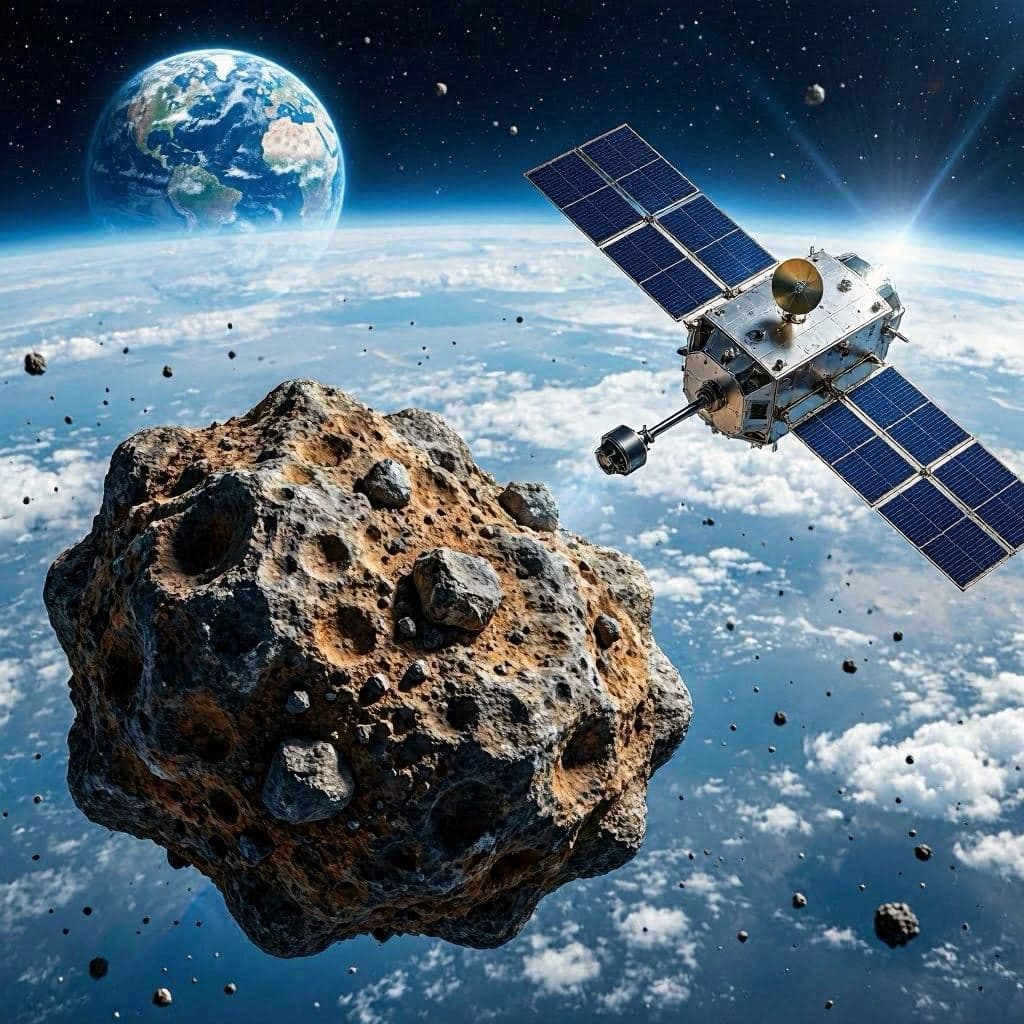
In the gravitational dance of the solar system, Earth has a subtle partner that few people know exists. Kamoʻoalewa, a small asteroid discovered in 2016, follows a complex path that keeps it in the vicinity of our planet, earning it the title of a "quasi-moon." Unlike our true moon, which orbits Earth directly, Kamoʻoalewa orbits the sun in a resonance that makes it appear to circle us. Now, this mysterious object is the target of an ambitious mission by China’s Tianwen-2 spacecraft, which aims to return samples to Earth, potentially revealing secrets about our own lunar history.
Body: The unique orbital dynamics of Kamoʻoalewa make it a fascinating subject for study. It is believed to be a fragment of the moon itself, ejected into space by a powerful impact billions of years ago. If this hypothesis is correct, studying Kamoʻoalewa could provide insights into the early geological history of the moon without the need for a new lunar landing. The composition of its rocks might hold clues about the moon’s interior and the events that shaped its surface, offering a window into the past that is otherwise difficult to access.
The Tianwen-2 mission represents a significant milestone in China’s growing space exploration capabilities. Scheduled to launch in the near future, the spacecraft will travel to Kamoʻoalewa, collect samples, and return them to Earth for detailed analysis. This sample-return mission is technically challenging, requiring precise navigation and autonomous operations in deep space. Success would place China among a select group of nations capable of retrieving material from beyond Earth’s immediate orbit.
Scientific interest in Kamoʻoalewa has grown as researchers analyze its spectral properties. Data suggests that its composition is similar to lunar silicates, supporting the theory of a common origin. However, definitive proof can only come from direct examination of physical samples. Laboratory analysis on Earth allows for a level of precision that remote sensing cannot match, enabling scientists to date the rock and determine its mineralogical makeup with high accuracy.
The mission also highlights the increasing international competition and collaboration in space exploration. As more countries and private entities venture into the solar system, the focus is shifting from mere exploration to resource utilization and scientific discovery. Missions like Tianwen-2 contribute to a broader understanding of near-Earth objects, which are important for both scientific research and planetary defense strategies. Understanding the nature of these objects helps us assess potential risks and opportunities.
Moreover, the study of quasi-moons like Kamoʻoalewa expands our understanding of orbital mechanics. These objects occupy stable regions in the Earth-sun system, known as Lagrange points, where gravitational forces balance. Studying their behavior helps refine models of celestial dynamics, which is crucial for planning future missions and managing space traffic. Kamoʻoalewa serves as a natural laboratory for testing theories about how small bodies interact with planets.
As the Tianwen-2 spacecraft closes in on its target, anticipation builds within the scientific community. The samples it returns could rewrite parts of the moon’s history, confirming or refuting the impact ejection theory. Regardless of the outcome, the mission demonstrates the power of space exploration to answer fundamental questions about our origins. It is a reminder that even objects that seem distant and insignificant can hold profound secrets.
Closing: China’s Tianwen-2 mission to the quasi-moon Kamoʻoalewa marks an exciting step in planetary science. By attempting to return samples from this unique object, scientists hope to uncover evidence linking it to the moon’s ancient past. The success of this mission could provide valuable insights into the formation and evolution of our celestial neighbor.
AI Image Disclaimer: Please be aware that the visual aids in this piece are AI-generated interpretations designed to support the narrative of the space mission.
Sources: Nature Communications China National Space Administration (CNSA) Space.com EarthSky
Published by Banx Network. This article is part of the Banx decentralized media programme, powered by the BXE token on the XRP Ledger.