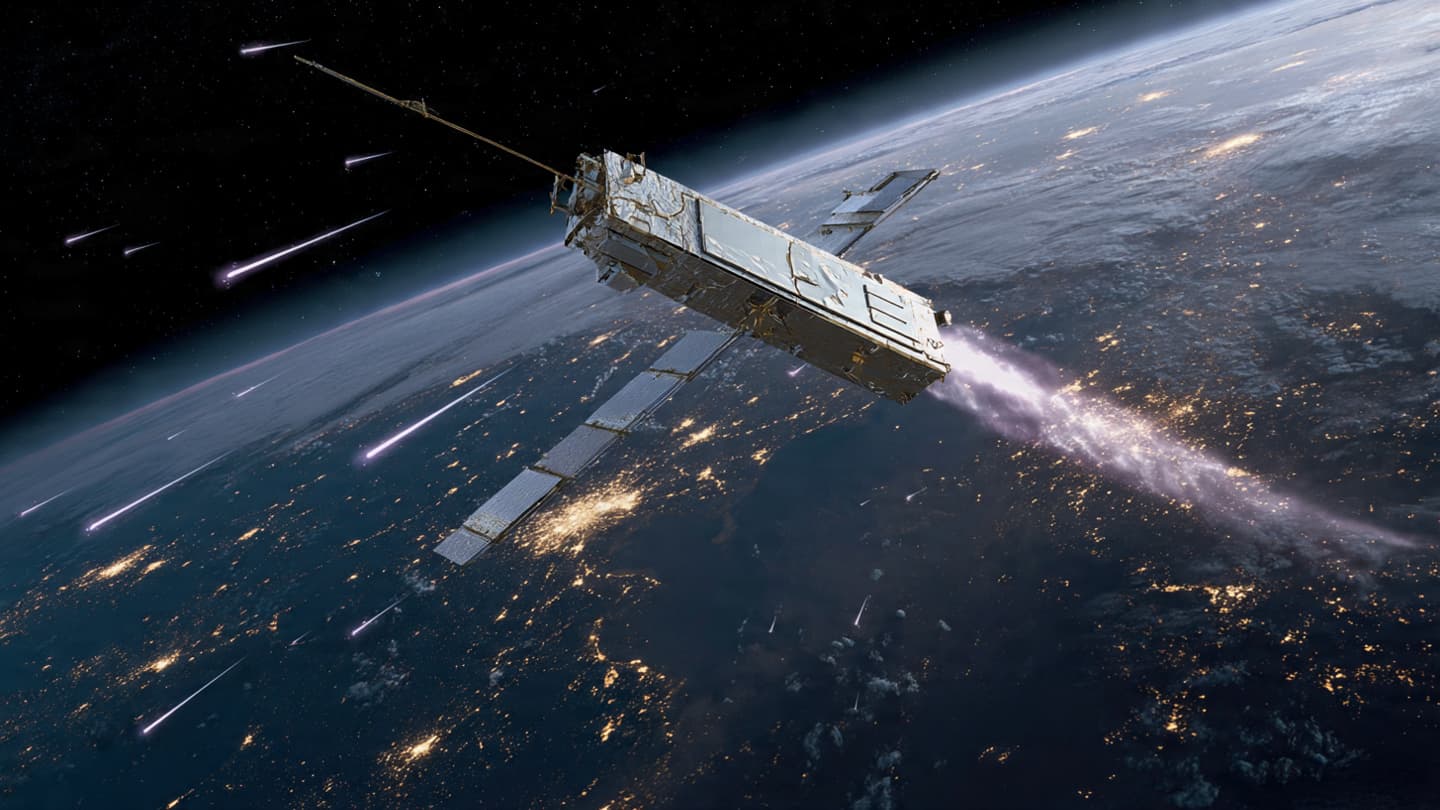
Scientific discovery often arrives indirectly, like distant light appearing where no one expected to look. Instruments designed for one purpose sometimes uncover realities far beyond their original mission. During the tense years of the Cold War, the United States launched the Vela satellites to monitor secret nuclear weapons tests. Yet while scanning Earth for signs of conflict, the satellites unexpectedly captured mysterious flashes from deep space that would eventually transform astrophysics.
The Vela program was originally developed to enforce international nuclear test ban agreements by detecting gamma radiation associated with atomic explosions. Orbiting high above Earth, the satellites served as silent observers during a period shaped by geopolitical rivalry and fear of hidden weapons development.
In the late 1960s, however, the satellites detected unusual bursts of gamma radiation that did not match the patterns expected from nuclear detonations. Scientists initially struggled to explain the signals, which appeared to originate far beyond Earth’s atmosphere. The phenomenon became one of the great scientific mysteries of the era.
Over time, researchers determined that the flashes were not evidence of secret military activity but cosmic events now known as gamma-ray bursts. These powerful explosions, originating from distant regions of the universe, release enormous amounts of energy within seconds and remain among the most extreme phenomena ever observed in astrophysics.
The discovery opened an entirely new field of scientific research. Astronomers and physicists began investigating the origins of gamma-ray bursts, eventually linking many of them to collapsing stars, supernova explosions, and collisions involving neutron stars. The findings reshaped understanding of how violent and energetic the universe can be.
The story of the Vela satellites also reflects how scientific progress often emerges from unexpected intersections between politics, technology, and curiosity. Systems built during periods of military competition sometimes produce discoveries that expand human knowledge far beyond strategic objectives.
Modern observatories and space telescopes continue studying gamma-ray bursts using technologies far more advanced than those available during the Vela era. These observations now contribute to research involving black holes, gravitational waves, and the early evolution of the universe itself.
What began as an effort to monitor nuclear secrecy ultimately became a turning point in space science. The accidental detection of distant cosmic flashes remains one of the most remarkable examples of how tools designed for earthly conflict unexpectedly revealed mysteries written across the universe.
AI Image Disclaimer: Some accompanying visuals were generated using AI technology to illustrate Cold War satellites and deep-space gamma-ray phenomena.
Sources: NASA, Scientific American, Nature, Smithsonian Magazine
Published by Banx Network. This article is part of the Banx decentralized media programme, powered by the BXE token on the XRP Ledger.