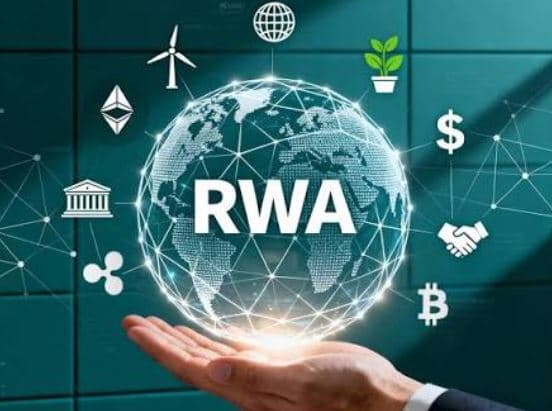
Real-world asset (RWA) tokenization stopped being a pilot program in 2026. It became a market with its own scoreboard, its own liquidity problems, and its own list of Wall Street names attached.
The Numbers Behind the Boom
According to rwa.xyz, the total value of tokenized real-world assets on public blockchains reached roughly $29 billion in the first quarter of 2026, a 263% jump from 2024. Other trackers, using slightly different methodologies, put the figure closer to $32–36 billion. Whichever number is used, the direction is the same: growth this year has outpaced every prior year combined, and Boston Consulting Group's projection of a $16 trillion tokenized market by 2030 no longer sounds like a slide-deck fantasy to the institutions building toward it.
BlackRock's tokenized Treasury fund, BUIDL, is the sector's benchmark product. It had grown to roughly $2.5 billion in assets by late May 2026, distributed across eight blockchains including Ethereum, Solana and Arbitrum, and began trading on Uniswap in February — a regulated institutional fund sitting on a decentralized exchange for the first time. JPMorgan has issued tokenized asset-backed securities, and the Depository Trust & Clearing Corporation — the backbone of US securities settlement — has moved from pilot talk to announcing production testing for tokenized securities starting in July 2026.
Institutional Anchors, Multiplying
What distinguishes 2026 from earlier tokenization cycles is the range of institutions now treating it as infrastructure rather than experiment. Ondo Finance's partnerships now span Mastercard, which integrated Ondo into its Multi-Token Network for RWA settlement, Fidelity, which folded Ondo's USDG into tokenized fund strategies, and PayPal, which set up a $25 million facility connecting PYUSD to Ondo's yield products. Tokenized US Treasuries remain the largest category by far, and tokenized gold had a breakout year, with Q1 2026 spot trading volume already surpassing all of 2025 combined, according to CoinGecko's RWA data.
The Piece Nobody Has Solved: Liquidity
None of that answers the industry's most persistent problem. The issuance side of tokenization — wrapping a Treasury bill or a private credit note into a compliant token — is largely solved; dozens of platforms can do it. What remains unsolved is the secondary market. An investor holding a tokenized real estate stake with a five-year lock-up has, in practice, few better options than an investor holding the traditional, untokenized version: find a buyer informally, negotiate a bilateral transfer with compliance checks, or wait for maturity. Building compliance-gated order books, DvP settlement and institutional-grade matching engines is the unglamorous work now defining which platforms actually succeed.
Regulation Set the Table
None of this growth happens in a vacuum. The GENIUS Act, which set a federal framework for payment stablecoins in mid-2025, gave institutions a settlement asset they could trust alongside tokenized products, and regulatory sandboxes in Singapore, Hong Kong and the UAE have lowered the friction of cross-border pilots. Only a sliver of the roughly $28 trillion US Treasury market has been tokenized so far — which is exactly the point analysts keep making: the runway, not the current total, is the real story.
The Bigger Picture
Tokenization in 2026 has stopped needing a marketing pitch. BlackRock, JPMorgan, Mastercard, Fidelity, PayPal and the DTCC are not participating because tokenized assets are novel — they're participating because atomic settlement, 24/7 markets and fractional access solve real operational problems. Whether the market reaches BCG's $16 trillion figure by 2030 depends less on issuance growth, which is already proven, and more on whether secondary liquidity infrastructure catches up to the assets it now needs to trade.
This article is for informational purposes only and does not constitute financial advice.
Published by Banx Network. This article is part of the Banx decentralized media programme, powered by the BXE token on the XRP Ledger.