
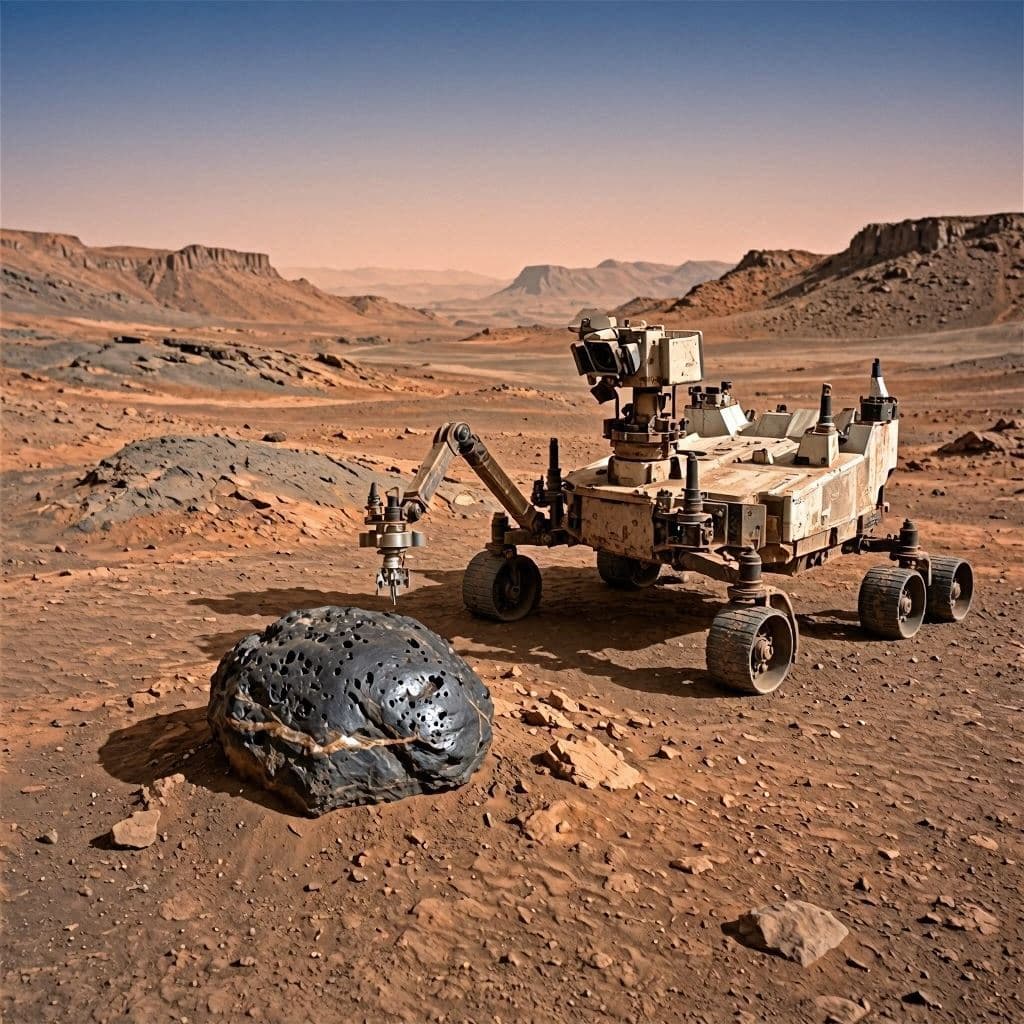
The most intriguing questions in science are often born from quiet surprises rather than dramatic discoveries. A single rock resting on the dusty surface of Mars may appear unremarkable at first glance, yet it has prompted scientists to pause and reconsider what they know about the Red Planet. Like a page from an ancient book with unfamiliar writing, the rock invites careful study instead of quick conclusions.
NASA's Perseverance rover recently examined a Martian rock containing an unusually high concentration of carbon. While carbon is one of the fundamental building blocks of life on Earth, scientists emphasize that its presence alone does not indicate biological activity. Instead, the finding presents a scientific puzzle whose origin remains uncertain.
Researchers explain that carbon can form through a variety of natural geological and chemical processes. Volcanic activity, interactions between rocks and water, atmospheric chemistry, or the impact of meteorites could all contribute to carbon-rich minerals. Determining which process occurred on Mars requires additional laboratory analysis that cannot yet be performed on the planet itself.
The discovery is particularly valuable because Perseverance is exploring Jezero Crater, an area believed to have hosted a lake and river delta billions of years ago. Ancient environments that once contained liquid water are considered promising locations for investigating whether Mars could have supported conditions favorable for microbial life in its distant past.
Scientists caution against interpreting the finding as evidence of past life. At present, no single measurement can distinguish with certainty between biological and non-biological sources of carbon. Instead, the discovery becomes one piece of a much larger scientific investigation that combines mineralogy, chemistry, geology, and future sample analysis.
The Mars Sample Return campaign, although facing technical and budgetary challenges, remains an important long-term objective. If selected rock samples eventually reach laboratories on Earth, researchers will be able to use highly sophisticated instruments unavailable on robotic spacecraft, allowing much more detailed examination of their composition and history.
Carbon plays a central role in planetary science because it participates in numerous chemical cycles. Understanding how carbon behaves on Mars may reveal new insights into the planet's geological evolution, its ancient atmosphere, and the environmental conditions that existed billions of years ago. Each new observation contributes another clue without immediately resolving the larger mystery.
For now, the carbon-rich rock stands as a reminder that exploration often advances through careful observation rather than immediate answers. Scientists will continue studying Mars with patience and precision, recognizing that each discovery—whether expected or surprising—helps build a more complete understanding of our neighboring world.
AI Image Disclaimer: The images accompanying this article are AI-generated visual interpretations based on scientific descriptions and are intended for editorial illustration only.
Sources NASA Nature Science News New Scientist
Published by Banx Network. This article is part of the Banx decentralized media programme, powered by the BXE token on the XRP Ledger.



