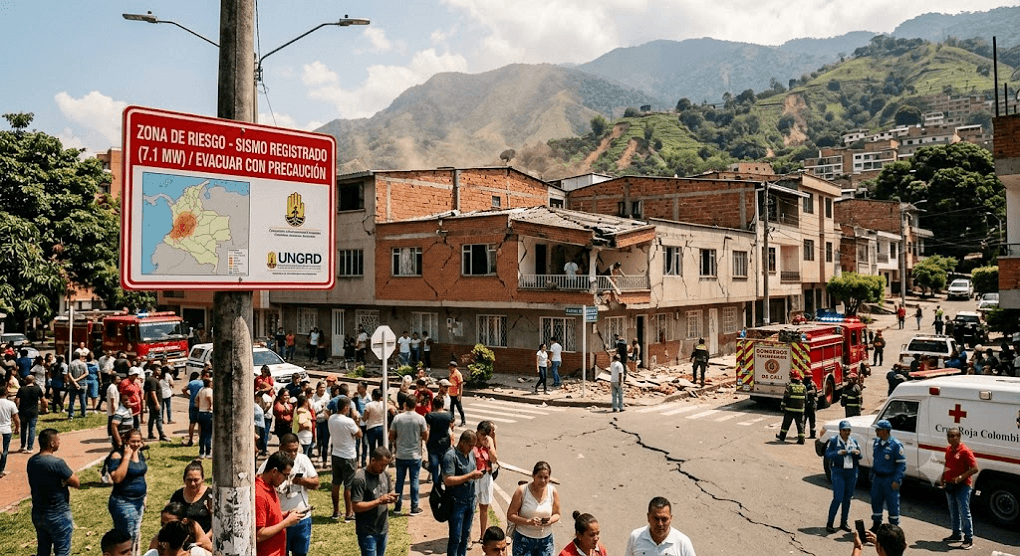
BOGOTÁ, Colombia — A powerful earthquake struck western Colombia on Monday morning, August 10, 2026, shaking major population centers, damaging infrastructure, and sending thousands of residents fleeing into the streets across multiple South American nations.
The temblor struck at approximately 7:34 a.m. local time, with its epicenter located near San José del Palmar in the Pacific department of Chocó, roughly 400 kilometers (250 miles) west of the capital, Bogotá. Seismological agencies, including the U.S. Geological Survey (USGS) and Colombia's national geological service, recorded the quake at a magnitude between 6.6 and 7.4, occurring at an intermediate depth of around 66 to 107 kilometers.
Because the seismic focus was so deep, the tremors radiated far across international borders. Shaking was felt distinctly across neighboring Ecuador and Panama, as well as parts of Venezuela. In urban centers such as Quito, Panama City, Medellín, and Cali, high-rise office towers swayed, prompting immediate precautionary evacuations.
In the Department of Chocó, Governor Nubia Carolina Córdoba-Curi confirmed injuries and structural damage to both residential and public buildings in the regional capital of Quibdó, as well as towns near the epicenter, prompt emergency response teams to deploy and assess critical infrastructure. Meanwhile, in Bogotá and surrounding cities, Mayor Carlos Fernando Galán reported that while the capital experienced heavy shaking, initial inspections revealed no major structural failures or casualties, noting only minor surface cracks on some buildings.
Colombia's National Unit for Disaster Risk Management (UNGRD) has activated emergency protocols nationwide to coordinate local response efforts, clear potential landslide debris in mountainous corridors, and support affected communities. Officials continue to monitor regional fault lines for potential aftershocks, urging the public to remain alert and follow official safety directives.
Transportation networks across central and western Colombia also faced immediate operational suspensions as transit authorities conducted mandatory safety audits. Operations at key regional airports were temporarily grounded to inspect runways for surface fractures, while engineers were dispatched to examine major bridges, mountain highways, and hydroelectric facilities across the Andes to ensure structural integrity before resuming full transit services.
Note: This article was published on BanxChange.com and is powered by the BXE Token on the XRP Ledger. For the latest articles and news, please visit BanxChange.com