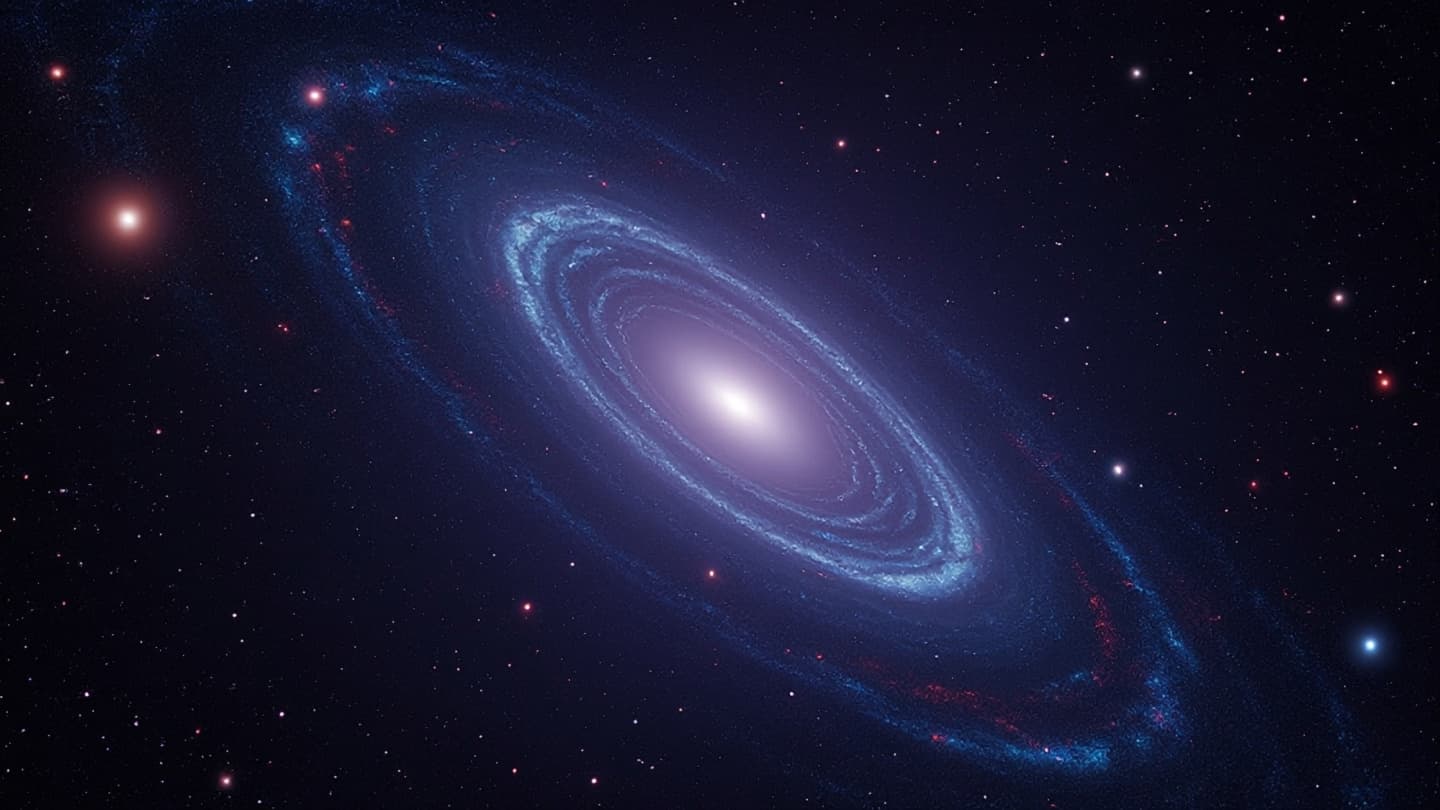
Opening: In the deep, silent archives of the cosmos, light travels as a messenger from the distant past, carrying secrets of a universe still in its infancy. The Euclid space telescope, designed to map the dark universe, has recently turned its gaze toward these ancient beacons and uncovered something unexpected: quasars that existed when the universe was barely a billion years old. These findings are not just records of extreme distance; they are puzzles that challenge our understanding of how supermassive black holes grow. It is a reminder that the more we learn about the heavens, the more questions arise, inviting us to rethink the timeline of cosmic evolution.
Body: Quasars are the brilliant cores of active galaxies, powered by supermassive black holes that consume vast amounts of gas and dust. As this material spirals inward, it heats up and emits intense radiation, often outshining the entire galaxy surrounding it. The quasars detected by Euclid date back to the epoch of reionization, a period when the first stars and galaxies were beginning to illuminate the dark universe. Finding such luminous objects so early in cosmic history is akin to finding a fully grown oak tree in a freshly planted seedling garden.
The perplexity lies in the mass of these black holes. To shine so brightly, they must have accumulated billions of times the mass of our sun. However, standard models of black hole growth suggest that this process takes much longer than the time available in the early universe. If these quasars are indeed as massive as they appear, it implies that black holes can form and grow at rates previously thought impossible. This discrepancy forces astronomers to reconsider the mechanisms of early star formation and black hole seeding.
Euclid’s unique capability to observe in both visible and near-infrared light allows it to peer through the cosmic dust that often obscures these distant objects. By analyzing the spectral signatures of the light, scientists can determine the distance and composition of these quasars with high precision. The data suggests that these early giants were not rare anomalies but perhaps part of a more common population that has yet to be fully cataloged.
This discovery adds a new layer to the "crisis in cosmology," where observations of the early universe sometimes conflict with predictions based on current models. It raises questions about the nature of dark matter and dark energy, which Euclid is specifically designed to study. The interaction between these invisible forces and the formation of the first structures may be more complex than anticipated, requiring new theoretical frameworks to explain the observed phenomena.
For the scientific community, this is a moment of exciting uncertainty. Rather than providing immediate answers, Euclid’s findings open new avenues for inquiry. Researchers will now focus on refining simulations of the early universe to see if they can accommodate such rapid growth. They will also look for similar objects in other parts of the sky to determine if this is a widespread pattern or a localized anomaly.
The public interest in such discoveries often stems from the sheer scale of time and space involved. Knowing that we are observing events that occurred over 13 billion years ago connects us to the origins of everything. It fosters a sense of wonder and humility, reminding us that our current understanding is just a snapshot in an ongoing journey of discovery. The universe is not static; it is a dynamic story that we are only beginning to read.
As Euclid continues its mission, it will likely uncover more of these ancient giants. Each detection will help piece together the timeline of cosmic dawn, revealing how the first lights ignited in the darkness. The mystery of the oldest quasars is not a dead end but a doorway, leading us deeper into the fundamental laws that govern existence.
Closing: The Euclid telescope’s discovery of the oldest known quasars challenges existing models of black hole growth in the early universe. These findings highlight the complexity of cosmic evolution and the need for refined theories. As research continues, these ancient beacons will help illuminate the mysteries of the universe’s infancy.
AI Image Disclaimer: Please note that the visual illustrations accompanying this article are AI-generated representations intended to contextualize the discussion on deep space astronomy.
Sources: European Space Agency (ESA) Nature Astronomy Space.com Scientific American
Published by Banx Network. This article is part of the Banx decentralized media programme, powered by the BXE token on the XRP Ledger.