
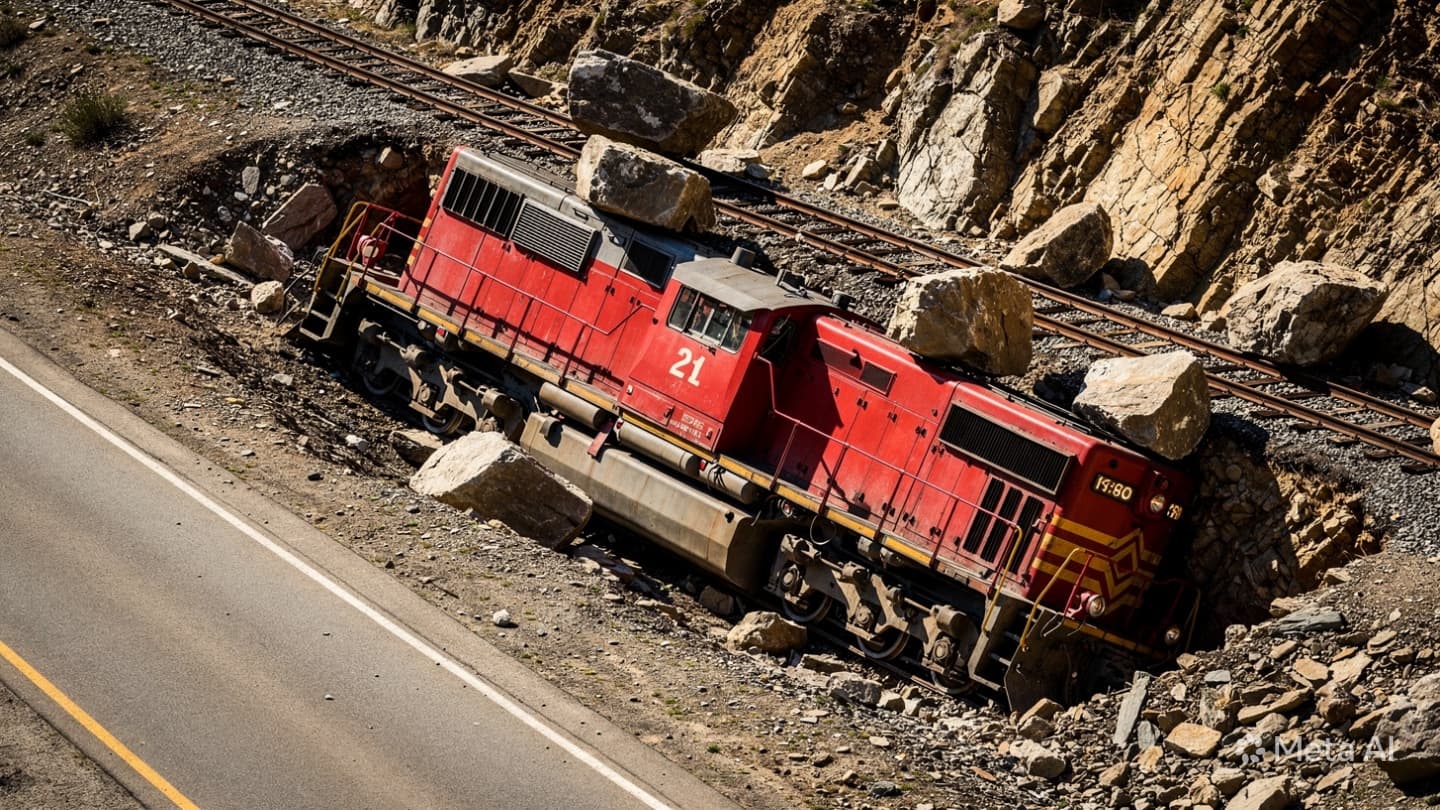
Finneidfjord, Norway—A northbound passenger express derailed into a steep embankment Thursday afternoon after striking a massive boulder that dropped directly onto the tracks from an overhanging cliff face. The collision killed the sixty-year-old locomotive driver instantly and sent five passengers to local medical centers with impact injuries. The accident occurred on a remote stretch of the Nordland Line between Bjerka Station and Finneidfjord, trapping forty-six passengers inside the carriages.
The train, operated by SJ Norge, departed Trondheim early in the morning and was traveling toward its final destination in Bodø when the mountain slope gave way. The impact forced the heavy DI4 diesel locomotive off the rails, causing it to slide down the gravel embankment before coming to a halt at a sharp angle. The lead passenger car remained coupled but hung precariously over the edge of the adjacent E6 highway.
Emergency services deployed an AgustaWestland AW101 rescue helicopter alongside regional ground crews to stabilize the listing carriages and evacuate the shocked passengers. Police cordoned off the entire area due to fears of secondary rockfalls from the unstable granite shelf above the tracks. The evacuation was completed within two hours, with uninjured passengers transferred to a temporary reception center in Mo i Rana.
The Norwegian Safety Investigation Authority launched a formal inquiry into the failure of localized rockslide protection measures along this specific mountain corridor. Heavy rainfall in the preceding forty-eight hours is suspected to have lubricated the bedrock fractures, loosening the multi-ton boulder. Investigators noted that a similar rockslide incident occurred on the exact same rail section back in 2016.
The derailment has severed Norway’s primary north-south highway, the E6, as the locomotive’s nose and scattered debris completely blocked the driving lanes. Road authorities have set up lengthy detours through Sweden and along coastal ferry routes, creating immediate freight backlogs for seafood exporters moving goods south. The transport artery is expected to remain closed for days while heavy recovery cranes are positioned.
Geologists are currently scaling the cliffside with safety ropes to assess the remaining rock mass before engineering crews are permitted to clear the tracks. The rail operator confirmed that the locomotive driver was a veteran employee with decades of service on the northern routes. Labor representatives have raised immediate questions regarding the efficacy of current slide-detection fences installed along high-risk zones.
The physical recovery of the overturned rolling stock presents severe engineering challenges due to the tight space between the mountain wall and the highway. Heavy lifting equipment must be brought in by rail from the south, a logistical move that requires suspending all regional freight operations. The state rail infrastructure manager, Bane NOR, has offered no timeline for the resumption of services.
The structural wreckage remains under guard as rainfall continues to slick the exposed rock faces above the Nordland Line. Passengers described a sudden emergency brake application followed by a violent jolt that threw luggage from overhead bins before the train ground to a halt in the mud. Forensics teams are waiting for the slope to be officially declared stable before recovering the locomotive's data recorder.
Published by Banx Network. This article is part of the Banx decentralized media programme, powered by the BXE token on the XRP Ledger.


