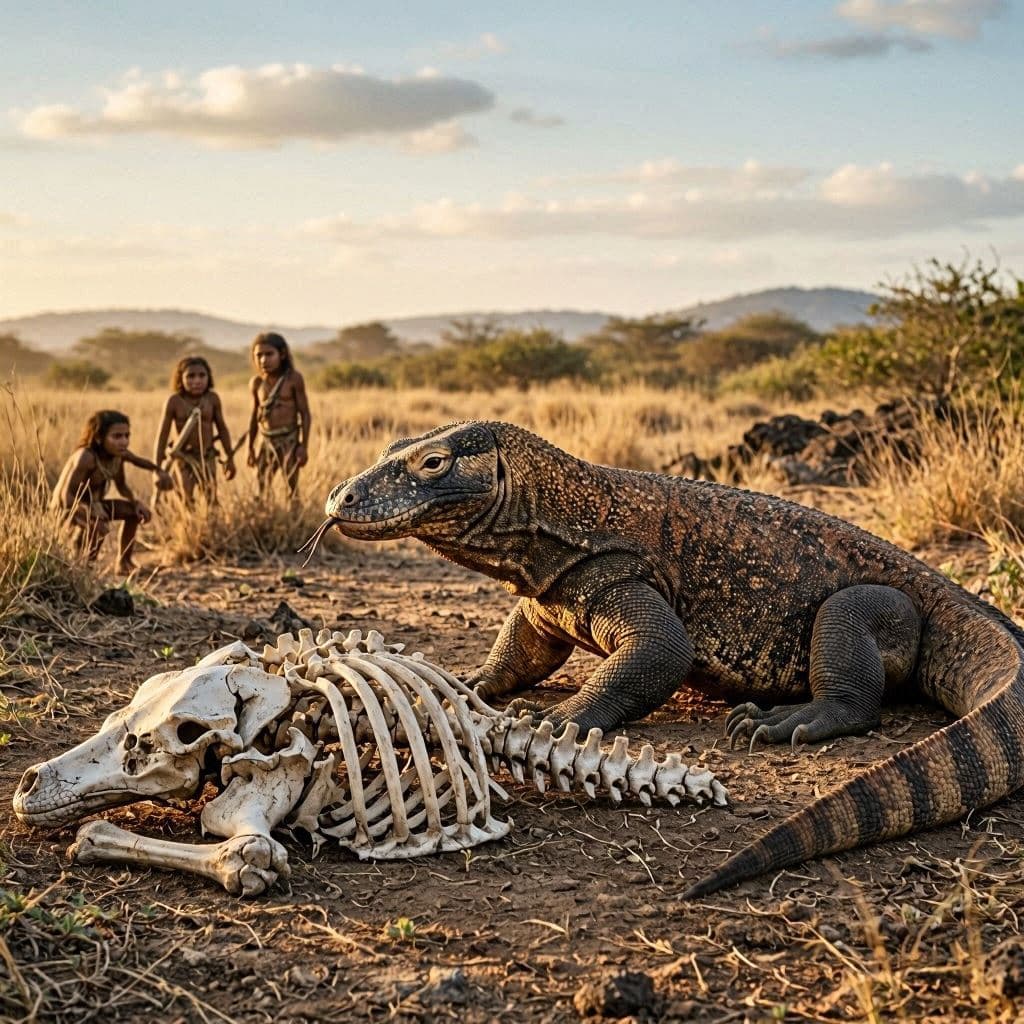
On the Indonesian island of Flores, the shadows of prehistory stretch long and deep. It was here that scientists discovered the remains of Homo floresiensis, a small-bodied hominin species nicknamed the "Hobbit" for its diminutive stature. For years, researchers have puzzled over how these ancient humans survived in a landscape dominated by giant predators, including the formidable Komodo dragon. New evidence suggests a surprising strategy: rather than hunting these apex predators, Homo floresiensis may have scavenged their leftovers, picking over the remains of kills made by the dragons. This theory paints a picture of cautious coexistence and adaptive ingenuity.
Body: The discovery of Homo floresiensis in 2003 revolutionized our understanding of human evolution. Standing only about three and a half feet tall, these hominins lived as recently as 50,000 years ago. Their small size is often attributed to insular dwarfism, an evolutionary response to limited resources on islands. But survival on Flores required more than just being small; it required navigating a dangerous ecosystem filled with large carnivores. The Komodo dragon, the world’s largest lizard, was one of the most significant threats.
Recent analysis of fossil sites has revealed cut marks on animal bones that suggest butchery by Homo floresiensis. However, many of these bones belong to animals that were likely preyed upon by Komodo dragons. The pattern of damage indicates that the hominins accessed the carcasses after the dragons had fed, removing meat from bones that the reptiles had left behind. This scavenging behavior would have minimized the risk of direct confrontation with the dangerous predators while still providing a source of protein.
This strategy highlights the cognitive flexibility of early humans. Scavenging requires knowledge of predator behavior, timing, and tool use to extract remaining nutrients. It suggests that Homo floresiensis was not merely a passive victim of its environment but an active participant, exploiting niches that other species might have ignored. Their ability to adapt to such a challenging ecosystem speaks to the resilience and resourcefulness of our ancient relatives.
The relationship between Homo floresiensis and Komodo dragons was likely complex. While scavenging reduced direct conflict, competition for resources may have still occurred. Some evidence suggests that hominins may have also hunted smaller prey or gathered plant foods, diversifying their diet to ensure survival. The island environment forced a unique evolutionary path, shaping both their physical traits and behavioral strategies.
Understanding this dynamic helps clarify the ecological context of human evolution. It shows that early humans did not always dominate their environments through brute force or superior hunting skills. Sometimes, survival depended on caution, observation, and the ability to make use of what others left behind. This perspective challenges the narrative of humans as solely apex predators, highlighting a more nuanced role in the food web.
Further research is needed to confirm the extent of this scavenging behavior. Excavations and comparative studies with modern scavengers may provide more insights into the dietary habits of Homo floresiensis. Each new finding adds depth to our understanding of how these small humans thrived in a land of giants. It is a testament to the adaptability that has characterized the human lineage throughout its history.
Closing: The theory that Homo floresiensis scavenged from Komodo dragons offers a compelling glimpse into prehistoric survival strategies. It underscores the ingenuity of early humans in adapting to challenging environments. As research continues, the story of the "Hobbits" of Flores becomes richer and more intricate.
AI Image Disclaimer: Please be aware that the visual aids in this piece are AI-generated interpretations designed to support the narrative of prehistoric life.
Sources: Nature National Geographic Smithsonian Magazine Journal of Human Evolution
Published by Banx Network. This article is part of the Banx decentralized media programme, powered by the BXE token on the XRP Ledger.