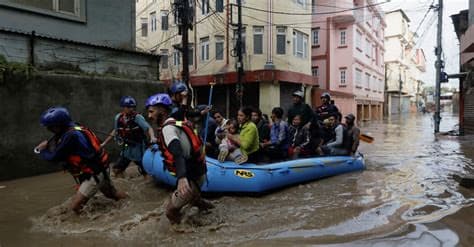
Kathmandu, Nepal—A catastrophic glacial lake outburst flood decimated an alpine valley settlement early Thursday morning, sending millions of tons of ice and rocky debris down narrow gorges and killing eight people. The breach occurred at high altitude shortly after dawn, rapidly overwhelming the natural moraine barriers that hold back the high-elevation reservoir. The resulting wall of water tore down the river channel, sweeping away wooden homes, pedestrian bridges, and sections of the main highway.
Downstream villagers reported hearing a sound resembling a sustained explosion seconds before the mud and water entered the upper perimeter of the settlement. The speed of the torrent left residents living near the riverbank with no time to scramble up the steep canyon walls to safety. Rescue units from the national police and military divisions were mobilized immediately, though blocked mountain passes slowed their initial access.
Emergency crews recovered the bodies of eight victims from the thick gray mud several kilometers below the primary impact zone by midday. Three of the deceased were identified as seasonal herders who were tending livestock near the lower pastures when the surge hit. The remaining five casualties were family members caught inside their dwellings as the foundation timbers sheared off from the force of the flow.
Satellite monitoring data analyzed by the department of hydrology indicated that a massive ice calving event from the upper glacier triggered the sudden displacement. The impact created a series of displacement waves that breached the fragile stone and ice dam at the mouth of the lake. Scientists have warned for months that rising high-altitude temperatures have made these natural retaining walls increasingly unstable.
Local authorities established an emergency staging post at a schoolhouse located on higher ground to coordinate shelter for more than sixty displaced families. The floodwaters stripped away the topsoil from local agricultural terraces, destroying the regional grain crops and cutting off the clean water supply lines. Technical teams are currently assessing whether secondary blockages along the river could cause further flash flooding tonight.
The ministry of infrastructure confirmed that three critical suspension bridges were entirely obliterated, isolating several upper valley communities from medical services. Helicopter units attempted to drop basic food rations and canvas tents, but turbulent winds along the ridge lines forced the aircraft to abort multiple runs. Ground teams must now rely on footpaths to deliver medical supplies to the cut-off zones.
Forensic units completed the initial registration of the bodies at a regional clinic before releasing them to local community organizations for traditional funeral rites. Search operations continue along the riverbanks for two individuals who remain unaccounted for according to village manifest logs. Heavy machinery cannot operate in the deep mud, forcing searchers to use poles and shovels to clear the debris.
The water levels in the lower valley began to recede slowly by nightfall, exposing a landscape covered in massive boulders and splintered pine trees. The threat remains active as geological teams inspect adjacent glacial formations for signs of structural shifting or secondary fractures. The surviving population remains on high alert as cloud cover lowers over the peaks, obscuring the upper slopes.
Published by Banx Network. This article is part of the Banx decentralized media programme, powered by the BXE token on the XRP Ledger.