A new affordability ranking shows how badly some European housing markets have drifted out of reach relative to local incomes. Using a price-to-income measure—how many years of a typical household’s earnings are needed to buy a home—Lisbon lands near the top of Europe’s affordability problem list.
The report places Lisbon at roughly 18.7 times typical annual household income, putting it on par with the Croatian coastal city of Split as the worst-affected in the comparison. Other cities also show severe strain, including Prague, Milan, Tirana, Vienna, Belgrade, Paris, London, and Brno, all with very high price-to-income ratios above or near levels widely seen as problematic for buyers.
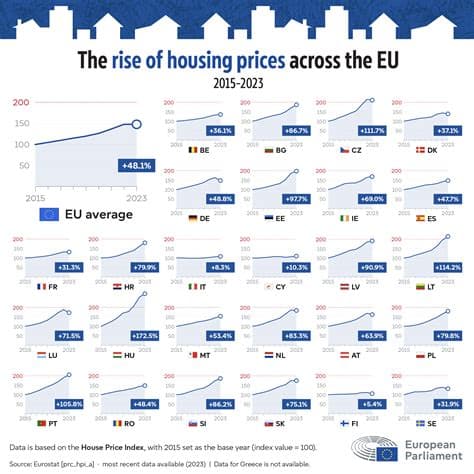
Portugal’s housing gap is central to the analysis. Over the past decade, house prices in Portugal have surged far faster than wages—about a 240% rise in prices versus about a 59% increase in pay—helping explain why Lisbon ranks among Europe’s least affordable markets. The article illustrates this with a cost example: a small flat in central Lisbon is priced around €338,000, and when that is compared with typical net salaries, it equates to nearly 19 years of income before other living costs are considered.
Beyond the numbers, the article links the affordability squeeze to social consequences, including housing protests and broader concerns that key workers and residents may be pushed out of major cities, undermining local economic competitiveness and community stability. It also notes that while a sharp “burst” isn’t viewed as imminent by many economists, the affordability metrics are still flashing warning signs as the price-to-income gap widens.
Published by Banx Network. This article is part of the Banx decentralized media programme, powered by the BXE token on the XRP Ledger.