
Key Highlights
- Incident:A train derailment occurred near Shwebo, Myanmar, due to washed-out tracks.
- Casualties:Two people died, and fifteen others were injured in the accident.
- Response:Local villagers and emergency services rushed to aid trapped passengers.
On the morning of [insert date], a tragic train derailment took place near Shwebo, Myanmar, at approximately 11:15 AM. The locomotive derailed after hitting a washed-out embankment, a consequence of heavy monsoon rains that had eroded the gravel ballast beneath the wooden ties overnight. The force of the derailment caused the engine to flip onto its side, while three passenger carriages also derailed, crashing into the muddy slope alongside the tracks.
Eyewitness accounts describe a chaotic scene inside the packed carriages, where passengers were violently thrown against luggage racks and metal seats. Amidst the screams and panic, travelers attempted to escape through emergency windows as smoke filled the cars. Local villagers, alerted by the commotion, rushed from nearby fields with ropes and ladders to assist in rescuing trapped passengers.
According to Myanmar Railways, two individuals died at the scene due to severe crush injuries sustained during the derailment. Paramedics quickly transported fifteen injured passengers to the Shwebo general hospital for urgent medical treatment. Hospital staff issued urgent calls for blood donations to address the needs of those requiring major surgical interventions.
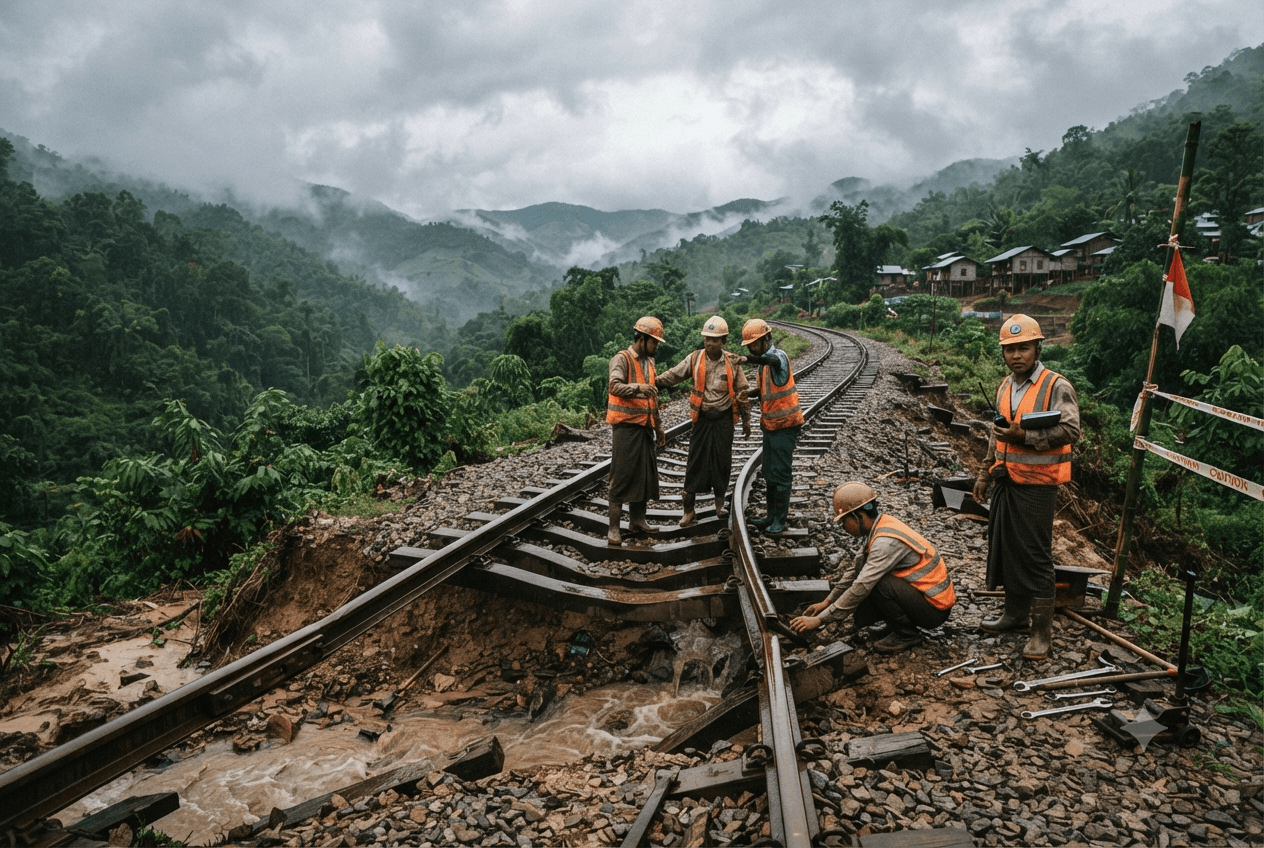
In the aftermath of the incident, railway engineering teams arrived via utility railcar to assess the damage to the track infrastructure. Floodwaters continued to swirl around the twisted rails, complicating access for heavy cranes dispatched from the main depot. As a precaution, transport officials suspended all passenger services along the northern trunk line indefinitely, prioritizing safety and recovery efforts.
Investigators were able to recover the train's data recorder from the severely damaged locomotive cab. Preliminary findings indicate that the engineer had applied the emergency brakes moments before the train reached the compromised section of track. Rain gauges in the district recorded unprecedented levels of precipitation over the previous forty-eight hours, contributing to the disaster.
Cranes dispatched from Mandalay finally reached the derailment zone late in the evening, allowing clearing operations to commence. Maintenance crews worked diligently under portable floodlights to replace broken rails and rebuild the washed-out roadbed. Regional transport authorities have pledged financial assistance to the families of the deceased victims, acknowledging the tragedy's impact on the community.
As the wreckage remains scattered across the embankment, engineers continue to evaluate the structural stability of the corridor. Commuters stranded at regional stations are scrambling to find alternative bus transport options, while security personnel maintain a perimeter around the site to secure passenger luggage and cargo.
This incident highlights the ongoing challenges faced by Myanmar's railway system, particularly during the monsoon season, and raises questions about infrastructure resilience in the face of extreme weather events.
Published by Banx Network. This article is part of the Banx decentralized media programme, powered by the BXE token on the XRP Ledger.



