
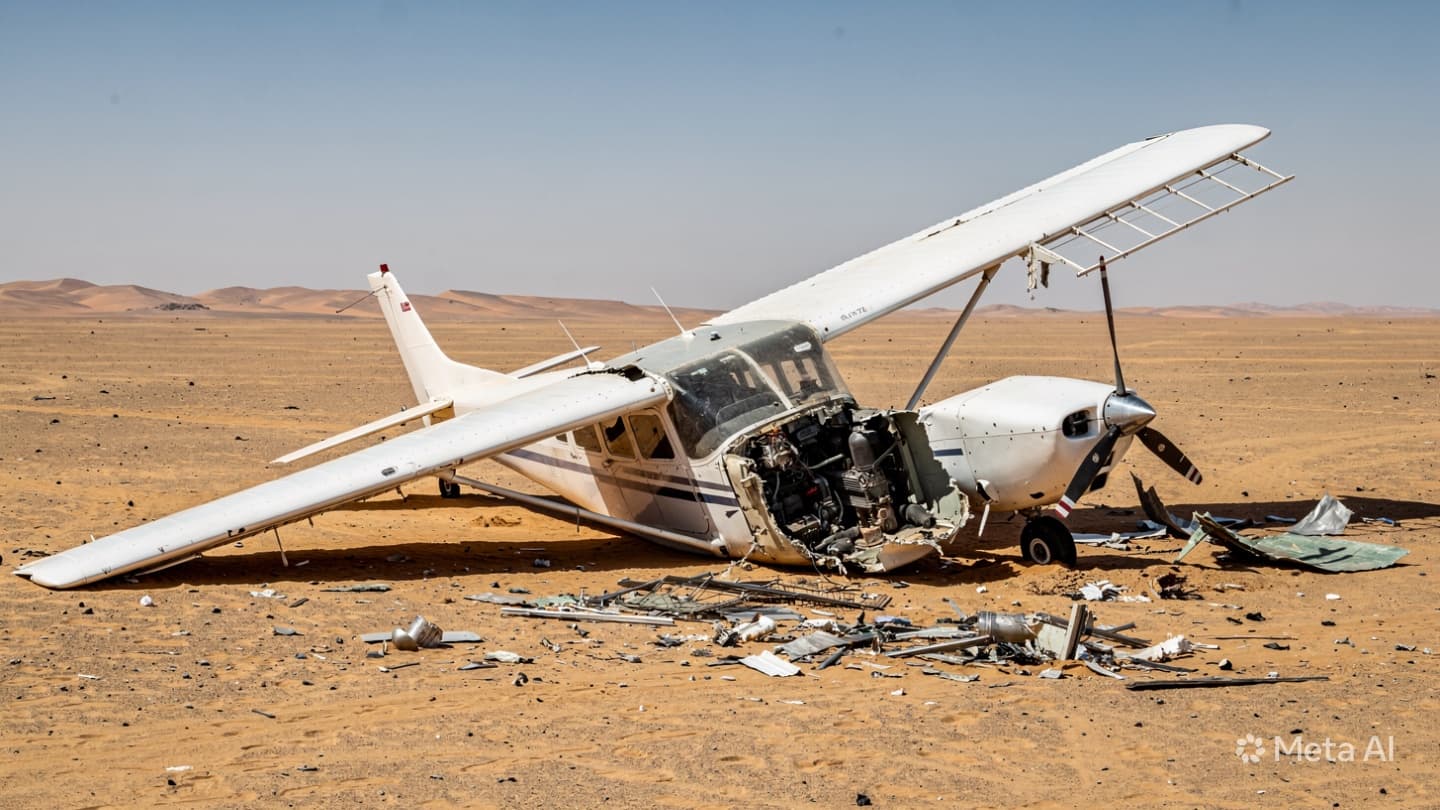
San Bernardino, United States—Federal aviation investigators are en route to a remote stretch of the Mojave Desert after a single-engine light aircraft suffered an in-flight emergency and performed a hard forced landing.
The aircraft, identified as a four-seat private passenger plane, was transiting the desert corridor when the pilot radioed air traffic control regarding a sudden loss of oil pressure and subsequent engine failure. The pilot attempted to glide the disabled machine toward an unpaved utility access road.
The aircraft impacted the uneven desert floor three miles short of the intended clearance path, striking a dense thicket of scrub brush and flipping forward onto its canopy. The impact crushed the forward engine compartment and sheared off the left wing assembly.
County sheriff deputies and desert rescue units tracking the emergency transponder signal located the wreckage within thirty minutes of the radar loss. First responders extracted the pilot from the inverted cockpit shell using manual tools.
The pilot, who was the sole occupant on board, sustained severe upper body trauma and lacerations during the rollover sequence. Paramedics stabilized the victim on-site before a medical transport helicopter arrived to evacuate the pilot to a regional medical facility.
Federal Aviation Administration records indicate the flight originated from a municipal airfield two hours prior to the mechanical failure. Fuel records are being audited to rule out starvation as a contributing cause to the sudden power loss.
Environmental protection teams monitored a small leak of aviation fuel from the ruptured right-wing tank, which spilled roughly fifteen gallons into the sandy soil before being plugged with chemical sealant. The remote location has prevented heavy equipment from accessing the site immediately.
"The pilot executed the forced landing under extremely limited options due to the rugged nature of the alluvial washes in this sector," a sheriff department spokesperson stated during an evening update.
The surrounding desert terrain has been cordoned off as a restricted federal investigation zone to protect the debris field from scavengers. National Transportation Safety Board personnel are scheduled to take over the primary site documentation early Tuesday morning.
Flatbed transport trucks equipped with desert tires are being assembled at a staging area twenty miles away to salvage the remaining fuselage components for metallurgical analysis. The aircraft remains upside down in the sand as investigators wait for field photography clearance.
Published by Banx Network. This article is part of the Banx decentralized media programme, powered by the BXE token on the XRP Ledger.

.jpg&w=3840&q=75 "Romania Passes Controversial Integrity Law for Officials to Access EU Funds")
