Science often advances through observations, but sometimes it moves forward through mathematics alone. Equations can act like lanterns carried into regions that remain invisible to telescopes, illuminating possibilities that may later guide future discoveries. A new theoretical study has taken such a path while exploring one of the universe’s most mysterious objects: black holes.
Researchers have proposed that unusual structures described as "space-time crystals" could play a role in the formation of certain rare black holes. The idea emerges from advanced mathematical models that extend traditional descriptions of gravity into higher-dimensional frameworks.
The study examines patterns of ripples within the geometry of space-time itself. According to the researchers, under specific conditions these patterns may evolve into exotic gravitational structures, including microscopic black holes and theoretical naked singularities.
Black holes are typically understood as forming when massive stars collapse under their own gravity. However, physicists have long explored alternative pathways that might create black holes under unusual cosmic circumstances. This research contributes to that ongoing discussion.
One notable aspect of the work is its reliance on analytical mathematics rather than large-scale computer simulations. The researchers employed methods that simplify otherwise extremely difficult equations, allowing them to investigate scenarios that would be challenging to model directly.
The findings do not provide observational evidence that such space-time crystals exist. Instead, they demonstrate that the mathematical framework permits these structures and suggests possible consequences if nature allows them to form.
Theoretical physics frequently explores ideas years or even decades before technology becomes capable of testing them. Concepts such as gravitational waves, once purely mathematical predictions, eventually became measurable phenomena through advances in instrumentation.
Scientists therefore view studies like this as part of a broader effort to understand gravity, black holes, and the structure of the universe at its most fundamental level. Whether future observations support or challenge these ideas remains an open scientific question.
For now, the research offers a fresh perspective on how rare black holes might arise. It adds another piece to the ongoing puzzle of understanding how space, time, and gravity interact in some of the most extreme environments imaginable.
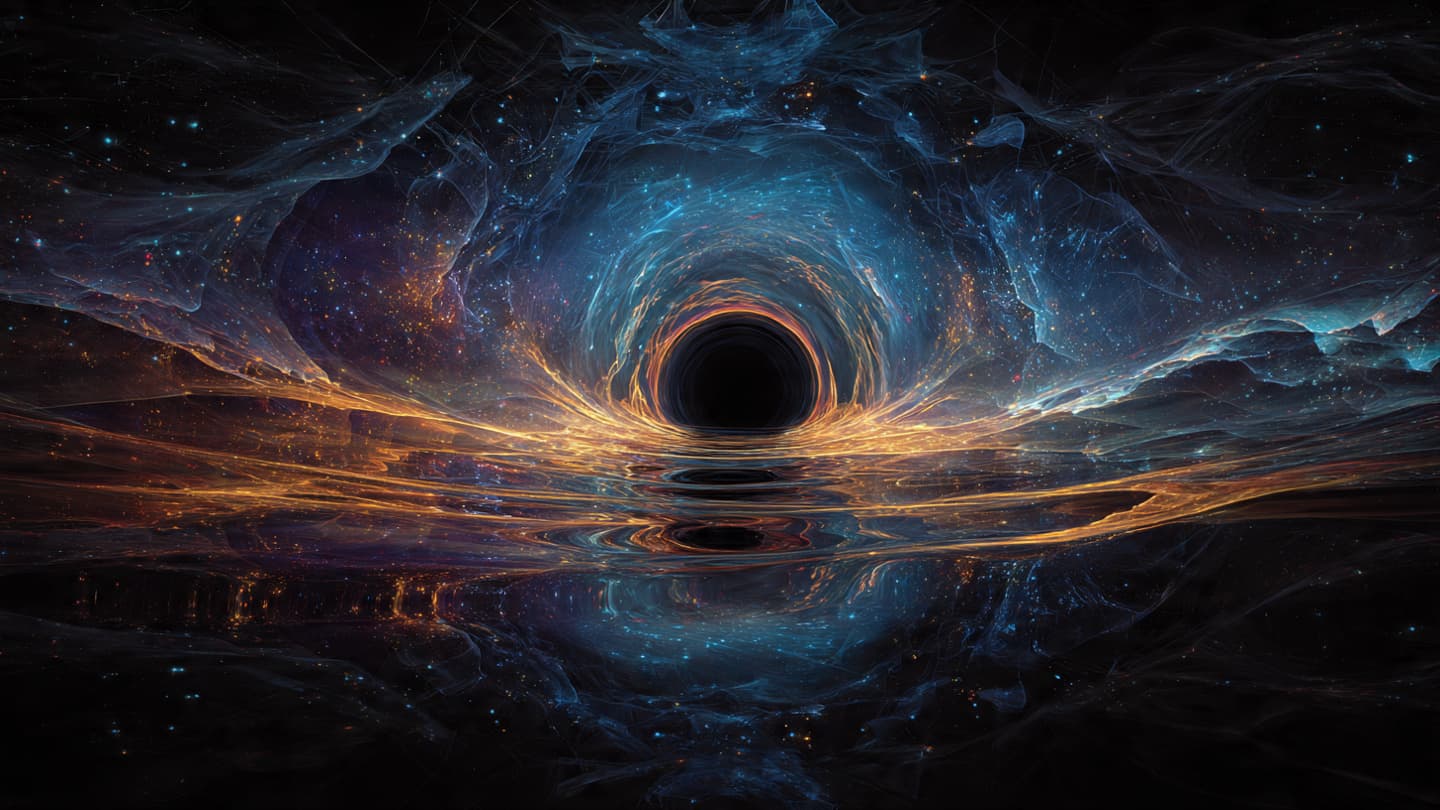
AI Image Disclaimer: The accompanying image is AI-generated for visualization purposes and should be viewed as an artistic interpretation of the scientific concept.
Sources Verified Live Science Physical Review Letters Space.com
Published by Banx Network. This article is part of the Banx decentralized media programme, powered by the BXE token on the XRP Ledger.