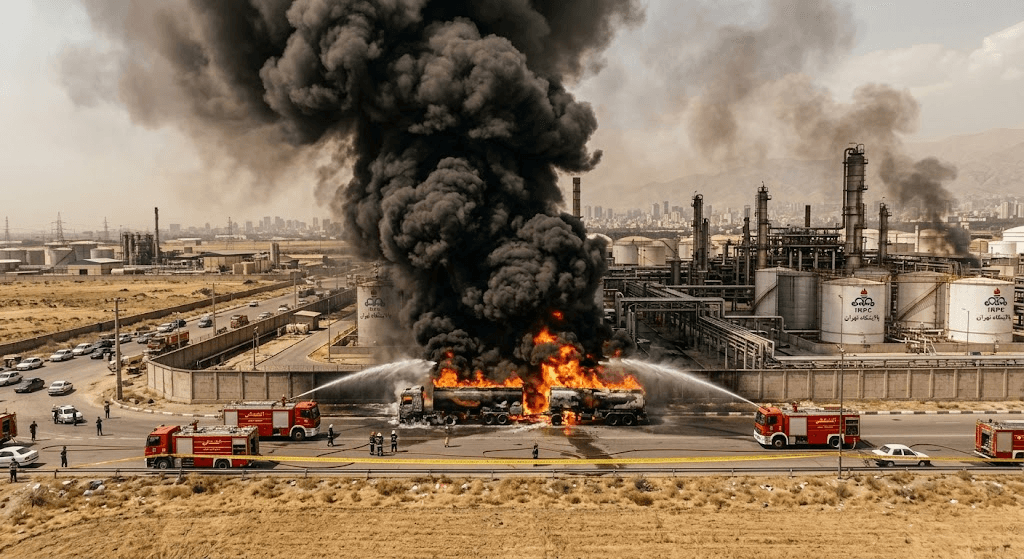
TEHRAN, Iran — Thick plumes of black smoke billowed over southern Tehran on Thursday, August 20, 2026, after a violent fire broke out involving two fuel tankers parked near a major oil refining facility.
The incident occurred adjacent to the Tehran Oil Refinery complex, triggering an immediate emergency response as firefighting units and hazard containment teams rushed to the scene to prevent the flames from spreading to critical fuel storage tanks and processing infrastructure.
Witnesses in the surrounding industrial district reported hearing loud explosions before massive flames engulfed the heavy transport vehicles. Emergency services deployed multiple fire engines, foam tankers, and specialized hazmat crews to suppress the high-intensity chemical blaze.
First responders successfully isolated the burning tankers and established a safety perimeter around the site, preventing the fire from compromising nearby pipelines or entering the main refinery grounds.
Local emergency officials reported that firefighters managed to bring the main body of the fire under control within hours, minimizing the risk of a secondary explosion. Preliminary assessments indicate that the primary refinery operations remained largely unaffected and continued without major interruption.
An official investigation has been launched by local municipal authorities and industrial safety inspectors to determine the precise cause of the fire, focusing on potential static electrical discharges, fuel transfer safety violations, or mechanical failure during tanker operations.
Environmental authorities in Tehran have issued a preliminary air quality warning for districts immediately downwind of the refinery, urging residents—particularly children, the elderly, and those with respiratory conditions—to remain indoors and keep windows closed until the dense smoke fully dissipates. Technical teams continue to monitor ambient air quality indicators across the southern municipality to assess the concentration of released volatile organic compounds and particulate matter.
In the wake of the incident, industrial safety directors at the refinery announced an immediate audit of all third-party transport contractors and fuel loading protocols across the facility. Enhanced safety checks for heavy transport vehicles, including mandatory grounding verification during fuel discharge and upgraded fire suppression equipment on tanker bays, will be enforced to prevent similar hazardous thermal events in the future.
Note: This article was published on BanxChange.com and is powered by the BXE Token on the XRP Ledger. For the latest articles and news, please visit BanxChange.com