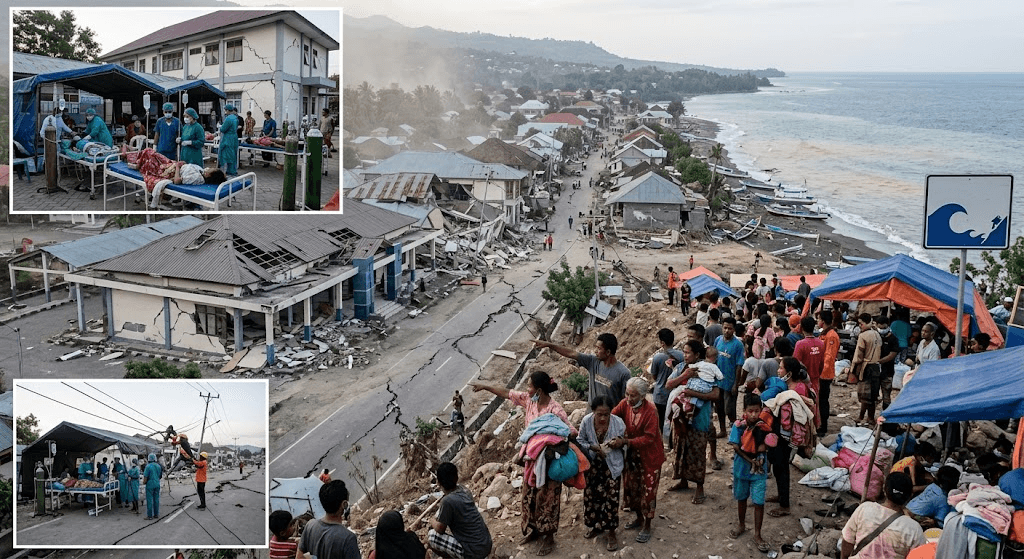
FLORES ISLAND, Indonesia — A powerful 7.7-magnitude earthquake struck off the northern coast of Flores Island in eastern Indonesia early on Saturday morning, August 15, 2026 bringing widespread destruction, triggering mass evacuations, and leaving at least two people dead.
The shallow undersea quake sent violent tremors across East Nusa Tenggara province, collapsing buildings, cutting off power lines, and prompting authorities to issue a brief tsunami warning for surrounding coastal regions.
The earthquake struck at 5:58 a.m. local time at a shallow depth of 10 kilometers (6.2 miles), according to the U.S. Geological Survey (USGS). Its epicenter was located roughly 68 kilometers north-northwest of the coastal town of Ende.
Because the quake hit at a shallow depth, the shaking was felt intensely across the island. In coastal towns like Maumere and Nagekeo, panic broke out as residents fled into the streets.
Local authorities and Indonesia’s Meteorology, Climatology, and Geophysics Agency (BMKG) swiftly issued a tsunami alert, urging communities along northern Flores and neighboring islands to seek immediate refuge on higher ground.
"Suddenly it started to shake and I panicked. Patients fled the hospital; the jolt was big. I saw some walls were cracked."— Lukas Lotar, resident of Maumere
In the Sikka regency, several public structures suffered severe structural failure. Witnesses reported the collapse of a passenger waiting terminal at the Maumere port, while the roof of an assembly hall collapsed at a local seminary.
At nearby hospitals, medical staff moved quickly to evacuate patients outdoors. Broadcast footage showed temporary emergency care units set up in open parking areas, with healthcare workers treating patients on cots alongside IV stands and oxygen cylinders to avoid potential hazards from aftershocks. Following the initial quake, coastal tide gauges were closely monitored after witnesses in nearby regencies reported temporary sea retreat—a classic precursor to a tsunami wave.
However, after tracking sea levels for several hours, BMKG confirmed that no significant tidal surge or destructive waves occurred. The tsunami warning was officially lifted later in the morning, allowing evacuees to begin returning to their communities, though officials cautioned against aftershocks.
Emergency response teams, local police, and disaster agencies are actively conducting search and rescue operations. Widespread power outages and disrupted communications have slowed initial damage assessments in remote regions, but authorities expect the full scale of structural damage and casualties to become clearer throughout the day.
Indonesia is frequently hit by seismic activity due to its position on the Pacific "Ring of Fire," an arc of intense tectonic plates and active fault lines spanning the Pacific Basin.
Note: This article was published on BanxChange.com and is powered by the BXE Token on the XRP Ledger. For the latest articles and news, please visit BanxChange.com