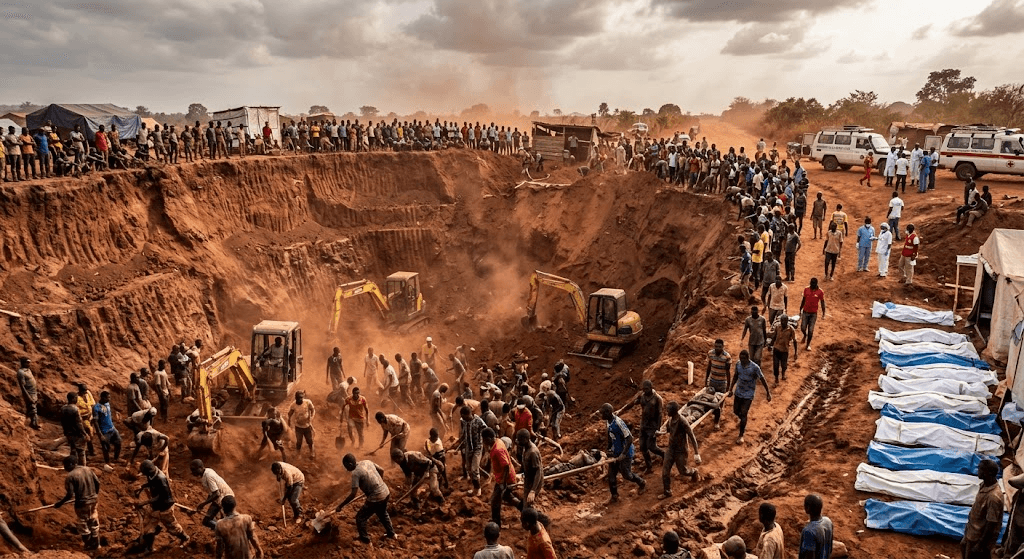
ZAMBOYE, Central African Republic — A catastrophic landslide triggered the collapse of an artisanal gold mine in western Central African Republic (CAR) near the border with Cameroon, leaving over 100 miners dead and dozens more feared trapped beneath thick mud and debris.
The disaster occurred at an informal open-pit mining site in the village of Zamboye, situated roughly 50 kilometers (31 miles) from the town of Baboua in the Nana-Mambéré prefecture. Hundreds of local workers were inside the excavation pit when the surrounding terrain completely gave way.
According to local authorities and surviving miners, the collapse was triggered by a massive soil slide following the structural failure of several interconnected underground tunnels. The sudden shift sent a massive avalanche of sand and heavy earth cascading into the pit, instantly burying workers operating below.
Eyewitnesses described chaotic scenes as fellow miners and nearby villagers attempted to dig through the collapsed soil using bare hands and basic hand tools. Local health officials and humanitarian volunteers confirmed that more than 100 bodies have been recovered from the site, while emergency responders continue working around the clock to recover additional victims.
Given the site's proximity to the Cameroonian border, authorities from both nations have initiated coordinated emergency responses. Border medical facilities in Cameroon have been placed on high alert to treat incoming injured workers transported across the border. Meanwhile, prosecutors in Baboua have opened a formal judicial inquiry to determine the precise structural triggers and verify compliance at the site.
The tragic disaster highlights the severe risks associated with unregulated artisanal mining across the region. Lacking modern structural reinforcements, heavy machinery, and standard safety protocols, thousands of informal miners perform high-risk manual excavation in unstable open pits to support their livelihoods, leaving them extremely vulnerable to seasonal landslides and fatal tunnel cave-ins.
In light of the catastrophe, regional civil society groups and international mining oversight organizations have renewed demands for comprehensive safety reforms and government regulation of artisanal extraction sites across the Central African Republic. Local community leaders called on national authorities to deploy geological survey teams to assess surrounding hillsides for structural stability, warning that ongoing rainfall could trigger secondary landslides and endanger nearby residential settlements and recovery teams.
Note: This article was published on BanxChange.com and is powered by the BXE Token on the XRP Ledger. For the latest articles and news, please visit BanxChange.com