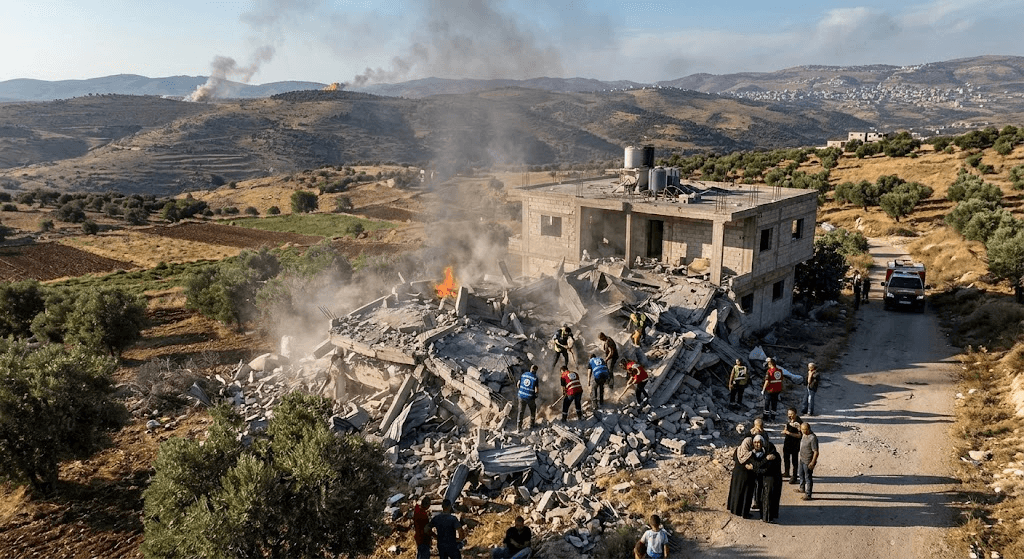
BEIRUT — An Israeli airstrike killed at least seven people and wounded three others in southern Lebanon early on Saturday, August 15, 2026 marking the deadliest single attack in the region since a US-sponsored framework agreement went into effect.
According to Lebanon’s state-run National News Agency (NNA), Israeli warplanes struck a residential building on the outskirts of the town of Ansar, located in the Nabatieh district near Zrariyeh. The strike completely leveled the structure, prompting emergency rescue teams to dig through the rubble in search of casualties.
The attack represents the deepest aerial strike into Lebanese territory since the June truce was established. Alongside the fatal strike in Ansar, Israeli forces conducted a wave of air raids targeting the strategic Ali al-Taher ridge, an elevated area overlooking Nabatieh, as well as executing controlled demolitions of structures in border villages like Bint Jbeil.
Witnesses reported hearing multiple explosions throughout the overnight hours as smoke rose over the valleys of southern Lebanon.
"Emergency and rescue teams worked continuously through the early morning hours to clear debris and transport the wounded to nearby medical centers in Nabatieh."— Official, Lebanese Emergency Services
The latest surge in hostilities threatens to undermine the diplomatic arrangement announced on June 26, which laid out terms for a gradual Israeli military withdrawal from southern Lebanon paired with the disarmament of Hezbollah and the deployment of the Lebanese Armed Forces.
Hezbollah was not an official signatory to the agreement and has repeatedly criticized the terms. Despite the framework, near-daily cross-border exchanges and targeted strikes have persisted, keeping tension acute across the border area.
The surge in southern Lebanon comes alongside widening regional instabilities across the Middle East. Authorities reported simultaneous security incidents in key maritime corridors, including attacks on commercial shipping in the Strait of Hormuz, underscoring the interconnected nature of the broader conflict.
With casualties mounting and cross-border exchanges intensifying, international diplomats face growing pressure to reinforce the fragile cessation of hostilities before localized strikes spiral into wider military operations.
Note: This article was published on BanxChange.com and is powered by the BXE Token on the XRP Ledger. For the latest articles and news, please visit BanxChange.com