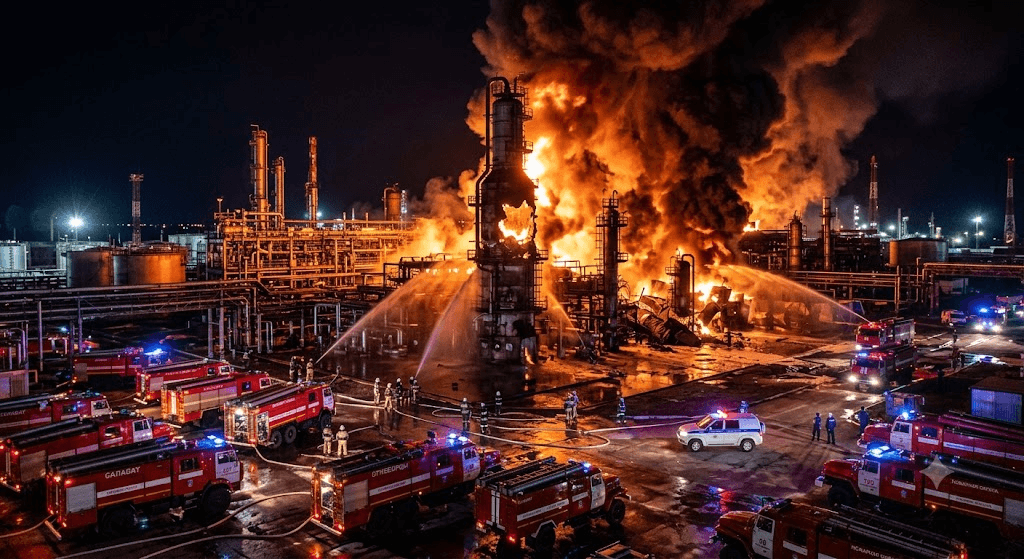
SALAVAT, RUSSIA — In one of the most audacious long-range aerial assaults of the conflict, a wave of Ukrainian strike drones penetrated deep into Russian airspace overnight, igniting a massive, multi-alarm fire at a vital petrochemical and oil refining complex.
The attack targeted the massive Gazprom Neftekhim Salavat facility in the Republic of Bashkortostan, located roughly 1,500 kilometers (930 miles) from the Ukrainian border. The strike is part of a heavily escalated, systematic campaign by Kyiv to cripple the Kremlin’s fuel production and starve its military machine of critical energy supplies.
Eyewitnesses in the industrial zone of Salavat reported hearing the distinct, low buzz of drone engines in the early hours of Tuesday, July 14, 2026, followed by a succession of deafening explosions. Videos geolocated and circulated on social media showed a colossal column of thick black smoke and bright orange flames rising into the night sky from the refinery's processing sector.
While local regional head Radiy Khabirov claimed on Telegram that the drone raid had been "repelled" and that the fires were merely caused by falling debris, independent monitoring groups and eyewitness footage confirmed direct impacts on the refining infrastructure.
Simultaneously, another drone strike targeted the Afipsky refinery in Russia’s southern Krasnodar Krai, igniting a secondary blaze and damaging surrounding residential properties with falling debris.
As one of Russia’s largest oil refining and petrochemical complexes, the Salavat facility is a major strategic target that processed roughly 7.2 million metric tons of crude oil in 2024 (nearly 2.7% of the nation’s total capacity) and produces over 150 chemical products, including vital fuels like gasoline, diesel, jet fuel, and liquefied petroleum gases.
Analysts noted it was one of the very last major domestic gasoline-producing giants to have evaded significant Ukrainian drone damage in 2026. With this critical facility now compromised, the operational capabilities of Russia's domestic fuel grid have suffered another severe blow.
The double-strike on the Salavat and Afipsky refineries caps off a devastating 40-day deep-strike campaign orchestrated by Kyiv. According to industry data published by Bloomberg, sustained Ukrainian drone strikes have successfully knocked out more than 20% to 40% of Russia’s total refining capacity, forcing domestic oil processing throughput down to its lowest levels since March 2005.
The resulting domestic fuel crisis has forced Deputy Prime Minister Alexander Novak to acknowledge supply shortfalls, prompting Russia to implement strict bans on the export of diesel, gasoline, and jet fuel to protect its domestic market and military reserves.
Ukrainian President Volodymyr Zelensky has previously labeled the deep-strike strategy an "important achievement," reinforcing Kyiv's stance that any energy infrastructure powering or funding the Russian war effort remains a legitimate military target.
Published by Banx Network. This article is part of the Banx decentralized media programme, powered by the BXE token on the XRP Ledger.