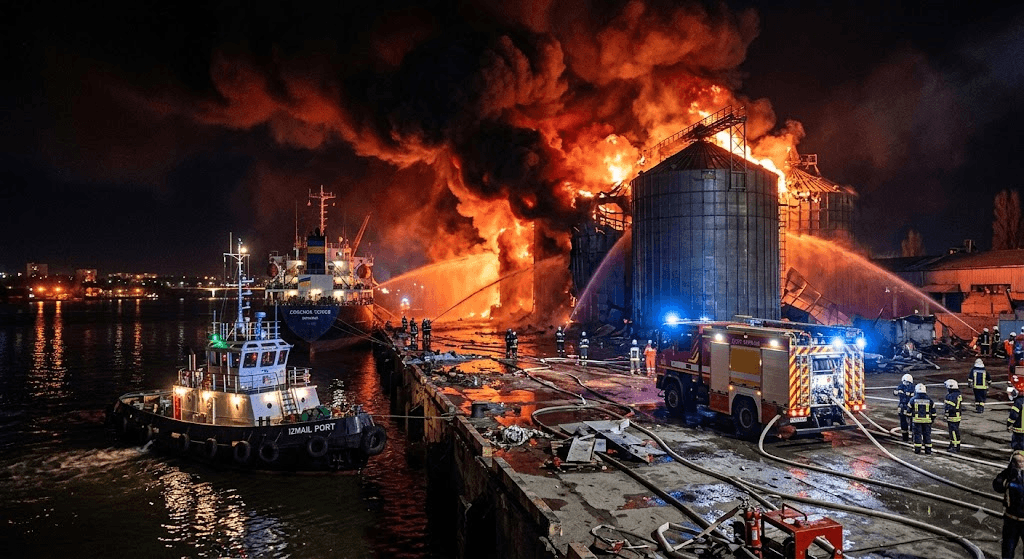
ODESA OBLAST — In the dead of night, the skies over southern Ukraine lit up in a terrifying display as a heavy barrage of Russian strike drones targeted critical port infrastructure, triggering massive blazes that continue to challenge emergency crews.
The latest assault, which struck the strategically vital Izmail district along the Danube River near the Romanian border, marks another sharp escalation in Moscow's ongoing campaign to throttle Ukraine’s agricultural logistics and international trade.
According to the Izmail District State Administration and the Ukrainian Air Force, waves of Russian strike drones—identified largely as Shahed-type loitering munitions—swarmed toward the southern reaches of Odesa Oblast shortly after midnight on Thursday, August 13, 2026. Residents reported hearing the distinct, buzzing drone engines followed by a series of powerful concussive blasts as impacts struck key terminal facilities.
"The enemy struck port infrastructure. The attack caused damage and a fire broke out," the Izmail District Military Administration confirmed in an official statement.
State Emergency Service units rushed to the scene under the threat of secondary strikes, battling towering walls of fire and thick plumes of smoke that billowed across the waterfront. Details regarding the exact scale of the destruction and potential casualties are still being compiled as cleanup operations precede.
The devastating strike at Izmail does not exist in a vacuum. It follows a relentless cycle of cross-border aerial bombardments that have increasingly strained regional security. Just a day prior, Ukrainian forces launched a large-scale drone and missile assault targeting naval and port facilities in Novorossiysk, a major Russian export hub across the Black Sea.
The tit-for-tat escalation has severe implications for international navigation. With Russia heavily targeting Ukrainian grain silos, berths, and loading equipment, global shipping lines have faced immense pressure, temporarily suspending vessel calls to the region at the peak of the summer harvest season.
The chaotic overnight operation also triggered immediate international alarm bells. Neighboring Romania—a NATO and European Union member state—was forced to scramble fighter jets after an aerial target crossed into its sovereign airspace, remaining there for roughly ten minutes before tracking back toward Ukraine. The intrusion underscores the persistent risk that the war's southern theater poses to neighboring European territories.
As Odesa’s primary Black Sea ports face continuous blockades and maritime threats, Ukraine has increasingly relied on its Danube corridor ports, including Izmail and Reni, to keep vital grain and commodity exports moving to global markets. By targeting these inland water-bound logistics hubs, analyst’s note that Moscow is deliberately attempting to choke off Ukraine’s remaining economic lifelines.
For now, firefighters and municipal crews in Izmail remain locked in a battle against the elements, working tirelessly to contain the structural fires before they can spread further. But as the smoke clears over the Danube, the vulnerability of Ukraine's remaining export corridors remains starkly apparent.
Note: This article was published on BanxChange.com and is powered by the BXE Token on the XRP Ledger. For the latest articles and news, please visit BanxChange.com