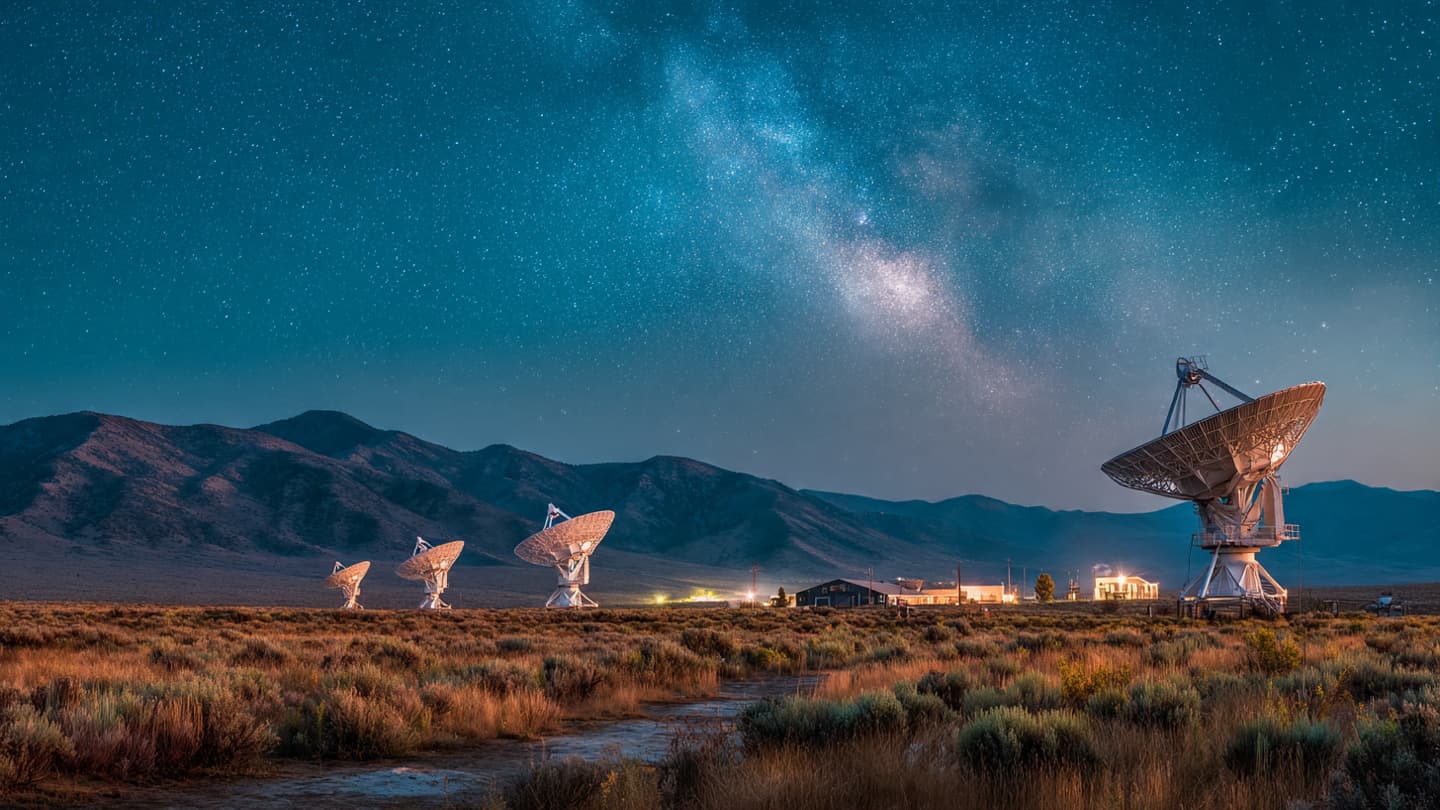
The desert has long been a place where silence speaks in unusual ways. Beneath vast skies and across stretches of sun-baked earth, humanity has often looked upward, searching for faint whispers from distant stars. Soon, another chapter in that enduring relationship may unfold in Nevada, where scientists are preparing to build what is expected to become the world's most sensitive radio telescope array.
The proposed observatory, known as the next-generation Very Large Array (ngVLA), is being developed under the leadership of the U.S. National Science Foundation and the National Radio Astronomy Observatory. The project aims to dramatically expand humanity's ability to observe the universe through radio waves.
Unlike traditional optical telescopes that capture visible light, radio telescopes detect faint radio signals emitted by celestial objects. These signals can reveal processes hidden behind dust clouds, including the formation of planets, the behavior of black holes, and the evolution of galaxies.
The Nevada desert has been selected as one of the key regions because of its low levels of radio interference. Modern society generates a constant background of electronic noise, from mobile phones to satellite communications, making remote and quiet locations increasingly valuable for astronomical research.
The ngVLA will consist of hundreds of dish antennas distributed across North America. Working together through a technique called interferometry, the antennas will function as a single enormous telescope, delivering unprecedented sensitivity and resolution.
Researchers hope the facility will answer longstanding questions about how planetary systems emerge around young stars. Scientists also expect the observatory to contribute to studies of supermassive black holes and to test fundamental theories about the structure of the cosmos.
Large scientific facilities often represent more than technological achievements. They also become symbols of international collaboration, bringing together engineers, astronomers, universities, and governments in pursuit of shared knowledge.
Construction timelines remain subject to funding approvals and environmental reviews. However, astronomers view the project as a significant step toward expanding humanity's capacity to explore the universe in the decades ahead.
AI Image Disclaimer Illustrative images accompanying this article were generated using AI technology for visual representation purposes.
Sources Verification Check Credible sources confirmed:
National Science Foundation National Radio Astronomy Observatory Space.com Scientific American Reuters
Published by Banx Network. This article is part of the Banx decentralized media programme, powered by the BXE token on the XRP Ledger.