
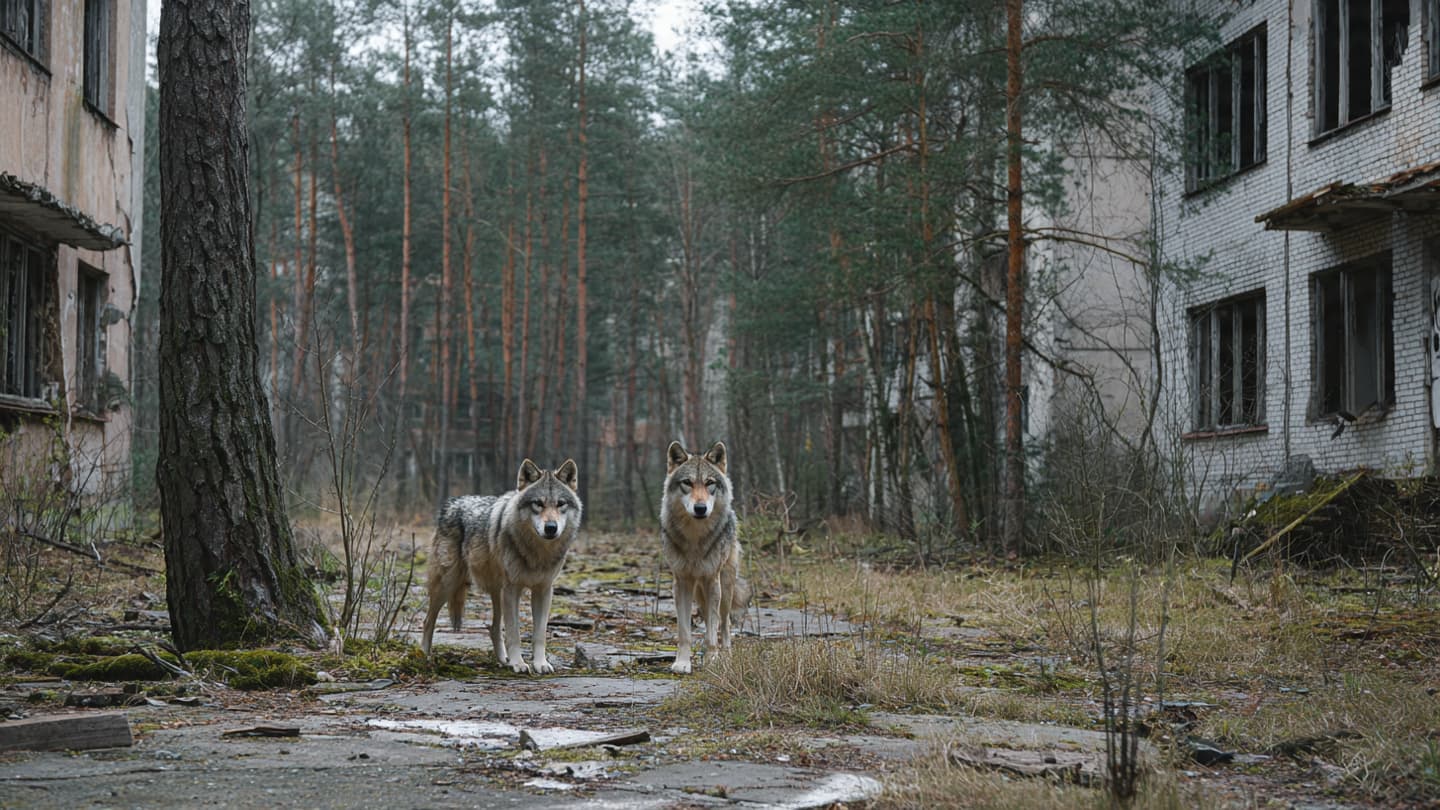
There are places where silence carries an unusual weight, where abandoned buildings stand like paused memories beneath open skies. In the exclusion zone surrounding in present-day , nature has continued moving forward through decades of human absence. A new scientific study now suggests that wildlife populations in the region may be thriving more successfully than many researchers once expected.
Since the catastrophic reactor explosion in 1986, large sections of the area around Chornobyl have remained largely free from permanent human settlement. While radiation contamination persists in parts of the zone, reduced industrial activity, farming, hunting, and urban expansion appear to have created conditions where certain animal species can move with relatively little human disturbance.
Researchers involved in recent studies report evidence of healthy populations of wolves, deer, wild boars, and other animals inhabiting the region. Scientists caution that radiation exposure still poses biological risks, particularly in highly contaminated areas, but the broader ecosystem demonstrates a complicated relationship between environmental damage and human absence.
The findings have contributed to ongoing discussions within ecology about how wildlife responds to landscapes altered by people. In many regions around the world, habitat destruction, infrastructure development, and pollution continue to pressure biodiversity. Chornobyl presents an unusual and deeply imperfect experiment in what happens when human activity suddenly disappears from a large area.
Experts emphasize that the situation should not be romanticized. The nuclear disaster caused immense suffering, displacement, and long-term environmental consequences. Thousands of families were uprooted, and the contamination remains a serious issue for public health and land management. The apparent recovery of wildlife does not erase the tragedy that created the exclusion zone.
Still, scientists say the area offers valuable insight into ecosystem resilience. Some species appear capable of adapting even within environments shaped by significant contamination, especially when other forms of human pressure are reduced. Researchers continue monitoring genetic effects, reproductive patterns, and long-term population health among animals living in the region.
The Chornobyl zone has also become a symbol within environmental research more broadly. It illustrates how quickly forests reclaim roads, buildings, and industrial spaces once regular human activity disappears. Trees grow through concrete, birds nest inside abandoned structures, and rivers move quietly through territories once dominated by machinery and settlement.
In recent years, renewed military activity connected to the war in Ukraine has complicated scientific work in and around the exclusion zone. Researchers have faced interruptions to field studies, concerns about environmental disturbances, and logistical challenges tied to regional instability.
Even so, the latest findings add another layer to the evolving story of Chornobyl. It remains a place shaped by disaster, caution, and memory, yet also one where life continues adapting in unexpected ways beneath the long shadow of human history.
AI Image Disclaimer: Several images used for this article were AI-generated to visually depict wildlife and landscapes associated with the Chornobyl exclusion zone.
Sources: Reuters, BBC, Nature, National Geographic, The Guardian
Note: This article was published on BanxChange.com and is powered by the BXE Token on the XRP Ledger. For the latest articles and news, please visit BanxChange.com