
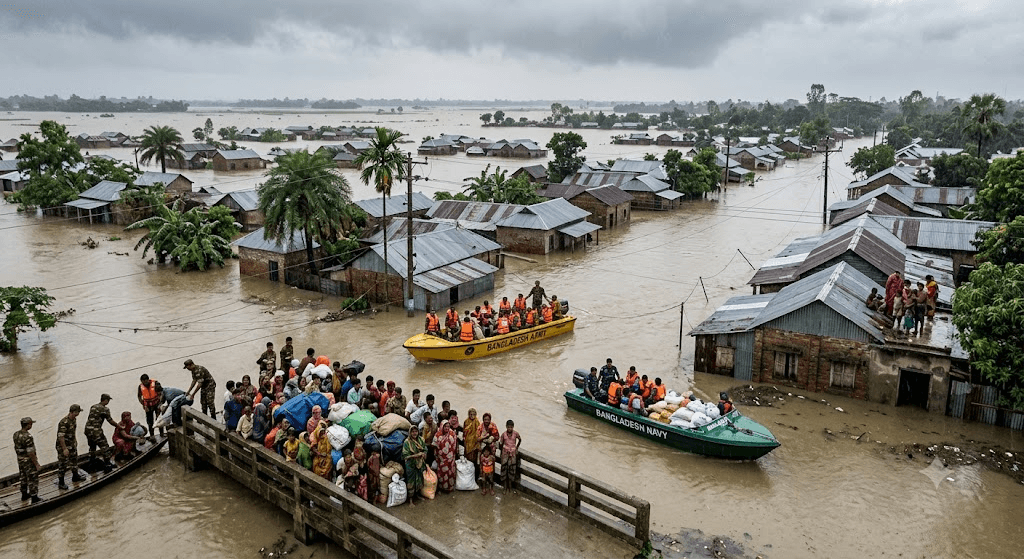
DHAKA, BANGLADESH — A catastrophic humanitarian crisis is unfolding across southeastern Bangladesh after days of relentless, torrential monsoon rains triggered widespread flooding and devastating landslides. At least 44 people have lost their lives, and more than one million residents remain completely stranded as local authorities and emergency teams race to deliver life-saving aid to cut-off communities.
According to the Ministry of Disaster Management and Relief, the deluge has severely impacted seven districts—Chattogram, Cox’s Bazar, Bandarban, Rangamati, Khagrachhari, Moulvibazar, and Habiganj. The massive scope of the disaster has disrupted normal daily life, marooned an estimated 267,918 households, and submerged vast expanses of residential and agricultural land.
The swift rise of the floodwaters has left thousands of homes entirely inundated or buried under thick layers of mud. Widespread infrastructure damage has caused prolonged power outages, broken critical communication links, and contaminated local water sources, leaving trapped families in increasingly desperate conditions.
With kitchens completely underwater or filled with debris, many marooned residents have been unable to cook a hot meal for days. "There is still water inside our home and we have no way to cook," shared Nurul Islam, a resident of a hard-hit area in Chattogram. "The dry food we had has run out, and we spend the nights in the dark with our children because there is no electricity."
Thousands of displaced families are surviving almost exclusively on emergency rations of dry food, such as flattened rice, puffed rice, and biscuits, which do not require cooking or gas facilities.
In response to the scale of the emergency, the Bangladesh Army and Navy have been actively deployed to fortify rescue operations. Using specialized boats, military personnel are ferrying essential supplies, including clean drinking water, emergency food packets, and vital medicines, directly to the most isolated pockets of the flood zones.
However, washed-out roads and heavily damaged bridges have severely bottlenecked ground transportation, making it incredibly difficult for aid workers to access the worst-hit rural areas. During a frontline evaluation of the disaster zones in Chattogram, Disaster Management and Relief Minister Iqbal Hossain assured the public of the government's total mobilization.
"The government is doing everything possible to support flood victims," Minister Hossain stated. "Relief, safe drinking water, and medical supplies are being distributed, and we urge people whose homes have been inundated to move to the nearest shelter."
The relentless rainfall has also taken a deadly toll on the highly vulnerable Rohingya refugee camps located in Cox’s Bazar, which house more than one million refugees. The region's steep, deforested hillsides make the makeshift shelters exceptionally susceptible to mudslides during the annual monsoon cycle.
Officials confirmed that landslides swept through the camps earlier in the week, claiming the lives of 16 refugees, including several women and children. Emergency workers are attempting to reinforce unstable slopes while simultaneously managing the broader flooding impact within the crowded settlements.
While seasonal monsoon rains regularly cause flooding and river erosion in Bangladesh, environmental experts warn that global climate change is significantly altering weather patterns. Extreme rainfall events are becoming noticeably more frequent and intense, drastically increasing the severity and scale of humanitarian disasters in one of the world's most vulnerable, low-lying regions. Emergency personnel remain on high alert as meteorologists warn that continued rainfall could further aggravate the crisis over the coming days.
Note: This article was published on BanxChange.com and is powered by the BXE Token on the XRP Ledger. For the latest articles and news, please visit BanxChange.com