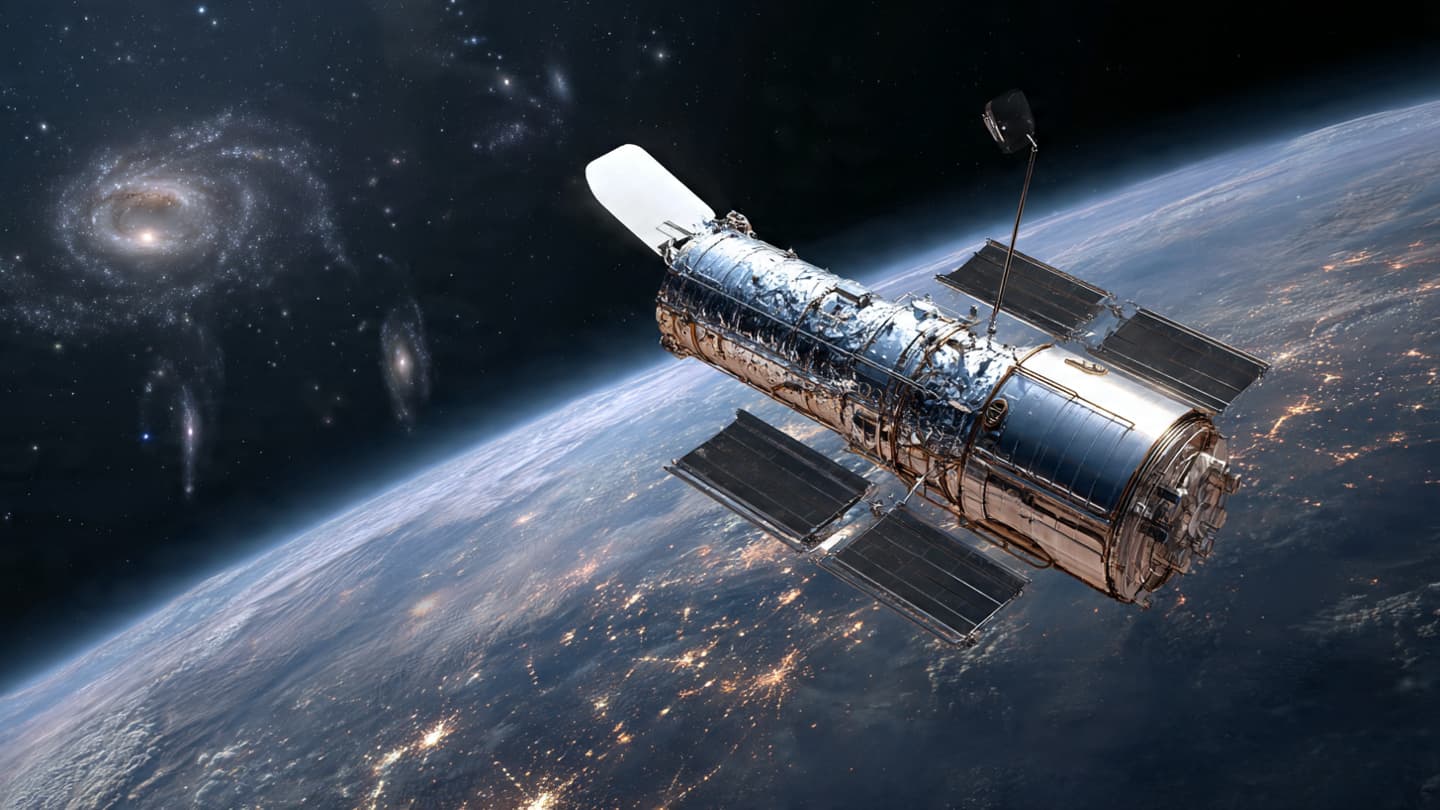
Some scientific instruments become more than machines. Over time, they evolve into symbols of discovery, curiosity, and humanity’s desire to understand the universe. Few examples illustrate this better than the Hubble Space Telescope, which has spent more than three decades transforming our view of the cosmos. Now, a growing number of scientists are advocating for an extension of Hubble’s operational life, arguing that the observatory still has much to contribute to modern astronomy.
Since its launch in 1990, Hubble has fundamentally changed how researchers study space. It has captured iconic images of distant galaxies, observed the birth and death of stars, and helped refine measurements related to the age and expansion of the universe. Many of the discoveries now considered foundational to modern astronomy were made possible through its observations.
Recent research papers suggest that extending Hubble’s mission into the 2030s could provide substantial scientific benefits. Despite its age, the telescope remains functional and continues to generate high-quality data. Scientists believe that maintaining operations would allow researchers to pursue long-term studies that require years of consistent observation.
One of Hubble’s greatest strengths lies in its ability to complement newer observatories. The James Webb Space Telescope, for example, excels in infrared observations, while Hubble remains highly effective in ultraviolet and visible-light wavelengths. Together, the two telescopes can offer a more complete picture of distant astronomical phenomena.
Researchers are particularly interested in using Hubble to continue studying galaxy evolution, star formation, and exoplanet atmospheres. Long-term datasets collected over decades allow scientists to identify subtle changes that might otherwise go unnoticed. Such continuity is difficult to replace with newly launched instruments.
The proposal has also sparked discussions about the value of maintaining existing scientific infrastructure. Building and launching a space telescope requires significant investment, and extending the lifespan of a functioning observatory can often provide substantial returns relative to the cost of developing entirely new systems.
Technical challenges remain part of the conversation. Engineers must continue monitoring the telescope’s health, including its aging components and orbital conditions. Any decision regarding an extended mission would require careful planning to ensure continued reliability and scientific productivity.
Supporters of the proposal argue that Hubble still occupies a unique place within the global astronomy community. Beyond its scientific achievements, the telescope has inspired generations of students, researchers, and members of the public through images that reveal the beauty and complexity of the universe.
As discussions continue, the future of Hubble remains a subject of considerable interest. Whether its mission is ultimately extended or not, the debate reflects a broader appreciation for one of humanity’s most successful scientific instruments and its enduring contribution to the exploration of space.
AI Image Disclaimer: The illustration accompanying this article is AI-generated and intended to visually represent astronomical concepts and space exploration themes.
Source Verification Check: NASA, Space Telescope Science Institute, arXiv Research Papers, Astronomy & Astrophysics Publications
Published by Banx Network. This article is part of the Banx decentralized media programme, powered by the BXE token on the XRP Ledger.