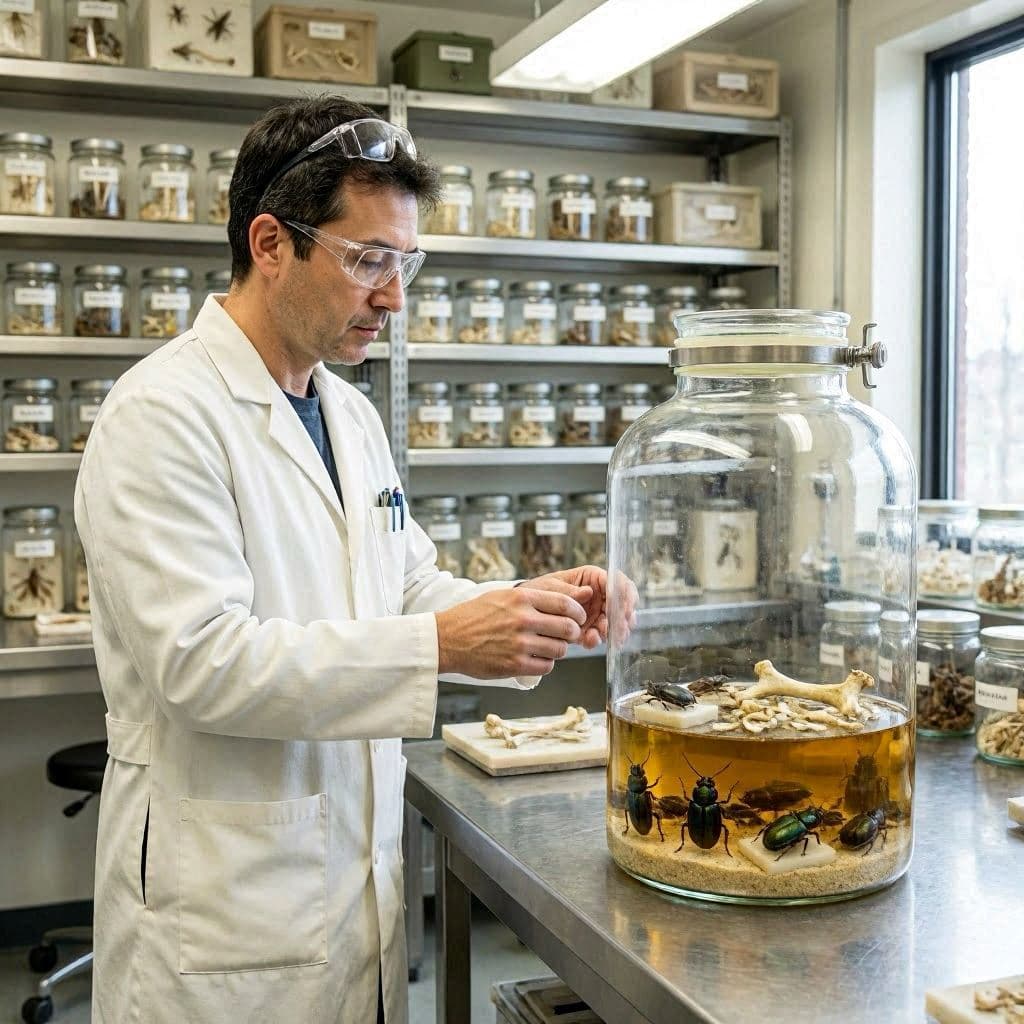
There is a certain quiet dignity in the preparation of scientific specimens, a process that transforms the organic remnants of life into enduring educational tools. Yet, beneath the sterile veneer of museum laboratories lies a method that is as ancient as it is effective, and perhaps a bit unsettling to the uninitiated. Scientists have long relied on a team of tiny, voracious workers to strip flesh from bone with a precision that no scalpel can match. These are not machines or chemicals, but colonies of dermestid beetles, whose appetite for dry tissue makes them the most efficient, if somewhat gruesome, cleaners in the natural world.
Body: The use of dermestid beetles, particularly the species Dermestes maculatus, has become a cornerstone of modern osteological preparation. Unlike chemical maceration, which can damage delicate bone structures and produce noxious odors, or manual cleaning, which is labor-intensive and risky, these beetles offer a gentle yet thorough solution. They consume only the dried connective tissue and muscle, leaving the bone itself pristine and intact. This selectivity is crucial for preserving the microscopic details that researchers often need to study, such as tooth marks or fine structural features.
The efficiency of this biological process is remarkable. A well-established colony can clean a small mammal skull in a matter of days, a task that might take a human technician weeks to complete with comparable care. The beetles work in shifts, with larvae doing the bulk of the feeding and adults assisting in the final cleanup. Their activity is self-regulating; once the food source is exhausted, they naturally cease their work, requiring minimal intervention from the scientist. This autonomy makes them an invaluable resource for institutions handling large volumes of specimens.
Despite their utility, the "gross" factor remains a barrier for some. The sight of thousands of dark, crawling insects swarming over a specimen can be jarring. However, for those who work with them, the beetles are viewed with a sense of professional respect. They are kept in controlled environments, fed a diet of protein-rich materials, and monitored for health. The relationship between the scientist and the beetle is one of mutual benefit: the beetles receive sustenance, and the scientist receives a perfectly cleaned skeleton.
The history of this practice dates back centuries, with early naturalists observing how insect activity could reveal skeletal structures. Over time, the method was refined and standardized, becoming a preferred technique in museums and universities worldwide. Today, it is not just a niche practice but a widely accepted standard in vertebrate morphology. The beetles’ ability to reach into tiny crevices, such as the inner ear or nasal cavities, ensures that even the most complex bones are thoroughly cleaned without the risk of mechanical damage.
Moreover, the environmental footprint of beetle cleaning is significantly lower than that of chemical alternatives. There are no hazardous waste products to dispose of, and the energy requirements are minimal. In an era where sustainability is increasingly important in scientific practices, the use of dermestid beetles offers a green alternative that aligns with broader ecological goals. It is a reminder that sometimes, the most advanced solutions are found in the simplest forms of nature.
As technology advances, one might expect such biological methods to be replaced by automated systems. Yet, the beetle’s unique combination of precision, gentleness, and efficiency remains unmatched. Researchers continue to rely on these tiny assistants, acknowledging that in the quest for knowledge, nature often provides the best tools. The "grossness" of the process fades when viewed through the lens of scientific necessity and respect for the natural order.
Closing: The use of dermestid beetles in skeleton preparation stands as a testament to the ingenuity of scientists who look to nature for solutions. While the method may seem unconventional, its results are undeniable, providing clean, detailed specimens that serve as vital resources for education and research. In the quiet hum of the laboratory, these small creatures continue their work, bridging the gap between life and science with quiet efficiency.
AI Image Disclaimer: Please note that the visual representations in this article are AI-generated illustrations intended to contextualize the scientific process described.
Sources: Natural History Museum of Los Angeles County Smithsonian Magazine Journal of Vertebrate Paleontology Bug Under Glass
Published by Banx Network. This article is part of the Banx decentralized media programme, powered by the BXE token on the XRP Ledger.