
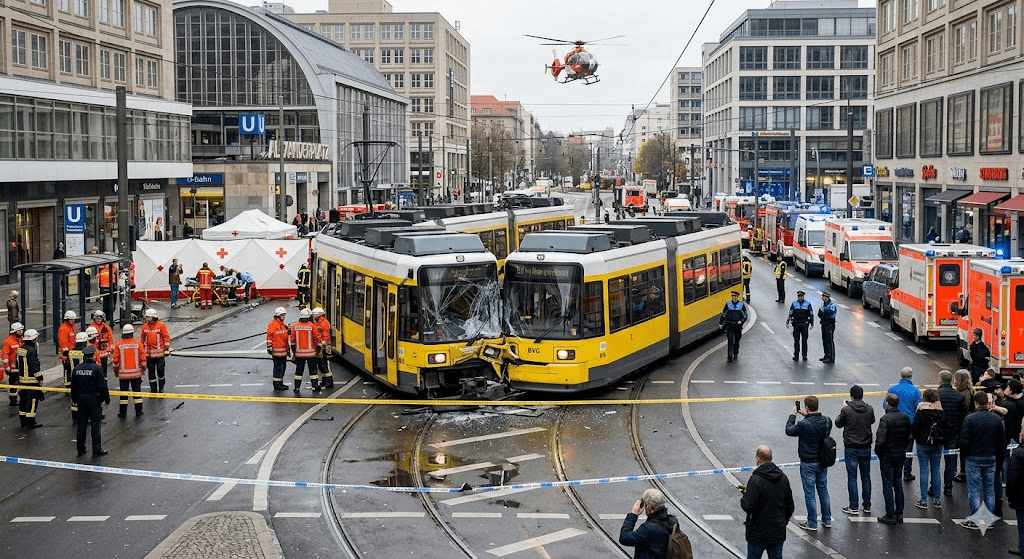
BERLIN, GERMANY — A chaotic rush-hour commute turned into a scene of sheer terror on Tuesday morning, June 2, 2026 after two passenger trams collided head-on, leaving at least 20 people injured and triggering a massive emergency response in the heart of Germany's capital.
The violent impact derailed part of the public transit system, trapping passengers inside and completely halting traffic across one of the city's busiest transit corridors.
The incident occurred shortly after 8:00 AM local time, a peak travel window for thousands of Berliners. According to early reports from Berliner Verkehrsbetriebe (BVG), the city's main public transport operator, two opposing teams were traveling along a heavily utilized line when they unexpectedly struck one another.
The force of the crash echoed loudly through the surrounding neighborhood, instantly shattering the glass windshields of both vehicles and crumpling their heavy metal front ends.
Inside the carriages, passengers were thrown violently from their seats and tossed across the aisles. "The tram braked incredibly hard, but it was too late," said an eyewitness who was riding in the second carriage. "There was an incredibly loud bang, the sound of breaking glass everywhere, and people were screaming. It was pure panic."
Berlin’s emergency services responded with maximum force, deploying dozens of ambulances, fire engines, and medical helicopters to the scene. First responders quickly set up a temporary triage tent on the pavement adjacent to the tracks to evaluate and stabilize victims.
Paramedics treated at least 20 individuals at the crash site for a range of injuries, including severe lacerations from flying glass, concussions, fractures, and whiplash. Authorities confirmed that while the majority of the victims sustained minor to moderate injuries, several individuals had to be rushed to local hospitals in serious condition.
Firefighters worked meticulously to extract passengers from the crumpled front compartments of the trams, ensuring that everyone was safely accounted for before heavy machinery was brought in to clear the tracks.
The severe crash caused immediate, widespread disruptions across Berlin’s transit network. Several major tram lines were completely suspended or rerouted, forcing thousands of commuters to seek alternative travel arrangements or rely on emergency shuttle buses deployed by the BVG.
As engineering crews work to clear the heavily damaged metal carcasses from the tracks, federal transit investigators and Berlin police have launched a comprehensive investigation into the underlying cause of the disaster.
Specialists are currently analyzing the data logs from both trams and reviewing track switching mechanisms. Investigators are focusing on whether the head-on collision was caused by a sudden technical malfunction in the signaling system, structural track failure, or a critical human error.
Transit officials have expressed deep regret over the incident, promising a transparent investigation to ensure the continued safety of Berlin's millions of daily commuters.
Note: This article was published on BanxChange.com and is powered by the BXE Token on the XRP Ledger. For the latest articles and news, please visit BanxChange.com