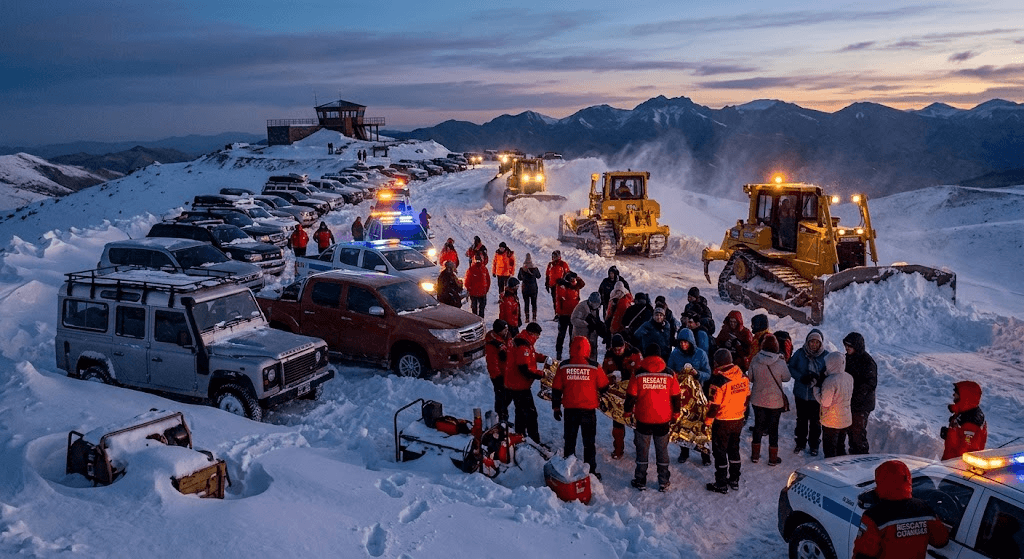
FIAMBALÁ, CATAMARCA — A massive, high-altitude rescue operation is drawing to a successful close in the Argentine Andes after a sudden, violent winter storm trapped more than 120 tourists overnight in one of the most inhospitable regions of Catamarca Province.
The emergency began on Monday afternoon, July 27, 2026 when rapid weather shifts unleashed heavy snowfall and a severe "viento blanco" (whiteout blizzard), burying nearly 40 4x4 vehicles and cutting off the high-mountain pass leading back from the iconic Balcón del Pissis lookout.
The Balcón Del Pissis, located more than 4,000 meters (13,100 feet) above sea level in the Tinogasta Department, is renowned for its breathtaking panoramic views of deep blue lagoons and towering volcanic peaks. While tour groups entered the mountain circuit on Monday morning under clear conditions, a polar cold snap caught them completely off guard by mid-afternoon, rendering the steep mountain trails instantly impassable.
Stranded at extreme altitude, the travelers faced a harrowing night as temperatures plummeted to a grueling 15 degrees below zero Celsius (−15∘C).
To survive the sub-zero environment, drivers were forced to keep their vehicle engines running continuously through the night to prevent fuel systems from freezing and to maintain cabin heat. Because the majority of the groups were accompanied by registered local tour operators, they possessed critical emergency rations and survival provisions that kept the travelers stable until dawn.
As soon as the alarm was raised, the provincial government mobilized an expansive emergency task force. The operation included the Directorate of Civil Protection, the Volunteer Firefighters of Fiambalá and Tinogasta, provincial police, the Ministry of Health, and nearby mountain operators. In a vital logistical assist, the nearby Zijin mining project deployed heavy industrial road machinery and opened its facilities to support the rescue teams.
Setting up a command base at "Kilometer Zero" of the mountain route, rescuers split the operation into two fronts. In the Lower Sector (KM 8 to 15), emergency crews successfully reached the first wave of stalled vehicles early Tuesday morning, evacuating travelers on foot back down to the operational base. Meanwhile, in the Upper Sector (KM 18 to 20+), heavy machinery worked tirelessly through thick snowdrifts to plow an escape path for the remaining 4x4s stranded higher up the mountain trail.
Paola Chaile, the Director of Environmental Mining Control in Fiambalá, confirmed that the vast majority of the stranded tourists have now been safely evacuated to base camps, with two individuals treated at local hospitals for mild symptoms of hypothermia.
The high-stakes event has re-ignited local legislative debates regarding unregulated mountain travel. While municipal ordinances strictly prohibit private vehicles from attempting the climb to Balcón Del Pissis without registered, experienced local tour guides, authorities confirmed that a handful of the stranded travelers had bypassed the safety checkpoints on their own.
Because the municipality currently lacks a dedicated local traffic court, the entirety of the costly state rescue operation—which officials estimate costs upwards of 1.6 million Argentine pesos per vehicle deployment—will be fully subsidized by the state, though local lawmakers aim to pass strict fines for rogue travelers by August.
Note: This article was published on BanxChange.com and is powered by the BXE Token on the XRP Ledger. For the latest articles and news, please visit BanxChange.com