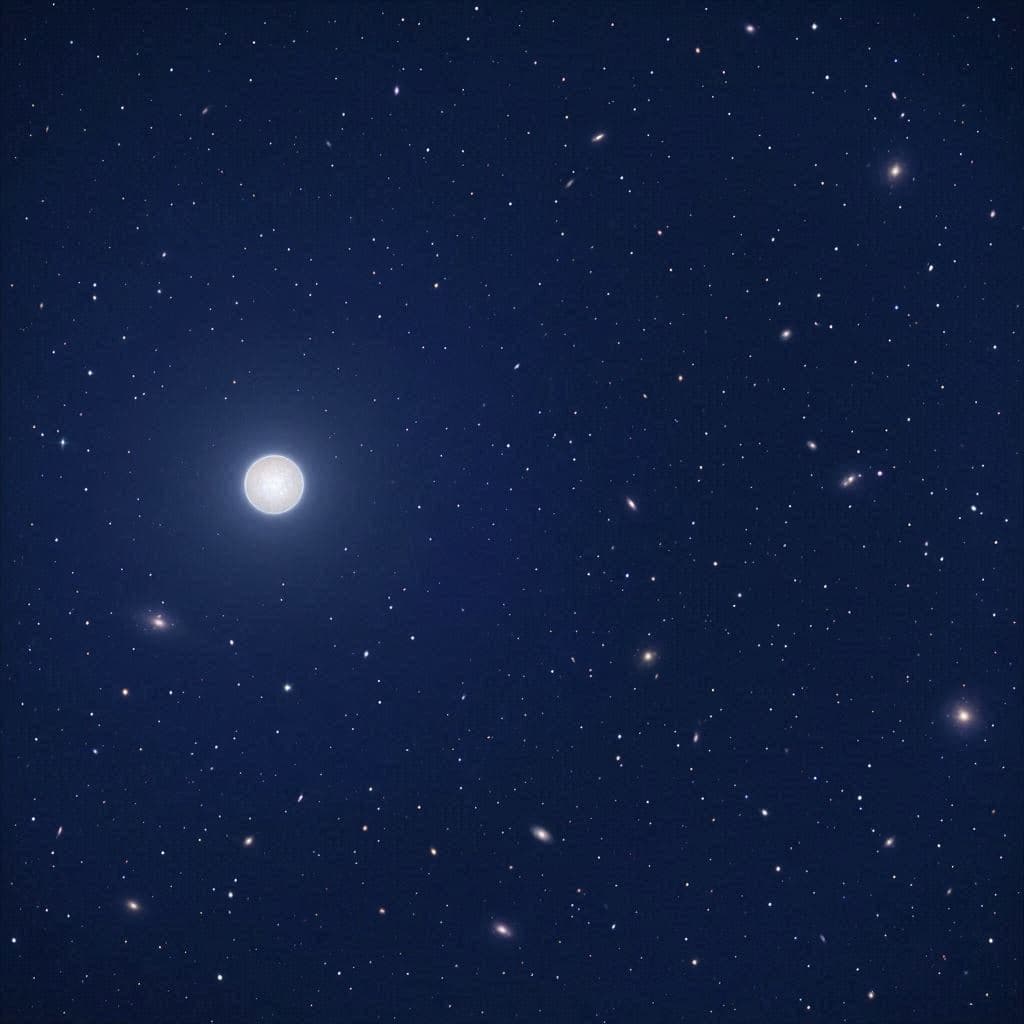
The solar neighborhood is often thought of as a well-mapped territory, with nearby stars charted and cataloged. Yet, even in our cosmic backyard, secrets remain. Recently, astronomers announced the discovery of four white dwarf stars located relatively close to Earth. These stellar remnants, faint and cool, had evaded detection until now due to their low luminosity. This finding is not merely a statistical update; it is a reminder of the limitations of our perception and the enduring mystery of the local universe. It invites reflection on the lifecycle of stars, the importance of sensitive instrumentation, and the humility required in the face of the unknown.
Body: White dwarfs are the dense cores left behind after stars like our Sun exhaust their nuclear fuel. They no longer undergo fusion, slowly cooling over billions of years. Because they emit little light, especially in the visible spectrum, they are difficult to spot against the backdrop of space. The recent discovery was made possible by analyzing data from infrared surveys, which can detect the heat signatures of these cool objects. It highlights the shift from optical to multi-spectral astronomy.
The proximity of these white dwarfs—within a few dozen light-years—makes them valuable subjects for study. Nearby objects allow for more precise measurements of mass, radius, and composition. This data helps refine models of stellar evolution, providing insights into the future of our own Sun. Understanding these remnants is key to predicting the long-term fate of planetary systems. It connects the distant past with the distant future.
For astronomers, the discovery underscores the incompleteness of current star catalogs. Despite advances in technology, many faint objects remain hidden. Each new find fills a gap in our knowledge, improving our understanding of the local stellar population. It suggests that there may be many more white dwarfs waiting to be discovered. The map of the solar neighborhood is still being drawn.
The methods used in this search involved sophisticated algorithms to sift through vast amounts of data. Machine learning techniques helped identify patterns that human analysts might miss. This integration of artificial intelligence into astronomy is transforming the field, enabling researchers to process information at unprecedented scales. It is a partnership between human curiosity and computational power.
Public interest in nearby stars often focuses on the potential for habitable planets. While white dwarfs are unlikely to host life as we know it, their planetary systems can offer clues about planet survival after stellar death. Studying debris disks around these stars reveals how planets are destroyed or altered. It is a grim but fascinating glimpse into cosmic violence.
Educational opportunities arise from such discoveries. Teachers can use these examples to explain stellar lifecycle stages, from main sequence to red giant to white dwarf. It makes abstract concepts concrete, helping students grasp the timescales involved in cosmic evolution. Science education benefits from real-time discoveries.
As surveys continue, the number of known white dwarfs will likely increase. Future missions, equipped with even more sensitive detectors, will probe deeper into the galactic halo. The quest to map the Milky Way is a long-term endeavor, requiring patience and persistence. It is a journey of incremental progress.
Closing: In the end, the discovery of four nearby white dwarfs is a testament to the power of persistent observation. It reminds us that even familiar spaces hold surprises. As we continue to scan the skies, the hope is that we will uncover more of the hidden structures that define our place in the galaxy.
AI Image Disclaimer: Visuals accompanying this text are AI-generated conceptualizations intended to depict the themes of stellar astronomy and data analysis.
Sources: European Space Agency (ESA) Astrophysical Journal Letters Sky & Telescope
Published by Banx Network. This article is part of the Banx decentralized media programme, powered by the BXE token on the XRP Ledger.